na vai yāce rājyaṁ na ca kanaka-māṇikya-vibhavaṁ
na yāce ’haṁ ramyāṁ sakala-jana-kāmyāṁ vara-vadhūm
sadā kāle kāle pramatha-patinā gīta-carito
jagannāthaḥ svāmī nayana-patha-gāmī bhavatu me
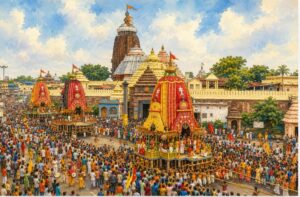 Ratha Yātrā is one of the most extraordinary festivals of the Hindu sacred calendar. Although chariot processions are celebrated in many regions of India and throughout the world, the most famous Ratha Yātrā belongs to the temple of Śrī Jagannātha Purī, Odisha.
Ratha Yātrā—रथयात्रा means “the journey of the chariot.” Yet the festival is much more than a ceremonial procession. It is a complete sacred act in which the Lord leaves the hidden sanctum of the temple, enters the public road, travels with his brother and sister, accepts the service of kings and ordinary people, and temporarily resides in another sacred abode. It is the only time anyone can meet Śrī Jagannātha as for most of the foreighners it is the only possibility to have darshan.
Jagannātha, Balabhadra and Subhadrā travel upon three enormous wooden chariots, while Sudarśana accompanies Subhadrā. The deities leave the main Jagannātha Temple and journey along the great ceremonial avenue of Purī known as the Baḍa Daṇḍa, or Grand Road, toward the Guṇḍicā Temple.
The outward journey traditionally begins on Āṣāḍha Śukla Dvitīyā, the second lunar day of the bright fortnight of the month of Āṣāḍha.
The Three Sacred Chariots
Each deity travels upon a separate chariot possessing its own name, colours, number of wheels, guardian deities, horses, flags and ritual identity. Every year the chariots are being newly constructed as per tradition. There is a special calculation for the startof preparations. For their construction a special wood is used: he primary timber used for the wheels and structural framework is Phasi. Other essential woods include Dhaura (Anogeissus latifolia), Asan (Terminalia elliptica), and Simal (Bombax ceiba).
Their ceremonial construction begins on Akṣaya Tṛtīyā. The carpenters, painters, tailors and other artisans involved in their creation are not regarded merely as workers. They are sevakas—ritual servants of Jagannātha. The construction of the chariots is therefore itself an act of worship.
Nandighoṣa – The chariot of Śrī Jagannātha
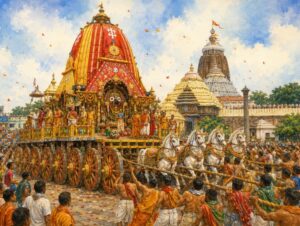 Jagannātha’s chariot is called Nandighoṣa. It is also known as Garuḍadhvaja (“the chariot whose flag bears Garuḍa”) and Kapidhvaja (“the chariot with the monkey flag)”. In present temple practice, Nandighoṣa has sixteen wheels and is covered primarily with red and yellow cloth. It is the largest and most prominent of the three chariots. It’s height variously as approximately 44 feet 3 inches, 45 feet, or 13.5 metres. Four white wooden horses of that chariot are : Śaṅkha, Balāhaka, Śveta and Haridāśva.
Even the ropes used to pull teh chariot have their own names. The one used to pull Jagannātha’s chariot is traditionally called Śaṅkhacūḍa or Śaṅkhacūḍa Nāginī.
The upper part of Nandighoṣa is crowned with the emblems of Garuḍa and the Sudarśana Cakra, while the great banner above it is known as Trailokyamohinī, “she who enchants the three worlds.”
Purī tradition also identifies three metal kalaśas placed on the summit of the chariot: Nava, Vyoma and Ākāśa. Nearby are two ornamental parrots named Jīva and Parama, representing the individual being and the Supreme.
These elements are not simply decorative additions. Together they give the upper structure of Nandighoṣa a distinctly cosmic meaning. The chariot rises like a sacred world in itself, expressing Jagannātha’s sovereignty, the order of the universe and his supreme position above all realms.
Tāladhvaja- The chariot of Balabhadra
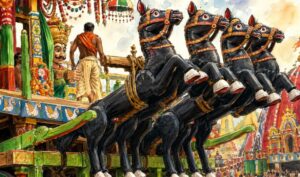 Balabhadra’s chariot is known as Tāladhvaja, “the chariot whose banner bears the palm tree.” It is also called Haladhvaja and Lāṅgaladhvaja, names connected with the plough carried by Balabhadra. In the present Purī tradition, Tāladhvaja stands upon fourteen wheels and is covered with red and green cloth. It is the second largest of the three chariots, reaching a height of approximately 43 feet 4 inches, or about 13.2 metres. Four black wooden horses draw the chariot: Tibra, Ghora, Dirghashrama and Swarnanava.
The rope used by the devotees to pull Tāladhvaja is called Vāsuki, or Vāsuki Nāga, after the great serpent king of Hindu tradition.
The flag flying above Tāladhvaja is known as Unnani, while the palm-tree emblem immediately identifies the chariot with Balabhadra. The upper structure also carries three metal kalaśas named Sūrya, Candra and Vidyut—the Sun, the Moon and lightning. Near them are two ornamental parrots called Śraddhā and Viśvāsa, whose names express faith and trust.
Taken together, these details give Tāladhvaja a character of strength, stability and unwavering devotion. The plough and palm-tree emblems recall Balabhadra’s close relationship with the earth, while the names placed at the summit connect his chariot with the powers of the sky. Śraddhā and Viśvāsa add another dimension: the immense chariot moves forward not only through physical effort, but through the faith of the devotees who gather to pull it.
Darpadalana –The chariot of Subhadrā
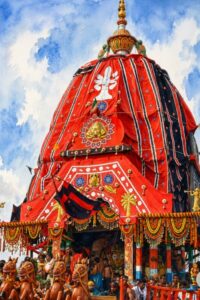 Subhadrā’s chariot is most commonly known as Darpadalana, “the crusher of pride.” In the Purī tradition it is also called Devadalana, Padmadhvaja and Kamaladhvaja, the last two names associating it with the lotus. Darpadalana is the smallest of the three great chariots. It has twelve wheels, rises to approximately 42 feet 3 inches, or about 12.9 metres, and is distinguished by its red-and-black covering.
Four red wooden horses draw the chariot. Their names are Rochikā, Mochikā, Jitā and Aparājitā. Sudarśana accompanies Subhadrā upon Darpadalana, while Arjuna serves as the charioteer. The rope by which the chariot is pulled is called Svarṇacūḍā, also given as Svarṇacūḍā Nāginī.
The flag above Darpadalana is known as Nāḍambikā, and its emblem is associated with Tripurasundarī, the beautiful Goddess who rules the three worlds. Three metal kalaśas crown the upper structure: Parā, Aparā and Vaikharī. Beside them are two ornamental parrots named Śruti and Smṛti.
These names give the summit of Darpadalana a distinctly feminine and sacred character. Parā and Aparā evoke the higher and lower dimensions of knowledge, while Vaikharī refers to speech made audible and manifest. The parrots Śruti and Smṛti recall the two great streams through which sacred knowledge is received and preserved: that which is heard and that which is remembered.
Darpadalana therefore appears not merely as Subhadrā’s vehicle, but as a moving seat of divine wisdom and Śakti. Even its name contains a spiritual teaching: pride must be broken. Only then can knowledge, remembrance and devotion take their rightful place within the heart.
The Festival Begins Long Before the Chariots Move. Ratha Yātrā is sometimes imagined as a single day during which enormous chariots are pulled through the streets. In reality, it forms the centre of a much longer ritual cycle. The journey begins symbolically weeks before the deities leave the temple. Every stage prepares Jagannātha, Balabhadra and Subhadrā for their public appearance and sacred journey.
Pāhaṇḍi: The Deities Leave the Temple
The ceremonial movement of the deities from the temple to their chariots is known as Pāhaṇḍi.
The large wooden forms are carried by groups of sevakas in a powerful, rhythmic and swaying motion. Their movement is slow but full of energy. The deities appear almost to dance as they advance through the gathered crowds.
Balabhadra emerges first, followed by Subhadrā and Jagannātha. Sudarśana is also carried from the temple and placed upon Subhadrā’s chariot.
Pāhaṇḍi is one of the most emotionally charged moments of the entire festival. The Lord who is normally hidden within the sacred architecture of the temple emerges visibly before the world. The boundary between the inner temple and the public road is crossed. The inaccessible becomes accessible.
Chhera Pahaṅrā: When the King Becomes a Servant
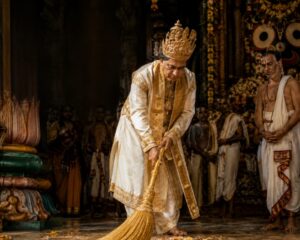 Before the chariots begin their journey, the Gajapati king of Purī performs the ceremony known as Chhera Pahaṅrā. It’s a significant ritual showing that the king is also a servant and the one who is the main sovereign of the world is Śrī Jagannātha. The king ascends the chariots and sweeps their platforms with a golden-handled broom. He then sprinkles sanctified water upon them.
The broom is the simbol of Sri Lakṣmī who is not merely the goddess of money. She is Śrī—auspiciousness, order, nourishment, beauty, fertility, well-being and the flourishing of the household.
She has a sister Alakṣmī, the absence of prosperity. The Śrī Sūkta itself asks for Alakṣmī—identified with hunger, thirst, deprivation and lack of growth—to be driven out of the home:
kṣutpipāsāmalāṃ jyeṣṭhām alakṣmīṃ nāśayāmy aham |
abhūtim asamṛddhiṃ ca sarvāṃ nirṇuda me gṛhāt ||
“I drive away Alakṣmī, associated with hunger, thirst and impurity. Remove from my home all want and lack of prosperity.” That is the cleansing ritual of the soul to start a spiritual journey without pride and in full devotion.
Jagannātha is the true sovereign. The king is traditionally understood as the foremost servant of the Lord, the ādya-sevaka. His political authority is legitimate only because it remains subordinate to divine authority. Social rank is reversed and purified before the Lord of the Universe.
The ceremony proclaims that no person is too powerful to serve and no service offered to the Lord is insignificant.
The Journey to Guṇḍicā
Once the rituals are complete, the three chariots begin their journey along Purī’s Grand Road. Balabhadra’s Tāladhvaja moves first, followed by Subhadrā’s Darpadalana, while Jagannātha’s Nandighoṣa comes last. Thousands of devotees gather around the great ropes and pull the chariots forward. For them, this is not simply part of a public festival. It is an act of devotion, service and surrender.
The procession moves toward the Guṇḍicā Temple, where Jagannātha, Balabhadra and Subhadrā remain for several days.
Guṇḍicā has several meanings within the Purī tradition. It is connected with Queen Guṇḍicā, the wife of King Indradyumna, and is also described as Jagannātha’s garden residence, his birthplace or a place of temporary retreat. In popular Odishan belief, it is often spoken of as the home of the deities’ maternal aunt.
Hera Pañcamī: Lakṣmī Comes Looking for Jagannāth
One of the most touching parts of Ratha Yātrā is Hera Pañcamī. The name comes from the words hera, “to see,” and pañcamī, “the fifth day.”
Jagannāth has gone to the Guṇḍicā Temple with Balabhadra and Subhadrā, while Lakṣmī has remained in the main temple. After a few days, she goes to Guṇḍicā to see why her husband has not returned. Before leaving, Lakṣmī’s attendants symbolically damage a part of Jagannātha’s chariot.
Hera Pañcamī shows the warmth and closeness of Jagannātha worship. The deities are not distant or cold. They express emotions that people understand very well: love, separation, jealousy, humour, longing and reconciliation.
Bāhuḍā Yātrā: The Return Journey
After residing at Guṇḍicā, the deities begin their return to the main Jagannātha Temple. This procession is called Bāhuḍā Yātrā.
The first journey of Ratha Yātrā is a movement outward. Jagannātha leaves the temple and comes into the streets, where everyone can see him. Bāhuḍā Yātrā carries a different mood. It is the journey back—a return after absence, a homecoming after separation.
Even then, the return is not immediate. When the chariots reach the Śrī Mandira, the deities remain outside for several more rituals, including Suṇa Veśa and Adharapāṇā. Only later do they enter the temple during Nīlādri Bije. In this way, the homecoming unfolds gradually, giving devotees more time to receive the Lord’s darśana.
During the journey, the chariots pause near the Mausī Mā Temple, where Jagannātha is offered poḍa piṭhā. This simple moment brings warmth and tenderness to the grand procession. The Lord of the Universe is returning to his temple, yet he still stops to accept food from a loving relative.
Bāhuḍā Yātrā therefore carries a deeper message. Every journey away from the sacred centre must one day become a journey back. It is a reminder that separation is not the end and that the path of devotion ultimately leads toward return, reunion and belonging.
Suṇa Veśa: The Deities in Golden Attire
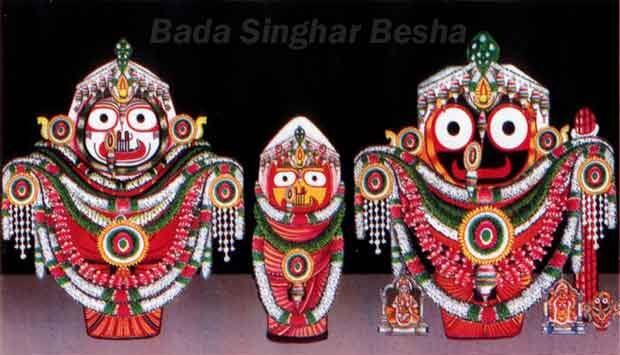
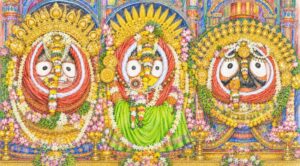 After returning near the main temple, the deities appear in Suṇa Veśa, the “golden attire.”
Jagannātha is decorated with a golden Cakra and a silver conch, while Balabhadra carries a golden plough and mace. Together with Subhadrā, they appear in the full splendour of divine royalty.
Suṇa Veśa shows another side of Jagannātha. During Ratha Yātrā, he comes out among the people and allows everyone to see him closely. In the golden attire, he reveals his majesty as the Lord of the Universe. He remains loving and accessible to his devotees, but at the same time he is the supreme ruler before whom all human wealth, status and power become insignificant.
Every veśa is not merely a robe. It has a dipper meaning and caries a very hidden and sacred information on a creation and existence of the world and the journey of the soul.
Nīlādri Bije: The Return to the Temple
Nīlādri Bije is the final return of Jagannātha, Balabhadra, Subhadrā and Sudarśana to the Śrī Mandira. After their stay at Guṇḍicā and the journey back to Purī, the deities leave the chariots and enter the temple one by one. They finally return to the Ratnasiṃhāsana, bringing the whole Ratha Yātrā festival to an end.
Jagannātha, however, is not allowed to enter immediately. Balabhadra and Subhadrā go inside, but Lakṣmī stops Jagannātha at the temple door. She is still upset because he left for Guṇḍicā without taking her with him.
Their playful disagreement is known as Lakṣmī–Nārāyaṇa Kalaha. Jagannātha asks for forgiveness and offers Lakṣmī rasagolā. Only then does she allow him to enter the temple. This ritual gives Nīlādri Bije a warm and deeply human meaning. Even the Lord of the Universe must restore peace at home. His return is completed not through power, but through humility, affection and reconciliation.
Nīlādri Bije also marks the end of Jagannātha’s public journey. During Ratha Yātrā, he leaves the temple and comes out among the people. Now he returns to his inner seat, the divine family is reunited and the usual order of the temple begins again.
The deeper meaning of Nīlādri Bije is completion. Separation ends in reunion.
The Lord of the Universe Becomes Part of the Family
The name Jagannātha means “Lord of the Universe.” Yet his greatness is revealed not only through cosmic sovereignty, but also through closeness. There is a principle known as Vasudhaiva Kuṭumbakam, which means that the whole world is one family. The Lord exists in the heart of every living being, and as the inner ruler, he governs the heart of each and every creature in the world.
The heart occupies a higher position within the cakra system. It corresponds to the level of Anāhata Cakra and Maharloka, which marks the beginning of the higher spiritual worlds leading toward the feet of the Lord.
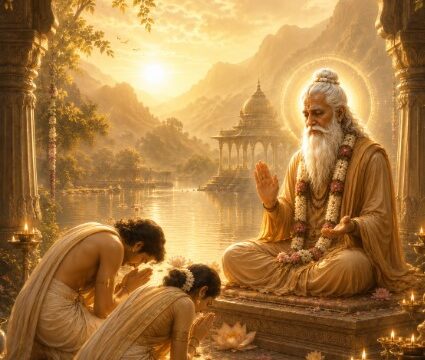
The journey of every soul begins with upadeśa. A person discovers the spiritual path through the words of a great Guru, whose teaching may completely change the direction of one’s life.
In Jyotiṣa, we know that Sūrya is in Mithuna Rāśi at the time of Ratha Yātrā. Mithuna is the natural third bhāva, connected with Guru upadeśa. Every soul receives its own upadeśa, which becomes the beginning of the journey back home—to the spiritual realms and ultimately to mokṣa.
The Chariot as the Human Body
The image of the chariot possesses a deep philosophical history in Indian thought.
The Kaṭha Upaniṣad declares:
आत्मानं रथिनं विद्धि शरीरं रथमेव तु ।
ātmānaṃ rathinaṃ viddhi śarīraṃ ratham eva tu
“Know the Self as the master of the chariot, and the body as the chariot.”
The body is the chariot, the senses are the horses, the mind is the reins, and the intellect is the charioteer. The true Self is the one who travels within.
This teaching offers a symbolic way of contemplating Ratha Yātrā. The great chariot may be understood as the human body, while its movement represents the journey of embodied existence.
The architecture of many traditional temples is also understood as reflecting the form of the human body and its cakra system. This reminds us that the human body is itself a temple, with Śrī Jagannātha dwelling within the heart.
It teaches us that we are here for a purpose higher than merely performing our social roles. We are here to recognise that we belong to something greater than ourselves—the divine reality that exists within and governs every living being.
Each year, Ratha Yātrā reminds us that after completing the journey of this life and receiving upadeśa, the soul must also begin its journey back home.
Om Tat Sat