 Guru Purnima is a sacred festival dedicated to the Guru—one who dispels ignorance and guides the student toward knowledge, discipline and inner awakening. It is observed on the full-moon day, or Purnima, of the Hindu lunar month of Ashadha, which usually falls in June or July.
The Sanskrit word Guru is traditionally explained through two syllables: gu, meaning darkness or ignorance, and ru, meaning that which removes it. A Guru is therefore not merely a teacher who gives us knowledge. A true Guru helps the disciple overcome confusion, ego, fear and spiritual blindness.
Guru Purnima is also known as Vyasa Purnima, because it honours Maharshi Veda Vyasa, the great Sage associated with the Vedas and the preservation of many important sacred teachings. On this day, seekers express gratitude not only to their personal Gurus but also to the entire lineage through which spiritual knowledge has been transmitted.
One of the best-known verses describing the Guru is:
Gurur Devo Maheśvaraḥ
Guruḥ Sākṣāt Paraṁ Brahma
Tasmai Śrī Gurave Namaḥ
Meaning:
The Guru is Brahmā, the Creator; the Guru is Viṣṇu, the Preserver; the Guru is Maheśvara, the Transformer. The Guru is the direct manifestation of the Supreme Reality. Salutations to that revered Guru.
This shloka does not merely identify the physical personality of the Guru with God. Rather, it describes the sacred functions fulfilled by the Guru. Like Brahmā, the Guru awakens knowledge within the disciple. Like Viṣṇu, the Guru protects and sustains the disciple’s spiritual life. Like Śiva, the Guru destroys ignorance, ego and false identification.
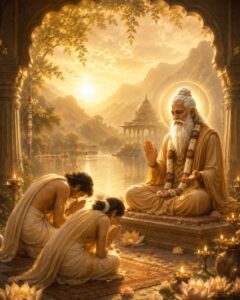
Maharṣi Vyāsa occupies a unique place in the Indian spiritual tradition. He is honoured as a great Guru who made profound wisdom accessible to future generations. don’t change text , correct sanscrit
Sri Vyāsa represents more than a single historical personality. He is the principle that gathers, organizes and transmits divine knowledge. Guru Purnima therefore celebrates every Guru who preserves wisdom and presents it in a form that others can understand.
The full moon symbolizes completeness, purity and illumination. Just as the Moon reflects the light of the Sun, the disciple’s mind becomes capable of reflecting divine knowledge when it is purified through humility, discipline and devotion.
This idea is expressed beautifully :
अज्ञानतिमिरान्धस्य ज्ञानाञ्जनशलाकया ।
चक्षुरुन्मीलितं येन तस्मै श्रीगुरवे नमः ॥Ajñāna-timirāndhasya
jñānāñjana-śalākayā
cakṣur unmīlitaṃ yena
tasmai śrī-gurave namaḥ
Meaning:
Salutations to the Guru who opens the eyes of one blinded by the darkness of ignorance, using the healing collyrium of knowledge.
The image is profound. The disciple is not without eyes; the eyes are simply unable to see clearly. The Guru removes the covering. Spiritual teaching is therefore an awakening of vision.
Another shloka from the Guru Vandana says:
अखण्डमण्डलाकारं व्याप्तं येन चराचरम् ।
तत्पदं दर्शितं येन तस्मै श्रीगुरवे नमः ॥Akhaṇḍa-maṇḍalākāraṃ
vyāptaṃ yena carācaram
tatpadaṃ darśitaṃ yena
tasmai śrī-gurave namaḥ
Meaning:
Salutations to the Guru who reveals that Supreme Reality which pervades the entire unbroken universe, including all moving and unmoving beings.
Ordinarily, the mind sees separation: self and other, sacred and ordinary, success and failure. The Guru teaches the disciple to perceive the one consciousness present within the diversity of existence. Thus, the highest function of the Guru is not merely to provide answers. It is to transform the disciple’s way of seeing.
On Guru Purnima, disciples may visit their Guru, offer flowers, fruits, cloth or other traditional gifts, and receive blessings. In monasteries, ashrams and spiritual communities, devotees may perform Guru Puja, recite scriptures, meditate, chant the name of the Guru and listen to spiritual teachings.
Some seekers begin a period of intensified spiritual practice on this day. They may undertake a new vow of mantra-japa, study, service, silence or meditation.
The outer offering, however, is secondary. The most valuable Guru-dakshina is sincere transformation. A disciple truly honours the Guru by practising the teaching, correcting harmful habits and living with greater truthfulness.
Guru Gītā verse 76 says:
ध्यानमूलं गुरोर्मूर्तिः पूजामूलं गुरोः पदम् ।
मन्त्रमूलं गुरोर्वाक्यं मोक्षमूलं गुरोः कृपा ॥ ७६ ॥Dhyānamūlaṃ guror mūrtiḥ
pūjāmūlaṃ guroḥ padam |
mantramūlaṃ guror vākyaṃ
mokṣamūlaṃ guroḥ kṛpā || 76 ||
Meaning:
The form of the Guru is the foundation of meditation. The feet of the Guru are the foundation of worship. The words of the Guru are the foundation of mantra. The grace of the Guru is the foundation of liberation.
Here, the feet of the Guru symbolize humility and surrender as well as finishing your ego. The words of the Guru represent living wisdom. The grace of the Guru becomes effective when the disciple is receptive, disciplined and sincere.
Guru Purnima also reminds us of the inner Guru – the light of discernment within the heart. An external Guru awakens the disciple’s capacity to recognize truth inwardly. A Guru does not create permanent emotional dependence. Instead, the Guru helps the student develop maturity, responsibility and direct understanding.
Respect for the Guru should therefore be joined with discernment. True devotion is not blind obedience. Guru encourages humility without humiliation, discipline without exploitation, and surrender without the destruction of conscience.
Guru Purnima is an opportunity to remember everyone who has brought light into our lives: parents, schoolteachers, spiritual Gurus, elders, sacred scriptures, and even difficult experiences that have taught us patience and wisdom. Not every Guru appears in a traditional form. Life itself can become a Guru when we are willing to learn. Guru Purnima ultimately celebrates the journey from darkness to light, from confusion to clarity, and from ego-centred living to spiritual understanding. It reminds us that knowledge becomes sacred when it is received with humility, practised with discipline, and shared with compassion.
If you are seeking a Guru, begin by reciting the Guru Vandanā, a prayer of reverence to the Guru—daily with sincerity and devotion. Pray for the blessings, guidance, and Grace of the Guru, and remain open to recognizing the Guru when the right time comes.
योगीन्द्रमीड्यं भवरोगवैद्यम् श्रीमद्गुरुं नित्यमहं नमामि॥
ānandamānandakaraṁ prasannam
jñānasvarūpaṁ nijabhāvayuktam |
yogīndramīḍyaṁ bhavarogavaidyam
śrīmadguruṁ nityamahaṁ namāmi -1
अखण्डमण्डलाकारं व्याप्तं येन चराचरम्।
तत्पदं दर्शितं येन तस्मै श्रीगुरवे नमः॥
akhaṇḍamaṇḍalākāraṁ vyāptaṁ yena carācaram |
tatpadaṁ darśitaṁ yena tasmai śrīgurave namaḥ ||2
अज्ञानतिमिरान्धस्य ज्ञानाञ्जनशलाकया।
चक्षुरुन्मीलितं येन तस्मै श्रीगुरवे नमः॥
ajñānatimirāndhasya jñānāñjanaśalākayā
cakṣurunmīlitaṁ yena tasmai śrīgurave namaḥ ||3
गुरुर्ब्रह्मा गुरुर्विष्णुः गुरुर्देवो महेश्वरः।
गुरुरेव परं ब्रह्म तस्मै श्रीगुरवे नमः॥
gururbrahmā gururviṣṇuḥ gururdevo maheśvaraḥ |
gurureva paraṁ brahma tasmai śrīgurave namaḥ ||4
ज्ञानशक्तिसमारूढः तत्त्वमालाविभूषितः।
भुक्तिमुक्तिप्रदाता च तस्मै श्रीगुरवे नमः॥
jñānaśaktisamārūḍhaḥ tattvamālāvibhūṣitaḥ |
bhuktimuktipradātā ca tasmai śrīgurave namaḥ ||5
मन्नाथः श्रीजगन्नाथः मद्गुरुः श्रीजगद्गुरुः।
मदात्मा सर्वभूतात्मा तस्मै श्रीगुरवे नमः॥
mannāthaḥ śrījagannāthaḥ madguruḥ śrījagadguruḥ |
madātmā sarvabhūtātmā tasmai śrīgurave namaḥ ||6
जन्मुखाम्नाय मासाद्य विद्यासिद्धिर्भुन्मम।
महात्रिपुरसौन्दर्य स्तवद्वयं गुरुम्भजे॥
janmukhāmnāya māsādya vidyāsiddhirbhunmama |
mahātripurasaundarya stavadvayaṁ gurumbhaje ||7
श्रीमत्परब्रह्म गुरुं स्मरामि श्रीमत्परब्रह्म गुरुं वदामि।
श्रीमत्परब्रह्म गुरुं नमामि श्रीमत्परब्रह्म गुरुं भजामि॥
śrīmatparabrahma guruṁ smarāmi
śrīmatparabrahma guruṁ vadāmi |
śrīmatparabrahma guruṁ namāmi
śrīmatparabrahma guruṁ bhajāmi ||8
ब्रह्मानन्दं परमसुखदं केवलं ज्ञानमूर्तिम्।
द्वन्द्वातीतं गगनसदृशं तत्त्वमस्यादिलक्ष्यम्॥
brahmānandaṁ paramasukhadaṁ kevalaṁ jñānamūrtim |
dvandvātītaṁ gaganasadṛśaṁ tattvamasyādilakṣyam ||9
एकं नित्यं विमलमचलं सर्वधीसाक्षिभूतम्
भावातीतं त्रिगुणरहितं सद्गुरुं तं नमामि॥
ekaṁ nityaṁ vimalamacalaṁ sarvadhīsākṣibhūtam
bhāvātītaṁ triguṇarahitaṁ sadguruṁ taṁ namāmi ||10
नमस्ते नाथ भगवन् शिवाय गुरुरूपिणे।
विद्यावतारसंसिद्ध्यै स्वीकृतानेकविग्रह॥
namaste nātha bhagavan śivāya gururūpiṇe |
vidyāvatārasaṁsiddhyai svīkṛtānekavigraha ||11
भवाय भवरूपाय परमात्मस्वरूपिणे।
सर्वाज्ञानतमोभेदभानवे चिद्घनाय ते॥
bhavāya bhavarūpāya paramātmasvarūpiṇe |
sarvājñānatamobhedabhānave cidghanāya te ||12
स्वतन्त्राय दयाक्लृप्तविग्रहाय शिवात्मने।
परतन्त्राय भक्तानां भव्यानां भव्यरूपिणे॥
svatantrāya dayāklṛptavigrahāya śivātmane|
paratantrāya bhaktānāṁ bhavyānāṁ bhavyarūpiṇe ||13
विवेकिनां विवेकाय विमर्शाय विमर्शिनाम्।
प्रकाशिनां प्रकाशाय ज्ञानिनां ज्ञानरूपिणे॥
vivekināṁ vivekāya vimarśāya vimarśinām |
prakāśināṁ prakāśāya jñānināṁ jñānarūpiṇe ||14
पुरस्तत्पार्श्वयोः पृष्ठे नमस्कुर्यादुपर्यधः।
सदा मच्चित्तरूपेण विधेहि भवदासनम्॥
purastatpārśvayoḥ pṛṣṭhe namaskuryāduparyadhaḥ|
sadā maccittarūpeṇa vidhehi bhavadāsanam ||15
त्वत्प्रसादादहम् देवं कृतकृत्योस्मि सर्वतः।
माया मृत्यु महापाशाद्विमुक्तोस्मि शिवोस्मि च॥
tvatprasādādaham devaṁ kṛtakṛtyosmi sarvataḥ |
māyā mṛtyu mahāpāśādvimuktosmi śivosmi ca ||16
Written by Dana Khanina, inspired by the teachings of Guruji Pandit Sanjay Rath.
OM TAT SAT
Om Shanti, Shanti, Shanti