The Festival of Divine Birth and Bhakti
Janmāṣṭamī, also known as Śrī Kṛṣṇa Janmotsava, is one of the most widely celebrated festivals in the Hindu world, marking the birth of Bhagavān Kṛṣṇa, the eighth avatāra of Viṣṇu. Observed on the Kṛṣṇa Pakṣa Aṣṭamī of the month of Śrāvaṇa or Bhādrapada (depending on regional calendars), the festival blends theology, ritual, art, and community celebration into a single, luminous cultural moment. More than a commemoration of a historical or mythic birth, Janmāṣṭamī is a reaffirmation of dharma, bhakti, and the perennial hope for divine intervention in times of moral decline.
Theological Significance

क्लीं klīṁ
In the Bhāgavata Purāṇa, Kṛṣṇa’s birth is framed as a cosmic response to adharma. The text declares:
yadā yadā hi dharmasya glānir bhavati bhārata…
“Whenever righteousness declines, I manifest Myself.”
Kṛṣṇa’s appearance in the prison cell of Mathurā symbolizes the descent of the infinite into the finite, the victory of light over darkness, and the assurance that the divine remains immanent in human affairs. His birth narrative—marked by miracles, celestial omens, and the liberation of Devakī and Vasudeva—serves as a theological archetype of divine grace (anugraha).
Rituals and Observances
क्लीं कृष्णाय नमः
klīṁ kṛṣṇāya namaḥ
Janmāṣṭamī is observed with a combination of austerity and celebration:
- Fasting (Upavāsa): Devotees undertake a day-long fast, breaking it only at midnight, the traditional moment of Kṛṣṇa’s birth. Thi fasting overcomes any torment of Chandra graha by Rahu in the horoscope chart. Parents undertake this vrata to protect their children.
- Jāgaraṇa (Night Vigil): Temples remain open through the night with continuous singing of bhajans, kīrtanas, and recitations from the Bhāgavata. The midnight prayers are for moksha.
- Abhiṣeka and Alankāra: The deity is bathed in milk, curd, honey, and ghee, then adorned with silk garments, jewels, and peacock feathers. Abhiṣeka removes sins of past and Alankāra gives benevolent results of yogas in chart
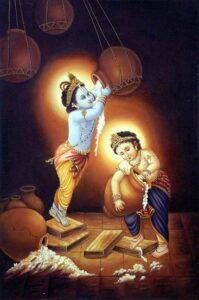
- Dahi-Handi: Particularly in Maharashtra, the playful aspect of Kṛṣṇa is celebrated through the breaking of a suspended pot of curd, symbolizing his childhood pranks in Gokula.
- Rāsa-līlā Performances: Dramatic reenactments of Kṛṣṇa’s early life, especially his divine play with the gopīs, highlight the devotional theme of surrender and love. Great love is experienced.
These rituals are not merely symbolic; they cultivate bhakti-rasa, the emotional and spiritual flavor central to Vaiṣṇava practice.
Cultural and Social Dimensions
Janmāṣṭamī transcends sectarian boundaries. In North India, temples like Mathurā and Vṛndāvana become pilgrimage centers, while in South India, households create miniature scenes of Gokula using clay dolls (golu). In Gujarat, the festival merges with the folk traditions of Garba and Raas. Across the world—from Fiji to the United States—diaspora communities celebrate Janmāṣṭamī as a marker of cultural identity and continuity.
The festival also reinforces social cohesion. Community feasts, collective singing, and temple gatherings create shared spaces of devotion that bridge caste, class, and regional divides. The child-form of Kṛṣṇa (Bāla Gopāla) evokes tenderness and inclusivity, making the festival accessible to all ages.
Philosophical Resonance
om namo bhagavate vāsudevāya
Beyond ritual, Janmāṣṭamī invites reflection on the nature of divine incarnation. Kṛṣṇa embodies paradox: he is both child and cosmic lord, playful cowherd and profound philosopher of the Bhagavad Gītā. His birth story teaches that the divine can manifest in the most unexpected circumstances, and that spiritual transformation often begins in the humblest of settings.
The midnight moment of his birth symbolizes the awakening of inner consciousness—light emerging from the darkness of ignorance. For many devotees, Janmāṣṭamī is therefore not only a historical remembrance but a personal spiritual milestone.
Conclusion
Janmāṣṭamī stands at the intersection of myth, devotion, philosophy, and cultural expression. It celebrates the birth of a deity who has shaped Indian thought for millennia—through poetry, music, dance, ethics, and metaphysics. More importantly, it renews the timeless message of Kṛṣṇa: that righteousness must be upheld, love must be cultivated, and the divine is ever-present in the rhythms of human life.