Written by Dana Khanina on the bases of the teachings of Guruji Pandit Sanjay Rath
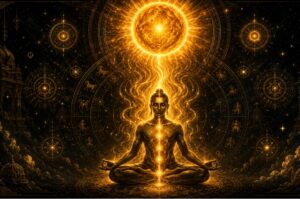 Sūrya is far more than the physical Sun. He is the visible source of light, warmth, time, nourishment and life. The Upaniṣads frequently connect him with prāṇa, the vital force that animates the body and sustains the universe.
The Sanskrit word prāṇa is often translated as “breath,” “life-force” or “vital energy.” In ordinary usage it may refer to respiration, but in the Upaniṣads it carries a broader meaning. Prāṇa is the principle that enables the senses to function, the mind to remain connected with the body and all the organism to survive and live.
Prāṇa is therefore not merely the air entering the lungs. Air is one physical medium through which life is maintained, whereas prāṇa is the organizing vitality behind respiration, circulation, digestion, perception and movement.
Gheranda Samhita states:
नागः कूर्मश्च कृकरो देवदत्तो धनञ्जयः ॥ ५.६० ॥हृदि प्राणो वहेन्नित्यमपानो गुदमण्डले ।
समानो नाभिदेशे तु उदानः कण्ठमध्यगः ॥ ५.६१ ॥
व्यानो व्याप्य शरीरे तु प्रधानाः पञ्च वायवः ।
प्राणाद्याः पञ्च विख्याता नागाद्याः पञ्च वायवः ॥ ५.६२ ॥
prāṇo ’pānaḥ samānaś codāna-vyānau tathaiva ca |
nāgaḥ kūrmaś ca kṛkaro devadatto dhanañjayaḥ || 5.60 ||
hṛdi prāṇo vahen nityam apāno guda-maṇḍale |
samāno nābhi-deśe tu udānaḥ kaṇṭha-madhyagaḥ || 5.61 ||
vyāno vyāpya śarīre tu pradhānāḥ pañca vāyavaḥ |
prāṇādyāḥ pañca vikhyātā nāgādyāḥ pañca vāyavaḥ || 5.62 ||
Prāṇa, Apāna, Samāna, Udāna and Vyāna are the five principal
vital winds. Prāṇa continually moves in the heart; Apāna resides
in the pelvic and anal region; Samāna is situated near the navel;
Udāna occupies the throat; and Vyāna pervades the whole body.
The text then distinguishes these five primary vāyus from the
five subsidiary vāyus—Nāga, Kūrma, Kṛkara, Devadatta and
Dhanañjaya.
• Prāṇa governs inhalation and the region of the heart and chest.
• Apāna governs downward-moving functions and elimination.
• Samāna governs digestion and assimilation.
• Vyāna circulates energy throughout the body.
• Udāna governs upward movement, speech and the departure of life at death.
During inhalation, one may become aware of receiving life. During exhalation, one may become aware of returning and sharing energy with the greater world. The deeper meaning of it lays in yogic So’ham–Haṁsa relationships which can be also found in Śiva Mahāpurāṇa.
The Praśna Upaniṣad later describes the Sun as the external prāṇa. The solar power rises and supports the faculty of sight, while other cosmic forces correspond to other functions of the vital system. All the forms become visible only because of the Sun. In Vaiṣṇava texts, Sūrya may be understood as a manifestation or instrument of Nārāyaṇa. In Śaiva texts, solar radiance may be interpreted as an expression of Śiva’s power. In Śākta traditions, the Sun’s energy may be understood as the manifestation of Devī. In Saura traditions, Sūrya himself is worshipped as the visible form of the Supreme. These points need not to exclude each other. They agree that the physical solar orb is the visible seat of a divine intelligence and sustaining power.
This teaching shows that human life is not conceived as isolated from nature. The body is a small cosmos, and the cosmos is reflected within the body. The physical Sun maintains cosmic activity; prāṇa maintains bodily activity.
In Praśna Upaniṣad 1.5, Maharṣi Pippalāda says:
rayir vā etat sarvaṃ yan mūrtaṃ cāmūrtaṃ ca |
tasmān mūrtir eva rayiḥ || 1.5 ||
and the Moon is rayi.
All this—whatever has form and whatever is formless—is
rayi; therefore,
everything created is food.”
Hence we get the explanation for Jyotish principle – Sun is the soul of all creation. Because of the prana everything has form and is filled with the form. It’s like a hand with the snow. While the hand is holding the snow it is there, taking the form of the hand. Once the hand disappears, the snow falls, melts, loses the form and vanishes. That metaphor is to show that we don’t exist physically without this force. That is God’s mercy on us that makes us not merely a body without movement. The shape is also given by the life energy called prana –agni that enlivens this body and gives it some form.
The view on Prana as per tradition and the calculation of PP
Pandit Sanjay Rath mentions that “since the Prana must come from the creator, and the creator is symbolised by the rajas guna of the movable signs, the Sun needs to be corrected to represent the creator for the purpose of cretion.”
So the following rules follow:
1.If Surya is in a movable sign, then correction is nessesary and its longitude is taken.
2. If Surya is in dual sign, then the 5th house from it is a movable sign and we need to shift it by 1 trine (120 degrees). So the formula will be:
Longitude of the Sun +120°
- If Surya is in the fixed sign then the 9th house from it will be a movable sign and we need to shift it by two trines (120°*2).
So the formula will be:
Longitude of the Sun +240°
“Indeed, this Self sustains itself in two forms:
as prāṇa and as
Āditya.”
Sūrya as Arka is connected to 12 Aditya, who are the givers of everything we need in the world. This is showing all 12 bhavas of our chart which have been created for the play of our individual soul here, on Earth.
The easiest formula for calculating Prāṇapada Lagna is:
Konarka (Longitude of the Sun+Correction )+ (Birth Time*300°)
Let’s take the example of the author:
Birth time is 22:20 pm (before midhnight, so we don’t need to add 24 hours as for the birth after midnight)
Sunrise: 07:23:04 am
BT= Birth Time -Sunrise= 14 hours, 56 minutes, 56 seconds=14.948888 hrs
Prāṇapada lagna:
Konarka (Longitude of the Sun+Correction )+ (Birth Time*300°) =
Su of the native is in the fixed sign Le 24°51’49”, so we need to add 240° to the longitude of the Sun and we will get 144∘51′49′′+240∘=384∘51′49′′
= 384°51′49′′+4484.6664°=4869.530011°=189°530011=189°31′48.04′′
So we will get Tula 9° 31′ 48″
Prāṇapada Lagna of the native is in Tula.
We should conclude that the teachings of the Upaniṣads, Yoga texts and Jyotiṣa reveal a profound relationship between Sūrya and prāṇa. Sūrya is not merely the physical Sun illuminating the external world; he represents the cosmic life-giving principle that awakens, sustains and organizes creation. Prāṇa is that same power operating within the living body, enabling respiration, perception, digestion, movement and consciousness to function through embodied existence.
Ultimately, the doctrine of Prāṇapada reminds us that physical existence is sustained by a power greater than the body itself. Just as form disappears when the sustaining force is withdrawn, embodied life continues only through the mercy of prāṇa. Sūrya shines as that life-force in the heavens, while prāṇa moves as the same divine fire within every living being.
Written by Dana Khanina, inspired by the teachings of Guruji Pandit Sanjay Rath and the Gurus of Parampara.
OM TAT SAT
Om Shanti, Shanti, Shanti