Written by ShivKaDaas
ॐ जानकीवल्लभाय नमः
After winning Lanka war, while sending Vibhīṣaṇa to Maa Sītā, Maharaj Śrī Rāma orders Vibhīṣaṇa:
Maharṣi Vālmīki Rāmāyaṇa, Yuddha Kāṇḍa, #114, Śloka 7
दिव्याङ्गरागां वैदेहीं दिव्याभरणभूषिताम्।
इह सीतां शिरःस्नातामुपस्थापय मा चिरम्॥ ७॥
divyāṅgarāgāṃ vaidehīṃ divyābharaṇabhūṣitām |
iha sītāṃ śiraḥsnātām upasthāpaya mā ciRāma || 7 ||
[Bring] the one anointed with divine unguents, the Vaidehi, [the one] adorned with divine ornaments; bring Sītā here, having bathed [Her] head, do not delay.
Comment: Why will Śrī Rāma refer the gold ornament as divine ornaments. Clearly He is referring to something else. Divine ornaments are the divine chakras of the body, when they are activated, will look like Divine Garland. Note that Śrī Rāma asks Maa Sītā to take bath from the head indicating the body cleanliness is extremely important. So Maharaj Śrī Rāma is clearly hinting here something that is going to happen.
(Maharṣi Vālmīki Rāmāyaṇa, Yuddha Kāṇḍa #115)
After Śrī Rāma refused to accept Mata Sītā, asserting that He fought the war purely to uphold His Kshatriya honour and instructing Her to go wherever She wished, Maa Sītā stood utterly shattered, deeply pained and weeping in front of the vast assembled gathering. She orders Lakṣmaṇa:
Maharṣi Vālmīki Rāmāyaṇa, Yuddha Kāṇḍa, #116, Śloka 18
चितां मे कुरु सौमित्रे व्यसनस्यास्य भेषजम्।
मिथ्यापवादोपहता नाहं जीवितुमुत्सहे॥ १८॥
citāṃ me kuru saumitre vyasanasyāsya bheṣajam |
mithyāpavādopahatā nāhaṃ jīvitumutsahe || 18 ||
O Saumitri (Lakṣmaṇa), prepare a pyre for me, which is the only remedy for this distress. Smitten by false allegation, I no longer wish to live.
Comment: There are couple of things to note here.
- Śrī Rāma did not ask Maa Sītā to give any kind of purity test.
- Maa Sītā asks Lakṣmaṇa to prepare a pyre for Her because She did not want to live.
- Lakṣmaṇa was the only one there whom She could order because brother in law is like son.
- She sat on pyre because She did not want Her body to be touched even after Her death.
Maharṣi Vālmīki Rāmāyaṇa, Yuddha Kāṇḍa, #116, Śloka 19
अप्रीतेन गुणैर्भत्रां त्यक्ताया जनसंसदि।
या क्षमा मे गतिर्गन्तुं प्रवेक्ष्ये हव्यवाहनम्॥ १९॥
aprītena guṇairbhartrā tyaktāyā janasaṃsadi |
yā kṣamā me gatirgantuṃ pravekṣye havyavāhanam || 19 ||
Abandoned in a public gathering by a husband unimpressed with my virtues, I shall enter the Fire-God (Agni)—which is the only appropriate path left for me to go.
Comment: Strictly as per the Vedas, हव्यवाहनम् (Havyavāhanam) is directly related to यज्ञ (Yajña), and NOT to the final rites of a person. The Fire God (Agni) takes on different titles and forms depending on the nature of the ritual. She is invoking Agni in His pure & divine Yoga form (Kuṇḍalinī) as the ultimate, holy witness of truth—not merely as a destructive or funerary fire.
As both Agni and Kuṇḍalinī rise upwards towards the sky, that’s the reason both are being termed as auspicious fire. Both forms of Agni take our prayers to Gods.
Most commentaries mention that “Goddess Sītā enters a burning pyre to prove her purity, chastity, and fidelity to Lord Rāmaa”.
This is a logically incorrect translation. We all know that fire burns the skin, and no one can pass through fire without being burned or harmed by it. Maa would never violate the laws of nature that She Herself created.
Maharṣi Vālmīki Rāmāyaṇa, Yuddha Kāṇḍa, #116, Śloka 23
अधोमुखं स्थितं रामं ततः कृत्वा प्रदक्षिणम्।
उपावर्तत वैदेही दीप्यमानं हुताशनम्॥ २३॥
adhomukhaṃ sthitaṃ rāmaṃ tataḥ kṛtvā pradakṣiṇam |
upāvartata vaidehī dīpyamānaṃ hutāśanam || 23 ||
Then, having circumambulated Śrī Rāma who was standing with His head bowed down, Vaidehi (Sītā) approached the blazing fire.
Comment: Even if we accept the translation that Maa Sītā entered the burning pyre, another important question arises: Maharṣi Vālmīki does not mention who actually lit the fire while She was alive and sat on pyre. Such an act would be against Dharma, and it is absolutely not possible that Śrī Rāma would have permitted it. Therefore, the question still remains: Who lit the fire?
- Strictly as per the Vedas, हुताशनम् (Hutāśanam) refers specifically to the Sacred Fire of यज्ञ (Yajña) and NOT to the fire of the funeral pyre.
- दीप्यमानम् means glowing brightly. This refers to bright light of Kuṇḍalinī.
Maharṣi Vālmīki Rāmāyaṇa, Yuddha Kāṇḍa, #116, Śloka 24-27
प्रणम्य दैवतेभ्यश्च ब्राह्मणेभ्यश्च मैथिली।
बद्धाञ्जलिपुटा चेदमुवाचाग्निसमीपतः ॥ २४॥
यथा मे हदयं नित्यं नापसर्पति राघवात्।
तथा लोकस्य साक्षी मां सर्वतः पातु पावकः॥ २५॥
यथा मां शुद्धचारित्रां दुष्टां जानाति राघव: ।
तथा लोकस्य साक्षी मां सर्वतः पातु पावकः॥ २६॥
कर्मणा मनसा वाचा यथा नातिचराम्यहम्।
राघवं सर्वधर्मज्ञं तथा मां पातु पावकः॥ २७॥
आदित्यो भगवान् वायुर्दिशश्चन्द्रस्तथैव च।
अहश्चापि तथा संध्ये रात्रिश्च पृथिवी तथा।
यथान्येऽपि विजानन्ति तथा चारित्रसंयुताम्॥ २८॥
praṇamya daivatebhyaśca brāhmaṇebhyaśca maithilī |
baddhāñjalipuṭā cedamuvā cāgnisamīpataḥ || 24 ||
yathā me hṛdayaṃ nityaṃ nāpasarpati rāghavāt |
tathā lokasya sākṣī māṃ sarvataḥ pātu pāvakaḥ || 25 ||
yathā māṃ śuddhacāritrāṃ duṣṭāṃ jānāti rāghavaḥ |
tathā lokasya sākṣī māṃ sarvataḥ pātu pāvakaḥ || 26 ||
karmaṇā manasā vācā yathā nāticarāmyaham |
rāghavaṃ sarvadharmajñaṃ tathā māṃ pātu pāvakaḥ || 27 ||
ādityo bhagavān vāyurdiśaścandrastathaiva ca |
ahaścāpi tathā saṃdhye rātriśca pṛthivī tathā |
yathānye’pi vijānanti tathā cāritrasaṃyutām || 28 ||
Having bowed down to the gods and to the Brahmins, Maithili (Sītā), with Her palms folded together, spoke these words near the presence of the Fire.
As my heart has never strayed away from Rāghava, so may the Purifier (Agni), who is the witness of the world, protect me from all sides.
Since Raghava considers me unchaste even though I am of pure character, so may the Purifier (Agni), the witness of the world, protect me from all sides.
Just as I have never been unfaithful to Rāghava—who knows all Dharma—in action, in thought, or in speech, so may the Purifier (Agni) protect me.
The Lord Sun, the Wind, the Directions, the Moon, as well as the Day, the two Twilights, the Night, and the Earth—and as all these others know me to be endowed with pure character, [may the Fire-God protect me].
Adhyatma Rāmāyaṇa, Yuddha Kāṇḍa, Sarga 12, Śloka 82-83
तथा लोकस्य साक्षी मां सर्वतः पातु पावक: ।
एवमुक्त्वा तदा सीता परिक्रम्य हुताशनम् ॥ ८२ ॥
विवेश ज्वलनं दीप्तं निर्भयेन हृदा सती ॥ ८३ ॥
tathā lokasya sākṣī māṃ sarvataḥ pātu pāvakaḥ |
evam uktvā tadā Sītā parikRāmaya hutāśanam || 82 ||
viveśa jvalanaṃ dīptaṃ nirbhayena hṛdā satī || 83 ||
Thus, may the purifier, the witness of the world, protect me from all sides. Having said thus, then Sītā, having circumambulated the fire, entered the blazing, burning [fire], with a fearless heart, Satī.
Comment:
लोकस्य साक्षी => Witness of the World. Kuṇḍalinī energy is the witness of the world, existing within every human being throughout creation. It is not the visible fire (Agni) of the funeral pyre.
Agni (अग्नि): Derived from the root अङ्ग् aṅg (to move tortuously) or agri (first). It literally means “the element of fire” or the primordial force that consumes and transforms.
Pāvaka (पावक): Derived from the verbal root pū (पू – to purify, cleanse) combined with the suffix ण्वुल् ṇvul (प्रत्यय). It translates to “The Purifier” (पवित्र करना) or “that which cleanses.”
पातु (pātu) = Refers to an invocation used to bless someone with divine safety.
If we take पातु literal meaning as protection then Śloka 18 and Śloka 25 becomes contradictory statements from Maa Sītā. In Śloka 18, She mentioned clearly that She no longer wants to live. So She is surely not asking for protection from fire to save Her life in this śloka .
Also note that Maa Sītā has used the name राघव 3 times to invoke Pāvaka (पावक).
Maharṣi Vālmīki Rāmāyaṇa, Yuddha Kāṇḍa, #116, Śloka 29
एवमुक्त्वा तु वैदेही परिक्रम्य हुताशनम्।
विवेश ज्वलनं दीप्तं निःशङ्केनान्तरात्मना॥ २९॥
evamuktvā tu vaidehī parikRāmaya hutāśanam |
viveśa jvalanaṃ dīptaṃ niḥśaṅkenāntarātmanā || 29 ||
English Translation: Thus having spoken, Vaidehi (Sītā), after circumambulating the Fire-God (Hutāśana), entered the brightly radiant, blazing fire with an unwavering and fearless inner self.
Hindi Translation: ऐसा कहकर, वैदेही ने हुताशन की परिक्रमा करके, निःशंक अन्तरात्मा से दीप्त (चमकते/जलते हुए) ज्वलन में प्रवेश किया।
Comments:
- ज्वल् (jval): to burn, to blaze, or to shine, to glow
- ज्वलनम् (jvalanam): ज्वलन (चमकता/जलता हुआ प्रकाश-पुंज या अग्नि) – A glowing/radiant mass of light and flame. It refers to activation of Kuṇḍalinī in Maa Sītā.
- हुताशनम् (hutāśanam): Strictly as per the Vedas, it refers specifically to the Sacred Fire of यज्ञ (Yajña) (Kuṇḍalinī Awakening) and NOT to the fire of the funeral pyre. It refers to activation of Kuṇḍalinī by Maa Sītā.
Maharṣi Vālmīki Rāmāyaṇa, Yuddha Kāṇḍa, #116, Śloka 30
जनश्च॒ सुमहांस्तत्र बालवृद्धसमाकुलः।
ददर्श मैथिलीं दीप्तां प्रविशन्तीं हुताशनम्॥ ३०॥
janaś ca sumahāṁs tatra bāla-vṛddha-samākulaḥ ।
dadarśa maithilīṁ dīptāṁ praviśantīṁ hutāśanam ॥ 30 ॥
And a very great crowd there, thronged with children and the elderly, saw Maithilī, radiant, entering Hutāśanam.
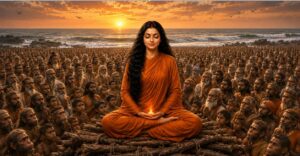
Comment: It is clearly written that a HUGE CROWD was present when it happened. So Maa entered the blazing auspicious fire in the presence of a lot of people. So this incident did not happen in closed room. This is THE MOST IMPORTANT thing to note in this śloka.
Maharṣi Vālmīki Rāmāyaṇa, Yuddha Kāṇḍa, #116, Śloka 31-35
सा तप्तनबहेमाभा तप्तकाञ्जनभूषणा ।
पपात ज्वलनं दीप्तं सर्वलोकस्य संनिधौ॥ ३१॥
ददृशुस्तां विशालाक्षी पतन्तीं हव्यवाहनम्।
सीतां सर्वाणि रूपाणि रुक्मवेदिनिभां तदा॥ ३२॥
ददृशुस्तां महाभागां प्रविशन्तीं हुताशनम्।
ऋषयो देवगन्धर्वा यज्ञे पूर्णाहुतीमिव॥ ३३॥
प्रचुक्रुशुः स्त्रियः सर्वास्तां दृष्ट्वा हव्यवाहने।
पतन्ती संस्कृतां मन्तैर्वसोर्धारामिवाध्वरे॥ ३४॥
ददृशुस्तां त्रयो लोका देवगन्धर्वदानवाः।
शप्ता पतन्तीं निरये त्रिदिवाद् देवतामिव॥ ३५॥
sā tapta-naba-hemābhā tapta-kāñcana-bhūṣaṇā ।
papāta jvalanaṃ dīptaṃ sarva-lokasya saṃnidhau ॥ 31 ॥
dadr̥śustāṃ viśālākṣīṃ patantīṃ havyavāhanam |
sītāṃ sarvāṇi rūpāṇi rukmavedinibhāṃ tadā || 32 ||
dadr̥śustāṃ mahābhāgāṃ praviśantīṃ hutāśanam |
ṛṣayo devagandharvā yajñe pūrṇāhutīmiva || 33 ||
pracukruśuḥ striyaḥ sarvāstāṃ dṛṣṭvā havyavāhane |
patantīṃ saṃskṛtāṃ mantrairvasordhārāmivādhvare || 34 ||
dadr̥śustāṃ trayo lokā devagandharvadānavāḥ |
śaptāṃ patantīṃ niraye tridivād devatāmiva || 35 ||
She, possessing the lustre of freshly refined gold and adorned with ornaments of pure gold, entered the brightly radiant blazing fire in the presence of everyone.
Then all living beings beheld the large-eyed Sītā—resembling a golden sacrificial altar—stepping into the Fire-God.
The Rishis, Gods, and Gandharvas saw that illustrious lady entering the fire like the sacred final offering (Purnahuti) offered into a यज्ञ (Yajña).
Seeing her enter the fire like a continuous stream of ghee (Vasordhara) sanctified by Vedic mantras poured into a यज्ञ (Yajña), all the women present cried out aloud.
The three worlds—including the Devas, Gandharvas, and Danavas—watched her entering the fire like a divine goddess falling from heaven into hell due to a curse.
Comment: पपात = to fall => which literally means “he/she/it fell down
The glow of the activation of Kuṇḍalinī energy was visible on Her face. Close your eyes and step into this moment—feel the profound beauty and heartbreaking pain as if you were standing right there beside Her. Maa Sītā is sitting on pyre and Kuṇḍalinī energy (divine Agni) is being activated. You will see Her as if She is falling on the Agni as Pūrṇāhutī because She is sitting on Pyre with Kuṇḍalinī energy activated at Mūlādhāra chakra. Maa Herself is being offered to this Divine Agni – indicating Pūrṇāhutī. This has been referred as पतन्ती because She is appearing as if She is falling on that Divine Kuṇḍalinī fire.
Maharṣi Vālmīki Rāmāyaṇa, Yuddha Kāṇḍa, #117, Śloka 1
ततो हि दुर्मना रामः श्रुत्वैवं वदतां गिरः।
दध्यौ मुहूर्त धर्मात्मा बाष्पव्याकुललोचनः॥ १॥
tato hi durmanā rāmaḥ śrutvaivaṃ vadatāṃ giraḥ |
dadhyau muhūrtaṃ dharmātmā bāṣpavyākulalocanaḥ || 1 ||
Then indeed, hearing the lamenting words of the people assembled there, the righteous Śrī Rāma became heavy-hearted and, with His eyes filled with tears, reflected deeply for a moment.
Comment: Word मुहूर्त indicates that the entire thing happened in approximately 48 mins.
Maharṣi Vālmīki Rāmāyaṇa, Yuddha Kāṇḍa, #118, Śloka 1
एतच्छुत्वा शुभं वाक्यं पितामहसमिरितम् ।
अङ्केनादाय वैदेहीमुत्पपात विभावसुः॥ १॥
etacchrutvā śubhaṃ vākyaṃ pitāmahasamīritam |
aṅkenādāya vaidehīmutpapāta vibhāvasuḥ || 1 ||
Having heard these auspicious words spoken by Lord Brahma, Agni (Vibhavasu), taking Vaidehi (Sītā) in his arms, emerged upwards out of the fire.
Comment: Now imagine that Kuṇḍalinī is rising upward and has crossed the Anāhata and reached Ājñā chakra. Our soul is in heart-lotus (Hṛd Padma). If you imagine this picture, you will see as if Agni (Kuṇḍalinī) has stood up and has taken Maa in his lap/arms (अङ्क). When a father takes a baby in his arms, he normally prefer baby head towards the left of his lap (near the Hrd Padma). Similarly when Kuṇḍalinī agni rose here, its head was in Ājñā chakra and Maa (in Hrd padma) has been visualised as being in lap of fire god (Kuṇḍalinī).
Maharṣi Vālmīki Rāmāyaṇa, Yuddha Kāṇḍa, #118, Śloka 2
विधूयाथ चितां तां तु वैदेहीं हव्यवाहनः।
उत्तस्थौ मूर्तिमानाशु गृहीत्वा जनकात्मजाम्॥ २॥
vidhūyātha citāṃ tāṃ tu vaidehīṃ havyavāhanaḥ |
uttasthau mūrtimānāśu gṛhītvā janakātmajām || 2 ||
Then, parting that piled altar of wood, the Fire-God Agni (Havyavāhana), taking an embodied form, swiftly rose up holding Vaidehi, the daughter of Janaka.
Comment: मूर्तिमान word has been used because the visible agni was inside the mother. विधूय चितां (vidhūyātha citāṃ) probably indicates the shivering of the body when Kuṇḍalinī crosses the middle area (Anāhata, Viśuddhi and Ājñā chakras) and also related to Prāṇāyāma. That shivering impacted the pyre. Following Śloka from Gheraṇḍa Saṃhitā confirms this point.
Gheraṇḍa Saṃhitā 5.55
अधमाज्जायते घर्मो मेरुकम्पश्च मध्यमात् ।
उत्तमाच्च भूमित्यागस्त्रिविधं सिद्धिलक्षणम् ॥ ५.५५ ॥
adhamāj jāyate gharmo merukampaśca madhyamāt |
uttamāc ca bhūmityāgas tri-vidhaṃ siddhilakṣaṇam || 5.56 ||
From the lowest [stage] arises heat; from the middle [stage] comes trembling of Meru; and from the highest comes leaving the ground. These are the three characteristics of attainment
Maharṣi Vālmīki Rāmāyaṇa, Yuddha Kāṇḍa, #118, Śloka 3-4
तरुणादित्यसंकाशां तप्तकाञ्जनभूषणम् ।
रक्ताम्बरधरां बालां नीलकुञ्जितमूर्धजाम्॥ ३॥
अक्लिष्टमाल्याभरणां तथारूपामनिन्दिताम्।
ददौ रामाय वैदेहीमङ्के कृत्वा विभावसुः॥ ४॥
taruṇādityasaṃkāśāṃ taptakāñcanabhūṣaṇam |
raktāmbaradharāṃ bālāṃ nīlakuñjitamūrdhajām || 3 ||
akliṣṭamālyābharaṇāṃ tathārūpāmaninditām |
dadau rāmāya vaidehīmaṅke kṛtvā vibhāvasuḥ || 4 ||
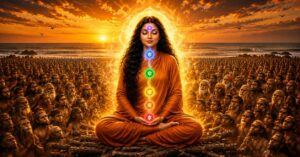
Resembling the morning sun, adorned with ornaments of refined gold, wearing red(रक्त) garments, youthful, with dark curly hair, wearing unfaded garlands and ornaments, unchanged in Her appearance, and faultless—Agni (Vibhavasu), holding Vaidehi (Sītā) in his arms, restored Her unto Rāma.
Comment: This shows the form of the mother at the time of highest Kuṇḍalinī rising stage.
विभा + वसुः = विभावसुः = He whose wealth/substance is light or radiance. = Kuṇḍalinī
विभा (Vibhā): Light, radiance, brightness, or splendor (Noun from root bhā – to shine).
वसुः (Vasuḥ) = Wealth, substance, or one who possesses/embodies (Noun from root vas – to dwell/shine).
अक्लिष्टमाल्याभरणां = Adorned with fresh, unfaded garlands and ornaments. This indicates the divine Chakras of the mother.
Maharṣi Vālmīki Rāmāyaṇa, Yuddha Kāṇḍa, #118, Śloka 5 and 10
अब्रवीत् तु तदा रामं साक्षी लोकस्य पावकः।
एषा ते राम वैदेही पापमस्यां न विद्यते॥५॥
विशुद्धभावां निष्पापां प्रतिगृह्णीष्व मैथिलीम्।
न किंचिदभिधातव्या अहमाज्ञापयामि ते॥ १०॥
abravīt tu tadā rāmaṃ sākṣī lokasya pāvakaḥ |
eṣā te rāma vaidehī pāpamasyāṃ na vidyate || 5 ||
viśuddhabhāvāṃ niṣpāpāṃ pratigṛhṇīṣva maithilīm |
na kiṃcidabhidhātavyā ahamājñāpayāmi te || 10 ||
Then Agni, the Purifier and witness of the world, spoke unto Rāma: ‘O Rāma, this is your Vaidehi (Sītā); no sin exists in Her.’
Accept Maithili, whose inner nature is completely pure and who is free from sin. Nothing critical should be spoken to Her; I command you.
Comment: Even if we take साक्षी लोकस्य पावकः as Fire on the pyre, we cant say that fire spoke. We know that physical fire never speaks. That’s the rule of nature. So here it clearly shows that this was the interpretation made by Śrī Rāma and Ṛṣis (who were present there) based on what they just saw.
Maharṣi Vālmīki Rāmāyaṇa, Yuddha Kāṇḍa, #118, Śloka 13
Maharaj Śrī Rāma says:
अवश्यं चापि लोकेषु सीता पावनमर्हति।
दीर्घकालोषिता हीयं रावणान्तःपुरे शुभा॥ १३॥
avaśyaṃ cāpi lokeṣu sītā pāvanamarhati |
dīrghakāloṣitā hīyaṃ rāvaṇāntaḥpure śubhā || 13 ||
And Sītā necessarily needed purification before the worlds, because this auspicious lady had dwelt for a long time in Ravana’s inner palace.
Comment: पावन = purification. Note very carefully that Śrī Rāma did not say that Her purity test was required. He is only taking about पावनम् (purification). He wanted to show that Maa Sītā is pure to the world and not test Her purity. Both are completely different things.
Maharṣi Vālmīki Rāmāyaṇa, Yuddha Kāṇḍa, #118, Śloka 14
Maharaj Śrī Rāma says:
बालिशो बत कामात्मा रामो दशरथात्मजः।
इति वक्ष्यति मां लोको जानकीमविशोध्य हि॥ १४॥
bāliśo bata kāmātmā rāmo daśarathātmajaḥ |
iti vakṣyati māṃ loko jānakīm aviśodhya hi || 14 ||
Indeed, Rāma, the son of Daśaratha, is childish and ruled by lust’—thus the world would speak of me if I accepted Janaki without establishing purity.
Comment:
शुध् (śudh) = which strictly means “to purify, cleanse, or make pure.”
अविशोध्य (Aviśodhya) means “Without establishing purity” in the world.
Maharṣi Vālmīki Rāmāyaṇa, Yuddha Kāṇḍa, #118, Śloka 15,17,20
Maharaj Śrī Rāma says:
अनन्यहदयां सीतां मच्चित्तपरिरक्षिणीम् ।
अहमप्यवगच्छामि मैथिलीं जनकात्मजाम्॥ १५॥
प्रत्ययार्थं तु लोकानां त्रयाणां सत्यसंश्रयः।
उपेक्षे चापि वैदेहीं प्रविशन्तीं हुताशनम्॥ १७॥
विशुद्धा त्रिषु लोकेषु मैथिली जनकात्मजा ।
न विहातुं मया शक्या कीर्तिरात्मवता यथा॥ २०॥
ananyahdayāṃ sītāṃ maccittaparirakṣiṇīm |
ahamapyavagacchāmi maithilīṃ janakātmajām || 15 ||
pratyayārthaṃ tu lokānāṃ trayāṇāṃ satyasaṃśrayaḥ |
upekṣe cāpi vaidehīṃ praviśantīṃ hutāśanam || 17 ||
viśuddhā triṣu lokeṣu maithilī janakātmajām |
na vihātuṃ mayā śakyā kīrtirātmavatā yathā || 20 ||
I too understand Sītā, the Maithilī, the daughter of Janaka, whose heart is devoted exclusively [to me] and who safeguards/keeps Her mind fixed on me. Indeed, relying on truth, for the purpose of creating conviction among the three worlds, I overlooked Vaidehi even as She was entering the fire. Maithili, the daughter of Janaka, is completely pure in the three worlds. She cannot be abandoned by me, just as glory cannot be abandoned by a self-controlled man.
Comment:
- Śrī Rāma did not ask for Agni Pravesha of Maa Sītā.
- He ALWAYS knew that Maa Sītā is completely and absolutely pure.
- For the sake of the three worlds, He did not stop Maa Sītā from Agni-praveśa.
- Maa Sītā proved Her purity in front of the three world. It is clearly given that She proved Her purity among the HUGE (Yuddha Kāṇḍa #116.30 जनश्च॒ सुमहांस्तत्र बालवृद्धसमाकुलः)
Maharṣi Vālmīki Rāmāyaṇa, Ayodhya Kanda, #109, Shloka 9
Maharaj Śrī Rāma says:
कामवृत्तोऽन्वयं लोकः कृत्स्नः समुपवर्तते ।
यद्वृत्ताः सन्ति राजानस्तद्वृत्ताः सन्ति हि प्रजाः ॥
kāmavṛtto’nvayaṃ lokaḥ kṛtsnaḥ samupavartate |
yadvṛttāḥ santi rājānastadvṛttāḥ santi hi prajāḥ ||
This entire world follows and conforms to the behaviour [of its leaders]. Whatever the conduct of the kings may be, indeed, that very same conduct is mirrored by the subjects.
NEVER DOUBT Maharaj Śrī Rāma. If you ever have doubts or questions about Śrī Rāma, bow before Maa Sītā, and She will give you the answer. Open your all three eyes wide and see who She truly is.
🙏 होइहि सोइ जो राम रचि राखा। को करि तर्क बढ़ावै साखा॥ 🙏
🙏 श्रीरामार्पणमस्तु 🙏