Om Gurave Namah
 Candra represents the mind and also blood connections. We strongly associate two words with the 9th bhāva: bhāgya and dharma.
The significations of the 9th bhāva are the father, Guru, protection, and higher knowledge. Therefore, we can expect someone who can control and protect your mind to be represented by the 9th from Candra. This bhāva will show what our highest philosophy is and what we need for protection and security.
We look at the 9th from Candra to understand the protection we have and what higher knowledge we can receive. Will you really be protected or not?
The 9th from Candra is your biological link to the father. This is how you learn to protect yourself during childhood. This energy will be predominant, especially until the age of 36.
Just as we consider the trines from the Sun to be important, the trines from the Moon are no less important. Your blood is your lineage, and it represents the child–father connection. Your learning comes from that bhāva. We can call it a blood triangle.
Grahas in that bhāva will show what you need to feel protected and where your protection comes from. Śani will bring insecurity to that bhāva. There will be a fear of death and poverty, so one needs a job and good health to feel secure. Maṅgala requires strength or celibacy to feel secure. Śukra may require a partner or love to feel secure.
The 9th bhāva will reveal the Dharma of Candra. In other words, it shows the social values and duties you receive and the principles you follow. Your morality will be strongly associated with the 9th from Candra. Your religious merit and even your virtue are there.
Why do we say that Mo in Alī creates kind-hearted people? Many healers, astrologers, and people in helping professions will have it. This is because the 9th from Candra is Karka rāśi, which is a jala rāśi—full of love and care towards others. The person will have a very caring nature despite his own experience of society—take Ke as Śubhapati. People may be extremely cruel towards him.
Now the question of the difference from Lagna will arise. How are Dharma and Bhāgya from Lagna different? Bodily fortune and mental fortune are different. Would you agree? Physical objects belong to Lagna Bhāgya, while mental objects belong to Candra Bhāgya. One is like Mukesh Ambani—having tons of material possessions and material success. The other is like Swami Vivekananda—possessing a great amount of knowledge that came from his Guru.
Mental bhāgya brings meaning to your life. Where is your citta? One part is surely in the 9th from Candra.
For Candra, the nakṣatra is important. The nakṣatra in the 9th from Candra will play a significant role, as it is the Ādhāna nakṣatra. Ādhāna is the 19th nakṣatra, which is the root of a person’s creation. It shows the things that help create the person’s destiny and individuality. This nakṣatra connects us to our Gurus.
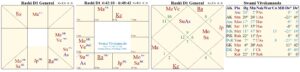
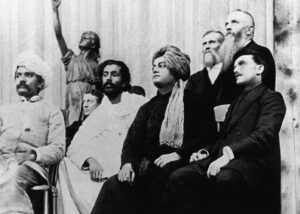
Have a look at Swami Vivekananda’s chart. His Candra is in the 10th bhāva, so on what topics will his citta be concentrated? The 9th from there is the 6th bhāva. What is his good luck? What is his real fortune? What is his citta constantly concentrating on? Service.
His mind is in service to the whole world—Vṛṣabha represents Vasudhaiva Kuṭumbakam.
Interestingly, the lord of this rāśi, Ve, is in the 6th bhāva from AL, which means that he is renounced. He renounced his desire for love and relationships. You see how the citta works here.
And his whole thought—Ke: “Let my service to my Guru end up in building a property for sadhus”.
Swami Vivekananda did far more than help establish a maṭha, or monastery. He founded the Ramakrishna Math as a formal monastic order dedicated to spiritual training—this is how Ke worked—and registered it as a trust in 1901. He also established its headquarters at Belur Math, on the banks of the Ganges near Calcutta, securing the land and mobilizing the necessary resources to create a permanent home for the order.
The 19th nakṣatra is Rohiṇī, ruled by Candra. Candra is with Śani. This combination shows that the entire mind dwells on spirituality and renounced people. Rohiṇī gives a highly compassionate, family-loving, and emotionally sensitive nature.
He was the son of Vishwanath Datta, a successful attorney at the Calcutta High Court. Vishwanath was educated in English and Persian literature and was interested in the Bible, the poetry of Ḥāfiẓ, music, history, and cultures outside orthodox Hindu society. Vishwanath encouraged Narendra to learn about different cultures, religions, and ways of thinking instead of following only one tradition. This helped Vivekananda become open-minded, confident, and respectful towards people from different backgrounds.
Vishwanath was also very generous. He often helped relatives and people in difficulty without judging them. When Narendra questioned this, his father explained that human suffering should be met with compassion, not quick criticism.
When Narendra once asked what his father had done for him, Vishwanath told him to look at himself in a mirror. The lesson was that the abilities, education, health, and character given to a child are themselves a significant inheritance.
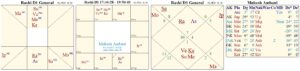
Let us now have a look at Mukesh Ambani.

Candra is in the 3rd bhāva in Dhanu, and the 9th from there is the Lābha bhāva with AK Ju. Therefore, his own gains will be of the highest priority. AK is the king.
Where is the concentration? “I am the king. My gains are important.” Ju has the tendency to expand. It receives graha dṛṣṭi from Maṅgala and Śani and is in mutual rāśi dṛṣṭi with Ra. This expansion is all about money and personal gains.
When Ju is aspected by malefic grahas and creates a dhana yoga, we say that the person will receive a great amount of money.
You see that his entire concentration is there. Do not forget—the mind is the king. Where your attention goes, energy flows.
Many wealthy people will have Candra in the 3rd bhāva. This exploitation of others comes from the 11th bhāva being the Dharma bhāva of the Moon—the natural Kumbha, ruled by Rāhu.
The Ādhāna nakṣatra is Maghā. Ke is with exalted Sūrya, Śukra, and Me, which shows that your mind is always concentrated on the inherited business that you learned from your father.
Mukesh joined Reliance while Dhirubhai was still expanding the company’s industrial operations. From his father, he inherited a vision of large-scale growth, technological advancement, vertical integration, and enterprises capable of serving millions of people. Mukesh’s later expansion into refining, retail, and telecommunications clearly reflects these principles.
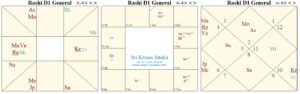
In Śrī Kṛṣṇa’s Jātaka, Candra is in the 1st bhāva, and all his concentration is on Dharma. The 9th bhāva represents the temple, pūjā, tapasya, and japa. That is one of the requirements in the long list for being an Avatāra—they come to uphold Dharma. Ke is there in parivartana with Śani.
War. Unending war. Ke is the graha that represents mokṣa. This is Klīṁ. He came to establish Dharma, and that was his main thought. He came to help people cross this terrible Kali Yuga—Makara rāśi. He left us the best mantra through which to reach him: the Hare Kṛṣṇa Mahāmantra. Avatāras are usually outside the scheme of the 27 nakṣatras; they relate to another world.
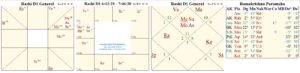
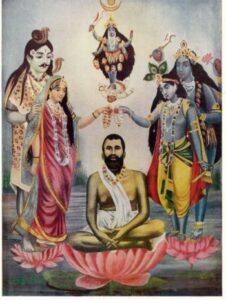 Thakur Rāmakṛṣṇa—see, Candra is in the 1st bhāva! Where is his mind always? In the temple. You cannot help it. The mind always runs to the temple. Śani is there. Whose temple is it? Śani is vakra, giving the result of debility. The mind always runs towards Kālī. Śani is the Lagna Lord in the 9th. Therefore, all his intelligence and citta are there in Tulā.
The Ādhāna nakṣatra is Viśākhā, ruled by Ju. Ju is in the 5th bhāva. Khudiram Chattopadhyay, his father, was an orthodox Bengali Brāhmaṇa deeply devoted to the family deity Raghuvīra, a form of Śrī Rāma.
Ramakrishna remembered his father as someone who spent much of his time in worship, meditation, repeating God’s name, chanting divine glories, and preparing garlands for Raghuvīra. During the recitation of the Gāyatrī, he was reportedly overcome with devotional emotion and tears. Therefore, you see that this concentration on mantra and worship comes from the ideals given by his own father.
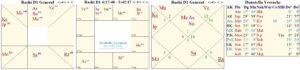
Now we shall take an example from the fashion world: Donatella Versace.
 Look at her Candra. It is in the 5th bhāva. The 9th from there will be Lagna. What does she want? Name, fame, and a good reputation. Lagna is Tanu bhāva, or the body. Su and Me are there. Therefore, you need wealth to feel secure. You need money—Me in digbala—to feel secure. You want talent—this is Nipuṇa Yoga in Lagna. Sūrya is the 5th Lord, so she is concentrating on power.
Ma, the lord of that bhāva, is in the 2nd bhāva in a Śukra sign, so it represents something you are doing with your own hands. You want to create and design and receive name and fame for it. You want to be the first in what you do in order to feel secure.
The nakṣatra there is Bharaṇī, ruled by Śukra. The concentration is on Śukra.
Donatella Versace’s father, Antonio Versace, was a successful salesman and finance manager who brought financial stability and critical connections to the family. Rather than traditional “luck,” his career choices directly built the foundation for his family’s ultimate ascent into global high fashion. You see how peculiar this 9th from Candra is.
The 9th bhāva from Candra shows the Dharma of the mind—what gives a person protection, meaning, guidance, and inner security. It connects us with the father, Guru, family principles, higher knowledge, and the values that shape our destiny. The grahas, rāśi, and Ādhāna nakṣatra connected with this bhāva reveal where the mind places its faith and concentration.
The examples of Swami Vivekananda, Mukesh Ambani, Śrī Kṛṣṇa, Ṭhākura Rāmakṛṣṇa, and Donatella Versace show that the 9th from Candra can express itself through service, wealth, Dharma, worship, creativity, or social success. It shows what the mind follows, what makes it feel protected, and which inherited principles guide the person throughout life.
Written by Dana Khanina, inspired by the teachings of Guruji Pandit Sanjay Rath and the Gurus of Parampara.
OM TAT SAT
Om Shanti, Shanti, Shanti