Om Gurave Namah
Very often, people who are just beginning to study Jyotiṣa confuse the terminology: they mistakenly identify Janma Rāśi with the Lagna sign. Instead, it is the sign where Moon is placed.
रयिर्वा एतत्सर्वं यन्मूर्तं चामूर्तं च ।
तस्मान्मूर्तिरेव रयिः ॥ १.५ ॥
rayir vā etat sarvaṃ yan mūrtaṃ cāmūrtaṃ ca |
tasmān mūrtir eva rayiḥ || 1.5 ||
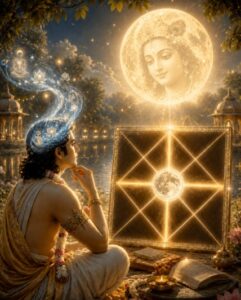 The shloka says: “The Sun is the prana and Moon is the rayi. Food is, indeed, all this – that which has form and which is formless. Therefore, everything is created from food”.
So Moon is the mother and mother likes to feed. It feeds with 2 kinds of food – one is that feeds the body and it is physical food and one which feeds the mind, which is prana.
Candra is the filter because wherever the mind goes, that is where life goes. It is duality of the mind, so when we examine Candra, there will always be two aspects, two polarities. Janma Rāśi Lord is called Śubhapati and it gives all the taste to your life, which gives you different states of the mind. It controls “Rayi”. Janma Nakṣatra Lord controls another part which is called “Prāṇa”.
Candra Lagna is extremely important and we should always check afflictions to it. Duṣṭhāna placement of the Moon as well as Bādhaka association or Vāyu Graha association can bring mental disorders and disease.
Candra shows the level of your awareness, the quality of your conciousness. Guna of the mind is important. Candra sign will show your thoughts, your thinking.
For further understanding, we need to understand the nature of the Moon in different rāśis.
| Candra in | Short effect |
|---|---|
| Meṣa | Brave, self-respecting, restless mind, wealth, wounds/head issues. |
| Vṛṣabha | Charitable, famous, steady, beautiful gait, strong body, comforts. |
| Mithuna | Intelligent, eloquent, artistic, sensual, witty, fond of pleasure. |
| Karka | Fortunate, emotional, fond of water, travel, homes, astrology. |
| Siṃha | Majestic, strong chest, proud, dutiful, stomach/teeth issues. |
| Kanyā | Learned, eloquent, pure, skilled, religious, helpful to others. |
| Tulā | Skilled in work, wealthy, relational, unstable mind, helpful to relatives. |
| Vṛścika | Intense, secretive, hardworking, troubled in childhood, passion and struggle. |
| Dhanuṣa | Knowledgeable, strong, grateful, courageous, good speaker, attached to relatives. |
| Makara | Serious, truthful, poetic, miserly, sensual, long neck/ears. |
| Kumbha | Artisan-like, rough body, unconventional, troubled mind, poverty or instability. |
| Mīna | Artistic, musical, religious, polite, wealthy, emotional, fond of travel/water. |
As Jyotiṣis, we should always consider many factors in our analytical process. Let us examine some charts for better understanding of judgement of results and common tendences of Janma rāśi.
In the tradition we always consider the Avatāra Jātaka first.
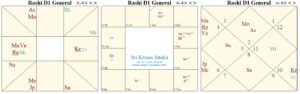
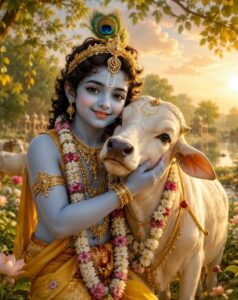 Śrī Kṛṣṇa’s Candra is in Vṛṣabha. It is a sthira rāśi, a fixed sign, and Vṛṣabha is the exaltation sign of the Moon. Therefore, the mind is very powerful, with extremely good memory and imagination. According to the nature of the sign, there may also be a certain firmness, steadiness, and stubbornness in character. Does he like food? Of course he does. And what kind of food? Food connected with the exalted Moon — milk, butter, ghee, and all nourishment coming from the cow. Moon is the cow.
Vṛṣabha is ruled by Śukra and is the exaltation rāśi of Candra. In Śrī Kṛṣṇa’s chart, Candra and Śukra are in parivartana, forming Yānavanta Yoga. This yoga refers to one who holds the reins of the vehicle — the charioteer who guides not merely a cart, but the movement of people, communities, and even humanity itself. It signifies leadership, direction, and the rare capacity to show the path to many, shaping and guiding their lives toward a higher purpose.What a mind!
People who are guided by Śukra are usually very charming, refined, and diplomatic, while Candra adds intuition, sensitivity, and very deep emotions.:”The Lord of Vrishabha Rashi is Sukra and Sukra stands for worship of beauty and for poetry and imagination. He is radiantly white like snow, the Kunda flower and the Utpal. He is also the encyclopedic expounder of all branches of learning.” BPHS
Vṛṣabha is connected with family, nourishment, wealth, and storage. Therefore, we can say that the principle of the exalted Moon in Vṛṣabha is “Vasudhaiva Kuṭumbakam “— he sees the whole world as one family.
Vriscika is in the 7th bhava, so can we say he will see some cruelty from that sign? That is the opposite sign from the Moon and vrishcika is the reshi of debility of the Moon, where it doesn’t like to be. It’s an isolation, separation. Shani is there – sorrow. It’s also 7th bhava from Lagna – person will see a lot of sorrow from the world, he will experience sorrow in the marriage. Sārāvalī says troubled in childhood. For sure in matters of relationships – he has been taken away from Devaki and Vasudeva.
So let us think how is the Lord in higher principles? It’s natural 9th bhava-Makara. It’s a Kali Yuga sign, very dark and evil. Makara is natural 10th bhava ruled by Shani who makes others work and rules tapas. It’s a Kali yuga sign
स्वकर्मणा तमभ्यर्च्य सिद्धिं विन्दति मानवः ॥ १८.४६ ॥
svakarmaṇā tam abhyarcya siddhiṁ vindati mānavaḥ || 18.46 ||
“From whom all beings arise, and by whom all this universe is pervaded — by worshipping Him through one’s own duty, a human being attains perfection.”
In that manner, we should judge the nature of the Janma Rāśi and the nature of the person’s mind. Of course, we should consider many more factors, but even from the nature of the Janma Rāśi alone, we can suggest a person’s likes and dislikes, as well as the type of mind, because all of this is based on emotions and senses and will have some common features and general tendencies. These will be modified by the Grahas in the sign and by the dṛṣṭi of other Grahas.
We started examples with Śrī Kṛṣṇa as he is also a Candra Avatar. Candra rules not only the mind but also family our relationships with people and all the social interractions. It represents the peace or frustration of the mind. Candra shows the inheritent nature of the person. When Candra is conjoined other planets it shows that those palenets can take away your pranas, especially if they are malefic. You are sharing it with the others.
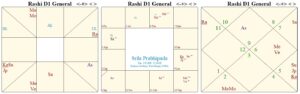
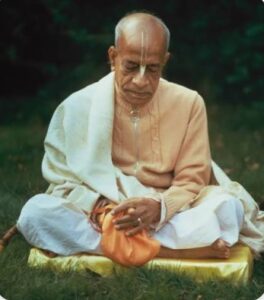 In this chart, the Moon is again in Vṛṣabha, gaining the same features as described previously. One factor that changes the colour slightly is the conjunction of the Moon with Maṅgala. This combination is known as Rudra Yoga, bringing a lot of Maṅgala energy to the Moon — anger, heat, and conflict. It is an imbalance created by the nature of the Grahas: Jala and Agni are enemies.
Always consider one important fact: which Graha becomes stronger in the combination will depend on its placement from Lagna and Ārūḍha Lagna. So, the remedy is:
kad rudrāya pracetase mīḷhuṣṭamāya tavyase |
vocema śantamaṃ hṛde ||Ṛgveda 1.43
This combination will give a lot of tears and suffering, the person will be troubled in relationships, they may break, there may be a blame game in relationships. The person should worship Rudra to overcome his weaknesses.
His marriage faced tension due to his wife’s lack of interest in his spiritual pursuits. When he later renounced family life, he made financial provisions for his grown children and wife.
Again proving the point of common traits of people with the same Janma rashi – his highest principle was engaging all of one’s natural skills, resources, and bodily services into the active, selfless service of Krishna, same Karma yoga principle. Candra here is exalted following the same principle: Vasudaiva Kutumbakam.
For Candra Lagna, conjunction with malefics is not good. When Candra conjoins Rāhu, it is a real battle. Rāhu is a natural Bādhaka — the one thing that you can never fully understand. The mind becomes restless, always overthinking and doubting. Your life becomes a fight to come out of that state.
Conjunction with Śani brings depression, feelings of loneliness, suffering to the home and marriage, poverty, and disease if badly placed. It is a Kālikā Yoga, and the person can see a lot of deaths in his life. Of course, if Candra is strong, it can sound different.
When Candra conjoins Ketu, it creates an eclipse of the mind. The problem here is that Ketu evaporates water, so for the Moon this combination can be extremely bad. The person may feel rejected, hurt, and humiliated. Such people usually have the tendency to run away from society. Do not forget that the Moon is nīca in Vṛścika. Mental happiness may be absent here.
So, now we can say that for the Moon enemies are always Vayu tattva Graha as Moon is the Vata+Kapha principle and it will cause physical and mental disease when Vata increases and Agni tattva Graha as well.
Candra is a very relecting Graha, so by the influence of tamas (also check aspects), the guna of the mind will have a tendency to become tamasic. It will for sure give adhama guna.
Now with all the knowledge we have gained about Janma rashi and Candra Lagna let’s examine one more case.
Remedies for conjunctions:
Candra and Shani – worship Kali
Candra and Mangal – worship Rudra
Candra and Rahu – read Bhagavat Gita daily
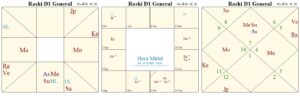
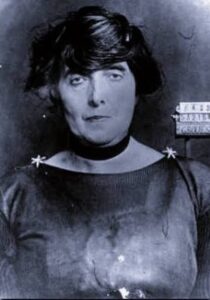 She was a French writer, feminist, lecturer, suffragist, and salonnière. Known for her occult interests, political intrigues, and turbulent personal life, Mirtel became infamous for the murder of her second husband, Georges Bessarabo, whose body was discovered in a “bloody trunk.”
Janma rashi is Makara. Makara is cara rashi – the mind is unstable, always moving. “Innocent face and nature of a crocodile”. No faith, dukha and dissapoinments in the mind. Very painful position. This is a Kali Yuga rashi and all the pain of Kali yuga is there. Moon is giving life , it doesn’t like the graviyard.
She was born on Shuka Navami, so Candra is considered to be strong. From Lagna Candra is in digbala.
Let’s examine the influences on Candra. First of all, it’s opposite to it’s svakshetra and aspected by debilitated Mangal in digbala. Shani is also putting graha drishti on the Moon. Ra is with LL Ve adding to the affliction of Candra and puts rashi drishti on the Moon. So you can see the Moon is getting a lot of tamasic influence. Ke in the 2d bhava from Candra is also not good, causing pressure on the mind and regection in married life.
Shani who is the shubhapati is a malefic and 4th and 5th Lord in Vrishcika. We would say Shani is among the worst shubhapatis. It’s in badhaka from the Moon. Sa gets rashi drishti of Mangal niccha creating a Yama yoga. What thoughts are you getting? How unfortunate. So the person may think this Graha is where his unhappiness lies.
You see the tendency of the mind – it will never understand what is wrong-shubhapati in badhaka giving wrong thoughts.
She said:
“I am not a woman who kills. Everything in my past life protests against such an accusation. All my works radiate with proof that I am a creatress. Being that, I cannot destroy.” These were the words from Madame Bessarabo, suspected murderess of her first husband and confessed assassin of the second one.
There was also a more strange version suggested by one of her literary friends: that she may have been under some kind of occult or trance-like influence.
You can see how mind rules the life. Afflicted, weak mind can ruin all your life.
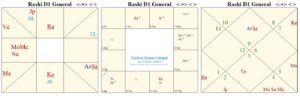
 He was an Indian playback singer, musician, and actor, widely regarded as one of the greatest and most dynamic voices in the history of Indian music. Known for his extraordinary versatility, yodelling, and ability to sing in many different voices, Kumar became one of the most popular singers of the Indian subcontinent. He performed across many genres, though some of his rare compositions, now considered classics, have been lost with time.
Let us look at his Candra. It is in Karkaṭa Rāśi, its own sign. What does Candra like? Music. What does Sārāvalī suggest as the result for Candra in Karkaṭa? Fortunate, emotional, fond of water, travel, homes, and astrology. What else can we add? Candra is a very moody Graha. The person may mostly live in the mind, be very caring, and have the capacity to heal. The Moon can fight Śani. Music can fight any sorrow in the mind. Candra in Karkaṭa is very compassionate by nature and loves people.
What is the guṇa of the mind? Predominantly, it is in a cara rāśi, a sāttvika rāśi. Candra is with Budha, which points to madhyama guṇa and gives a creative mind full of hope. Sūrya adds udāsīna guṇa, which can either give a krūra nature or a tendency toward spirituality.
Candra is in Puṣya Nakṣatra, ruled by Guru, and this forms Īśāna Yoga. Look at the dṛṣṭi — Īśāna Yoga is caused by Guru, as in Latā Maṅgeśkar’s case. The person is blessed by Śiva with talent.
Let us examine the influences. It is an Amāvasyā Moon — a very lonely Moon, a dark Moon — and it is with Budha. MKS Moon also will not lead to a happy mind. The mind feels as if it is dying. Śani is also putting rāśi dṛṣṭi from Lagna. Despite all this, the Moon in its own sign has a tendency to fight Śani. Śukra also helps by influencing Śani through graha dṛṣṭi. So, through music, the person has the power to overcome his own sorrows.
He was not happy in a simple, ordinary sense. Kishore Kumar seems to have been a man of contradictions: outwardly comic, playful, eccentric, and full of life, but inwardly lonely, sensitive, wounded, and deeply reflective. He also said he had no friends and preferred talking to his trees. This shows a very strong withdrawal from society. His personal life brought deep pain. He had four marriages, and his marriage to Madhubala was especially tragic because he cared for her during her long illness until her death. He seems to have possessed a deeply spiritual curiosity, drawn to themes of death, solitude, memory, nature, and the mystery of the soul. His attraction to cemeteries, Biblical films, and ideas of past lives shows a contemplative and unusual spiritual imagination.
When the Moon is in its own sign, we have several options: either to take Ucchanātha as Śubhapati, or the Nakṣatra Lord, or the Kāraka of the bhāva where Candra is placed, or the Candrāṃśa Lord, meaning the lord of the Navāṃśa placement of the Moon. If one of these four is the Ātmakāraka, it will have a dominant say.
Candra is a very social Graha and needs surroundings. It does not like isolation, so there must be planets in the 2nd and 12th from the Moon. This forms two yogas: Anaphā Yoga, when Grahas are in the 12th from the Moon, and Sunaphā Yoga, when Grahas are in the 2nd from the Moon. If Grahas are in both places, it causes Duradharā Yoga.
The Moon represents society, and it is always connected with sharing with the world and with what we receive back from society and family. One side is dependent on us, which is Anaphā Yoga, and the other gives to us, which is Sunaphā Yoga. This is a very simplified explanation, but indeed we should check whether the person has someone to give to and someone to receive from emotionally, and how this influences his happiness. Without planets there, there is no motivation for work and family.
Candra Lagna must always be examined carefully, because it shows the world as experienced by the mind. Benefic influences can give emotional support, creativity, devotion, compassion, social connection, and healing power. Malefic influences can disturb the mind, causing fear, anger, depression, isolation, rejection, overthinking, or destructive tendencies. Therefore, the same Janma Rāśi may give common tendencies, but the final result changes according to conjunctions, dṛṣṭi, Śubhapati, Nakṣatra Lord, Candra’s strength, and the condition of the 2nd and 12th from the Moon.
The examples show an important principle: a strong Moon does not always mean a happy mind. It can give deep sensitivity, memory, talent, compassion, and the power to heal others, but if afflicted, it may also carry loneliness, sorrow, emotional pressure, or inner darkness. A weak or afflicted Moon can ruin life, while a strong and protected Moon can transform sorrow into art, devotion, service, and wisdom.
Thus, the judgement of Janma Rāśi and Candra Lagna is the judgement of the living mind. It shows what the person loves, what wounds the person, what nourishes the person, and how the person shares himself with the world.
Written by Dana Khanina, inspired by the teachings of Guruji Panit Sanjay Rath and the Gurus of Parampara.
OM TAT SAT
Om Shanti, Shanti, Shanti