Written by Dana Khanina, inspired by the teachings of Guruji Pandit Sanjay Rath
अग्निर्मूर्धा दिवः ककुत्पतिः पृथिव्या अयम् ।
agnir mūrdhā divaḥ kakut patiḥ pṛthivyā ayam |
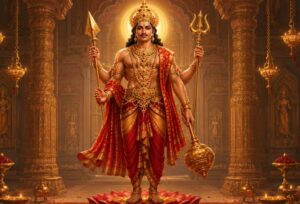 The name Maṅgala means “auspicious,” “fortunate,” “beneficial,” or “that which brings welfare.” Unlike the common name Mars used for this Graha, the traits that the name carires may associate with fire, weapons, struggle, anger, injury, war and conflict. But once you call this Graha auspicious, it turns to be as a remedy and worship. Grahas are like people and no one likes to be called with some bad name.
You may argue that Maṅgala is a malefic. But a surgeon uses a blade to remove disease. A warrior raises a weapon to defend the innocent. Fire burns, but it also purifies. Discipline may feel painful, yet it produces strength. In the same way, Śrī Maṅgala represents the force that cuts through weakness, fear, hesitation, and disorder so that Dharma may be restored.
Maṅgala — मङ्गल – “auspicious,” “fortunate,” “beneficial,” or “that which brings welfare.”
गुरुः शुक्रः शनी राहुः केतुश्चैते यथाक्रमम् ॥ ३.१० ॥
guruḥ śukraḥ śanī rāhuḥ ketuś caite yathākramam || 3.10 ||
Bhūputra — भूपुत्र – literally means “the son of the Earth”:
क्रूराः शेषग्रहाः सौम्याः क्रूरः क्रूरयुतो बुधः ॥ ३.११ ॥
krūrāḥ śeṣagrahāḥ saumyāḥ krūraḥ krūrayuto budhaḥ || 3.11 ||
Kuja — कुज – “born from the Earth.”
ku (कु) — the Earth
ja (ज) — born or produced
सत्त्वं कुजो बुधैः प्रोक्तो बुधो वाणीप्रदायकः ॥ ३.१२ ॥
sattvaṃ kujo budhaiḥ prokto budho vāṇīpradāyakaḥ || 3.12 ||
Dharātmaja — धरात्मज
dharā (धरा) — the Earth, that which supports and sustains
ātmaja (आत्मज) — one born from oneself, a son
बुधो राजकुमारश्च सचिवौ गुरुभार्गवौ ॥ ३.१४ ॥
budho rājakumāraś ca sacivau guru-bhārgavau || 3.14 ||
Bhauma — भौम – “belonging to the Earth,” “born from Bhūmi,” or “the son of Bhūmi.”
नराः शेषाश्च विज्ञेया भानुर्भौमो गुरुस्तथा ॥ ३.१९ ॥
narāḥ śeṣāś ca vijñeyā bhānur bhaumo gurus tathā || 3.19 ||
Dharāsuta — धरासुत – son of Earth:
dharā (धरा) — Earth
suta (सुत) — son or offspring
क्षीरोपेतांस्तथा चन्द्रः कटुकाद्यान् धरासुतः ॥ ३.३९ ॥
kṣīropetāṃs tathā candraḥ kaṭukādyān dharāsutaḥ || 3.39 ||
In Jyotish, although Maṅgala is classified as a Krūra Graha, a fierce or severe Graha, this does not make him evil or adhārmic. The term krūra describes the manner in which his energy operates: through heat, pressure, cutting, struggle, discipline, and decisive action.
Maharṣi Parāśara describes him as netā, the leader or commander. He also states that Kuja represents sattva, which in this context can indicate strength, vitality, courage, and the essential power of action.
Maṅgala refers to Sura Grahas – those who follow Sūrya. He is the general of the Devas who possesses the force necessary to carry out a righteous decision. One important trait of Maṅgala : he usually attacks first.
Maṅgala is strong at night as well as Candra and Śani. That does not mean he can’t have strength during the day, it only refers to some results in chart making his influence more negative or positive. For example, in case he causes breakage of marriage or some bad result intencity may be different – in one case the husband will go away, in the other may die – depends on birth of the person during the day time or night time and strength of the Graha as well as other factors.
Maṅgala represents Majjā Dhātu — मज्जा धातु, the marrow or soft tissue contained within the bones.
Maharṣi Parāśara states that in Bṛhat Parāśara Horā Śāstra 3.31:…अस्थि रक्तस्तथा मज्जा त्वग् वसा वीर्यमेव च ।…“Bones, blood, marrow, skin, fat, reproductive essence, and sinews are governed respectively by the Grahas beginning with Sūrya.”
The closest modern anatomical comparison is bone marrow, including the soft tissue found within the medullary cavities of bones. Bone marrow participates in blood-cell formation and contains both blood-forming and fatty tissues.
In Sārāvalī, Kalyāna Verma describes Maṅgala in the twelve bhāvas in Chapter 30, ślokas 26–37.
According to Sārāvalī, Maṅgala gives his clearest constructive results in the 3rd, 10th and 11th bhāvas:
- 3rd: courage and victory:
“If Mars be in 3rd, the native will be courageous, unconquerable, bereft of co-born, be
delighted, will have all virtues and be famous.”
In Jyotish 3d bhava shows our courage, so the ruling planets may show your attitude in that field. If Me is there – the person will not like to fight and will not have much courage unless there is a malefic influence. But if Mangal is there – for sure the person is fearless and brave.
- 10th: action, authority and accomplishment. However it’s a Digbala position bringing good results.
We should not forget the principle of Jyotish that better for malefics to be weak. For example, the stronger they are in Kendras – the more they will beat. Mangal increases tamas in a system and we don’t want tamas to increase. If we compare exalted (natural Makara rasi) Mangal and debilitated – from Jyotish perspective we shall say debilitated is better, because it means I will not fight. Fights will be the reason to come back again.
“If Mars occupies the 10th, the native will be proficient in his acts, be valorous, unconquerable,
will serve important people, be endowed with sons and happiness and be very courageous.”
- 11th: gains, prosperity and fulfilment
“If Mars occupies the 11th, the native will be virtuous, happy, courageous, endowed with
wealth, grains and sons and be devoid of sorrow.”
Being Kāraka of the 3d and 6th bhava (some traditions regard Śani as a Kāraka of the sixth Bhāva, but we follow the teachings of the tradition of Śrī Acyutānanda Dāsa) he represents the heat and the fighting power of the person towards others or others towards the person. In other words, in 3d bhava you beat, in 6th bhava other people beat you.
Other position of Mangala Sārāvalī describes as being not as good.
If Mars occupies the 2nd, the native will be poor, will eat bad food, will possess an ugly face,
will join bad men and be bereft of learning.
If Mars is posited in 4th, the native will be devoid of relatives, paraphernalia and conveyances,
be very miserable, will live in others houses and be distressed.
If Mars occupies the 5th, the native will be devoid of happiness, wealth and sons, be fickleminded, be a talebearer, will incur evils, be wicked, distressed and mean.
If Mars occupies the 6th, the native will be highly libidinous, will have powerful digestive fire,
be beautiful, tall, strong and great among his relatives
If Mars occupies the 8th, the native will suffer from diseases, be short-lived, will possess an
ugly, or deformed body, will do base acts and will suffer grief.
If Mars occupies the 9th, the native will not be skillful in acts, be odious, will kill living beings,
be not virtuous, be very sinful and honoured by the king.
Should Mars be in 12th, the native will have diseased eyes, will fall in moral sense, will kill his
wife, be a talebearer, be fierce and will contract humility and imprisonment
For sure, we should consider other factors when reading classical texts and trying to understand how the results may manifest in different cases. In Jyotiṣa, we examine many different factors: the Lagna, the position of the Graha from the relevant bhāva, the rāśi, nakṣatra, dṛṣṭi, and many other considerations.
Though some positions of Mangal are considered not good we should look at other factors alos to decide.
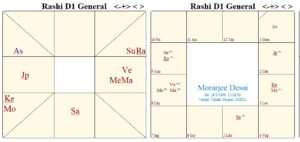
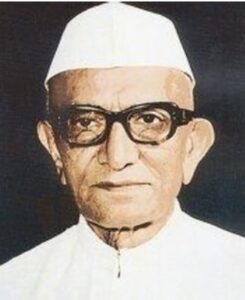
Morarji Ranchhodji Desai was an Indian politician and independence activist who served as the prime minister of India between 1977 and 1979 leading the government formed by the Janata Party. During his long career in politics, he held many important posts in government such as the chief minister of Bombay State, the home minister, the finance minister, and the deputy prime minister.
Normally Ma in the 8th bhava we expect that “the native will suffer from diseases, be short-lived, will possess anugly, or deformed body, will do base acts and will suffer grief.
His Mangal is 6th and 11th Lord who is getting exalted in the 8th bhava. Despite normal expectation of early death he lived a long life. So you see how it can overcome the prescribed results.
Being a trika Lord, for sure this Ma will bring some problems into his life from collegues (11th bhava) being enimical to him (6th bhava).
Again exaltation of Mangal brings a different result to marriage life. Being born at day time we can say Mangal can bring some very negative results into his marriage but it is exalted and we expect Sa to give the results. Shani is exalted in the 5th bhava which we can say was a forced marriage. From his words we will get to know:
“My grandparents arranged my marriage…
“We did as we were told in those days. We never thought about such things as choosing a partner for life.”
Anyway as Sa is exalted we expect Sukra to have a final say in this question. Desai married Gujraben in 1911, at the age of 15Gujraben lived to see her husband become prime minister. She died on 25 October 1981 at the age of 81
So before blindly assuming some results we should always have a clear picture.
If Mars is posited in 7th, the native will lose his wife, will suffer from diseases, will take to bad
ways, be miserable, sinful, devoid of wealth, distressed and emaciated.
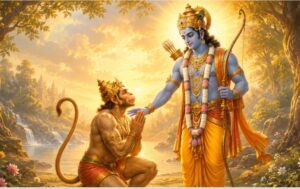 7th bhava is Bhu-loka, it is our general experience of life. If natural malefic affects 7th bhāva (alone) we shall say that you will have a good heart. This is what Maharṣi Parāśara shows. But for sure Mangal – will be your experience. The person will fight-fight-fight. All your life is a war (7 house is either war or love). Mangal is also a brahmacarya, so usually Ma in 7th bhava will also impact married life. Here if we have Ju influence like in the chart of Sri Rāma Mangal will be balenced. Hanuman listens only to Sri Rāma .
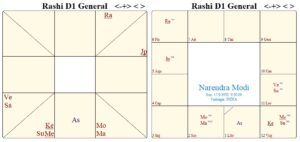
Narendra Modi has Maṅgala placed in the second bhāva in svakṣetra. For Tulā Lagna, Maṅgala is a māraka, being the lord of both the second and seventh bhāvas.
Candra, the lord of the tenth bhāva, is placed in the second bhāva, forming Siṃhāsana Yoga, and is conjoined Maṅgala in svakṣetra, forming Rudra Yoga.
As a strong natural malefic, Maṅgala is placed in the sixth bhāva from the Arūḍha Lagna. Therefore, he possesses the power to confront and defeat his enemies.
Maṅgala’s placement in its own rāśi further strengthens the horoscope and enables it to produce powerful rājayoga results.
Thus, despite the statement found in the Sārāvalī—
“The native will be poor, will eat bad food, will possess an ugly face, will associate with wicked people, and will be bereft of learning”—
we can see how the prescribed results are significantly modified by Maṅgala’s lordship, dignity, conjunctions, yogas, and position from the Arūḍha Lagna.
As Mangal represents also competition and it’s a very competative in nature graha, let us have a look at the example of a sportsman.
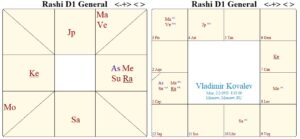
 Vladimir Nikolayevich Kovalyov is a retired Soviet-Russian figure skater who competed internationally for the USSR. He is an Olympic silver medalist and two-time World champion. He trained at VSS Trud in Moscow.bay State, the home minister, the finance minister, and the deputy prime minister.
He is Makara Lagna with Mangal 11th and 4th Lord being placed in the 3d bhava.
“If Mars be in 3rd, the native will be courageous, unconquerable, bereft of co-born, be
delighted, will have all virtues and be famous.”
Another name for the third Bhāva is Parākrama . Śukra is uccha (exalted) and conjoined Maṅgala, which brings him success in competition. Therefore, he will be successful in a field represented by Maṅgala.
Maṅgala in the third Bhāva represents the blessing of a Kāraka upon its Bhāva. He is conjoined an exalted Graha, which elevates him and helps him rise. The native is certainly courageous, unconquerable, and famous.
Śukra represents water, while frozen water must have a connection with Śani. Śukra is placed in the Nakṣatra of Śani; therefore, competition on frozen water brings him success.
The examples above demonstrate that the results given in classical texts should never be applied mechanically. Maṅgala may signify conflict, injury, competition and separation, but the same force can also manifest as courage, leadership, discipline and victory.
Its final result depends on many factors, including bhāva lordship, rāśi dignity, conjunctions, dṛṣṭi, nakṣatra, yogas and the overall strength of the horoscope. Therefore, the placement of Maṅgala in a particular bhāva gives only the foundation of interpretation; the complete chart reveals how that energy will actually manifest in the native’s life.
OM TAT SAT
Om Shanti, Shanti, Shanti