Om Gurave namah
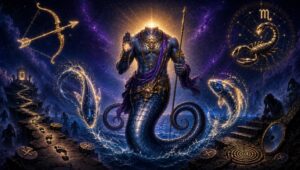 Ketu is a very mystical Graha. He is a kāraka for mokṣa, but, ruling the naisargika eighth bhāva, he also indicates karmic debts, unawareness, and mistakes. All of these are consequences of our past karmas and sins.
Śrīmad-Bhāgavatam 8.9 reveals the story of Rāhu and Ketu.
During the churning of the Ocean of Milk, the asura Svarbhānu disguised himself as a deva and secretly drank the nectar of immortality. Sūrya and Candra recognized him and warned Viṣṇu, who severed him with the Sudarśana Cakra. But the nectar had already made him immortal. His head became Rāhu, symbolizing endless desire and ambition. His headless body became Ketu, symbolizing detachment, instinct, and liberation. Rāhu later pursued the Sun and the Moon in revenge, creating eclipses whenever he swallowed them. Because he had no body, their light always returned. Together, Rāhu and Ketu represent two forces within us: the urge to acquire and the need to let go.
So as Ketu is a headless graha it indicated mistakes and wrong decisions. Vriscika is svakshtra or home of Ketu and it will show the first mistake. It’s natural Randhra bhava. Randhra ( रन्ध्र )— means an opening, cavity, hole, fissure, or hidden passage. In Jyotiṣa, Randhra Bhāva is associated with hidden matters, vulnerability, longevity, death, transformation, secrets, inheritance, and unresolved karma. It shows our nija doshas – own errors.
We tend to believe thany Graha is a part of us, our intelligence and character. But it’s wrong. You tend to play blame-game with those Grahas, so the first mistake of Ketu is unawareness of your own past sins and mistakes and identifying yourself with the body (it’s a headless Graha as you remeber).
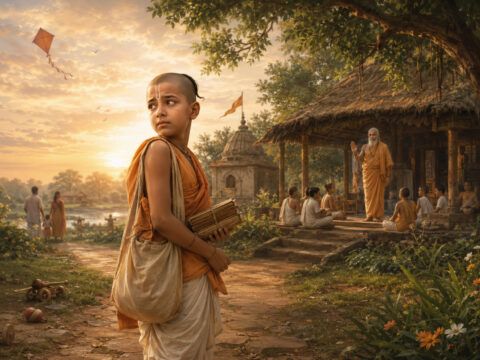
Our mind is trapped by the concepts that we get during our upbringing. When we are born, we get a name, we are told who our parents are, and with the father, we get to know our first Dharma beliefs. We are usually told which religion to follow, and naturally, we tend to follow our father’s religion.
As we grow up, we get the possibility to differentiate and make our own decisions based on the 9th bhāva graha influences. But still, differentiation can lead to some fundamental intolerance and can be tough, which is signified by Ketu’s exaltation in Dhanu, a sign of a battlefield and Dharma. That can create problems and even lead to extremes when a person becomes a terrorist in the name of religion. How many battles has humanity fought for the wrong things just to ensure supremacy?
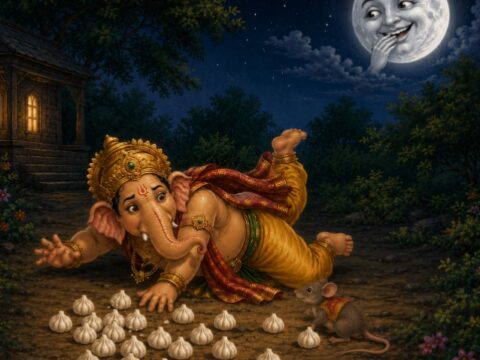
But the fundamental idea is that nobody is 100% right in this world, and all religions have common roots. For sure, we should not accept wrong ideas even in the name of the Dharma that we follow, and we should not become headless and intolerant. We should see more broadly, beyond borders, and should seek the blessings of the Guru—the 9th bhāva, for which Guru is the kāraka—to obtain this broad vision. Like Gaṇeśa, we may need to use the head of the Guru to understand some things, and not our own, which is narrow in its vision.
Kṛṣṇa says in the Bhagavad Gītā:
Ye yathā māṁ prapadyante tāṁs tathaiva bhajāmy aham.
“In whatever way people approach Me, I respond to them accordingly.”
— Bhagavad Gītā 4.11
So, all ways lead to the same ocean, and this reveals the third mistake. The mūlatrikoṇa of Ketu is in Mīna Rāśi, Pisces, and this is the naisargika 12th bhāva. Mūlatrikoṇa is an office of a graha, where it works. Ketu is the fish, and the fish tends to be in the ocean.
It is the mokṣa trine—the 4th, 8th, and 12th bhāvas. It is a Vyaya Bhāva, where, with the help of knowledge, we are able to find the path to mukti and understand God. The 12th bhāva is related to the faith of the person, and nobody can get to God through logic. You need faith to accept the existence of what you do not see and faith to trust Him. Faith itself is a tough path and a long journey. One should completely let go of logic and develop trust that is contrary to ordinary logic.
Mīna Rāśi is depicted as two fishes. One is going upward toward spirituality and God, and the other points downward toward material things. We should all understand the truth that, if this universal power that we call Bhagavān exists, then nothing is ours. We should let go of our concepts and develop faith with the help of knowledge as well.
Our mistake is to be stuck in material things and to understand the world from that perspective. But with the help of knowledge, we can widen our horizons and find faith and mukti. Here, our soul gets a chance to attain freedom. Aditya of Mina rashi is Visnu. He is the protector and is the Paramatma. He can help to overcome all the human weaknesses.
Ketu teaches us through absence, separation, and the consequences of what remains unconscious. As a headless graha, he reveals the places where we act without awareness, repeat old karmic patterns, or blame external forces instead of recognizing our own nija doṣas—our personal errors and unresolved tendencies.
The final lesson of Ketu is surrender. In Mīna and the natural 12th bhāva, Ketu points toward mokṣa, faith, and release from attachment. Logic alone cannot lead us to the Divine; knowledge must eventually become trust.
Ketu’s path is therefore not simply one of loss. It is the journey from unconsciousness to awareness, from religious rigidity to universal understanding, and from attachment to liberation. When we stop identifying only with the body, possessions, beliefs, and personal opinions, the soul gains the possibility of freedom.
Written by Dana Khanina, inspired by the teachings of Guruji Pandit Sanjay Rath. All mistakes are mine, all knowledge belong to the Guru.
OM TAT SAT
Om Shanti, Shanti, Shanti