Written by Namita Bhaladhare
 The soul’s journey is a map of time, etched into the heavens at the moment of birth. To find one’s “Dharma,” or sacred life purpose, is to decode the strategic blueprint the cosmos has provided. In the tradition of the seers, we begin this exploration through the “tripod of life”—the Sun (Soul), the Moon (Mind), and the Lagna (Physical Manifestation). These three pillars provide the essential coordinates for navigating the human experience.
However, a master-level understanding of destiny requires us to distinguish between different streams of time. According to the teachings of the Siddhas, daśā systems may be classified into Phalita Daśā, which indicate events and the fruition of karma, and Āyur Daśā, which are primarily concerned with longevity, vitality, and health.
Within this framework, Vimśottarī Daśā is regarded as the foremost nakṣatra-based Phalita Daśā system, whereas Aṣṭottarī Daśā, according to this particular lineage, is approached as a powerful Āyur Daśā associated with the Sañjīvanī Mantra and the life-restoring knowledge of Śukra.
Thus, we do not examine only what occurs. We also study the interaction between the native’s mental reception and external reality, because the mind perceives the destiny that the surrounding environment ultimately helps to manifest.
Manifestation is never a static event; it is a progression governed by the precise timing of the heavens. Success arises at the intersection of internal readiness and external opportunity. To map these two dimensions, we employ two complementary daśā systems.
Vimśottarī Daśā
Vimśottarī Daśā is the principal system used to examine the native’s internal experience and state of mind. It is calculated from the janma nakṣatra, the lunar mansion occupied by Candra at birth.
It reveals the native’s psychological landscape and their capacity to process, interpret, and respond to the messages of life. It may show whether the mind is receptive, stable, fertile, disturbed, or obstructed during a particular period.
Nārāyaṇa Daśā
Nārāyaṇa Daśā, also referred to in some traditions as Padakrama Daśā, is a rāśi-based daśā used to assess the unfolding of external circumstances. It reflects the messages arriving from the environment, the conditions created by the world, and the opportunities or challenges presented during a particular period.
The Strategic Impact
This duality explains why an individual may possess immense wealth (favorable environment/Nārāyaṇa) yet suffer from a “disturbed mind” (unfavorable Vimśottarī). To pursue a high-value purpose, internal perception and the external message must eventually harmonize. This “Static vs. Dynamic” synthesis is where the blueprint of potential transforms into a lived mission. When these systems align, the doors to Divine Yogas—the specific signatures of power and fortune—finally open.
In the architecture of a horoscope, a Yoga (union) is the primary indicator of status, power, and success. It is the signature of the soul’s intended impact on the world.
The Dharma-Karmādhipati Yoga
The highest indicator of a professional mission is the Dharma-Karmādhipati Yoga. This is formed through a specific relationship (Sambandha) between the 9th Lord (Dharma/Duty) and the 10th Lord (Karma/Profession). This union ensures power, status, and undying fortune, as it bridges the gap between what is right and what is done.
The Hierarchy of Significators (Kārakas)
To refine this blueprint, the Narrative Architect must analyze three tiers of significators:
Naisargika (Natural): The inherent, universal significators of life departments.
Sthira (Fixed): Those that represent the enduring aspects of the physical experience.
Chara (Temporal): The moving significators, specifically the eight-planet scheme (including Rāhu), which define the individual’s specific role in this incarnation.
Yogadā: Planets influencing the Lagna and special ascendants. A planet influencing the Lagna and Horā Lagna becomes a Dhana Yogadā (wealth-giver); those influencing the Lagna and Ghaṭikā Lagna become Rājya Yogadā (power-giver). A supreme Rājya Yogadā influences all three.
The Strategic “So What?”
The placement of these Yogas dictates the tempo of the mission. Yogas occurring in the 2nd and 4th houses (quadrants) grant early success and an easier path. Conversely, Yogas placed on the 1st and 7th house axis demand that the native endure significant hardship and struggle before the mission’s ultimate “Rājayoga” and fame are realized.
The Rāśi (D1) is merely the physical plane. To view the mental and karmic planes, we must utilize the Harmonic Cycles of divisional charts.
The Physical Plane (1st Cycle, D1–D12): Focuses on the body, wealth, and immediate environment.
The Conscious Mental Plane (2nd Cycle, D13–D24): Rules the individual’s mental awareness and accomplishments.
Specific Strategic Charts:
Daśāṃśa (D10): Known as the Karmāṃśa or Svarga Chakra (pathway to heaven). Here, the Artha Trikoṇas (2, 6, 10) determine the professional path. The 9th house represents the “boss” or superior, while the 5th house represents followers or subordinates. If the Lagna lord is in the 9th, the person is suited for independent business (being their own boss); if in the 5th, they prefer service.
Viṃśāṃśa (D20): Evaluates spiritualism, religiosity, and the study of the occult.
Caturviṃśāṃśa (D24): Rules Siddhi, representing learning, skill, and vocational accomplishments.
Ṣaṣṭiāṃśa (D60): The 5th Cycle (past births). This chart carries the highest weightage in the Viṃśopaka scheme because it contains the heritage of the individual’s Karma from previous incarnations.
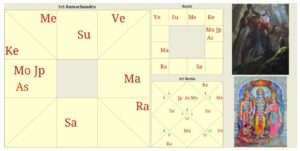
To understand the fulfillment of a high-level mission through struggle, we analyze the chart of Śrī Rāma, the Dharma Avatāra.
Primary Yogas and Manifestation
In this Karkaṭa Lagna chart, Guru and Candra conjoin in the Lagna, creating the Gajakeśarī and Mahālakṣmī Yogas, which Jaimini defines as combinations for “undying fame.”
The Path of Purposeful Suffering
The supreme Dharma-Karmādhipati Yoga is formed here by the relationship between Guru (9th lord) and Maṅgala (10th lord). Crucially, Maṅgala is the Yogakāraka for Karkaṭa Lagna. Because this Yoga occurs on the 1st and 7th house axis, it dictates that royal status (Rājayoga) would be achieved only after extreme hardship.
Planetary Execution
Śani in the 4th house: This was the specific cause of his 14-year exile in wild jungles.
Exalted Maṅgala in the 7th house: As the Yogakāraka, this exalted Maṅgala caused the “destruction of foes” (the defeat of Rāvaṇa), enabling the retrieval of his wife and his eventual return to rule Ayodhyā.
The synthesis of these placements reveals that even a “Divine” mission is subject to the timing of planetary cycles, requiring a period of profound exile before the destination of leadership is reached.
The final layer of understanding purpose is the concept of Argalā (Intervention). Every activity, ruled by a house called the Kāryabhāva, is subject to factors that either support or obstruct its manifestation.
Śubhārgalā (Beneficial Intervention): Caused by planets or signs in the 2nd, 4th, and 11th houses from the Kāryabhāva or its Kāraka. These represent the men, material, and money that support the purpose. (Note: Malefics in the 3rd house also cause Śubhārgalā).
Virodhārgalā (Obstruction): Caused by bodies in the 12th, 10th, and 3rd houses, which hinder the primary Argalās.
By analyzing the “net” strength of these interventions, we determine the actualization of one’s destiny.
The Three Pillars of Finding Purpose
- Alignment of Mind and Environment: Synchronizing internal perception (Vimśottarī/Phalita) with external messages (Nārāyaṇa/Padakrama).
- Activation of Yoga: Identifying the relationship between Dharma (9th) and Karma (10th) to unlock the potential for power and fortune.
- Refinement through Division: Navigating the harmonic cycles—specifically D10 for professional hierarchy, D24 for skill (Siddhi), and D60 for the heritage of past Karma.