Written by Dana Khanina, inspired by the teachings of Guruji Panit Sanjay Rath
mahate jyaiṣṭhyāya mahate jānarājyāyendrasya indriyāya ||
imam amuṣya putram amuṣyai putram asyai viśa eṣa vo ’mī rājā |
somo ’smākaṃ brāhmaṇānāṃ rājā ||
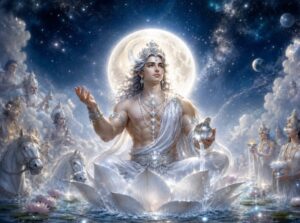
Candra is the king of a night sky. From the Sanskrit चन्द्र, meaning “shining,” “radiant,” or “luminous.”
He is also known as Soma, the divine nectar that bestows vitality, strength, and immortality. The ancient scriptures praise the power of Soma. The entire ninth Maṇḍala of the Ṛgveda is devoted to Soma, the sacred substance through which the Devas receive divine strength and immortality.
Puruṣa Sūkta of the Ṛgveda10.90.13:
मुखादिन्द्रश्चाग्निश्च प्राणाद्वायुरजायत ॥
mukhād indraś cāgniś ca prāṇād vāyur ajāyata ||
Indra and Agni were born from his mouth, Vāyu from his breath.”
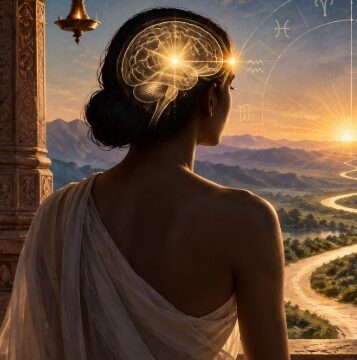
As the Moon himself emerged from the mind of Puruṣa, we find here one of the most important connections in Jyotiṣa: the connection between Candra and Manas. Candra is the overlord of Manas, and the mind is the king that rules our entire mundane life. It represents the four Kendras of Bhū-loka, through which our entire life is manifested. Bhū-loka corresponds to the Mūlādhāra Cakra, which has four petals—the four Kendras in Jyotiṣa and Kendras are the pillars of our life. They are Viṣṇu sthānas and Viṣṇu is the supporter of life.
As a manifestation of Viṣṇu, Candra (Soma) is also mentioned in the Śrīmad Bhāgavatam, where he is described as the son of Maharṣi Atri.
दत्तं दुर्वाससं सोममात्मेशब्रह्मसम्भवान् ॥ १५ ॥
jajñe suyaśasaḥ sutān
dattaṁ durvāsasaṁ somam
ātmeśa-brahma-sambhavān
Therefore, Candra is also called Ātreya, “the descendant of Atri,” or Atriputra, “the son of Atri.”
विप्रौषध्युडुगणानां ब्रह्मणा कल्पितः पतिः ॥ ३ ॥
somo ’mṛtamayaḥ kila
viprauṣadhy-uḍu-gaṇānāṁ
brahmaṇā kalpitaḥ patiḥ
The tears of Atri may refer to a cooling nature of the Moon, to a healing and soothing nature. The most important word here describing the Moon is “amṛtamaya” which brings us to the point that that Soma is connected to longevity, so Moon is connecting us to longevity.
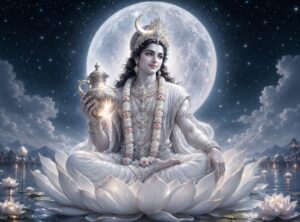 Soma is a drink of immortality in Vedic culture. Interesting that in biology, the soma is the central cell body (or perikaryon) of a neuron. It maintains the cell’s life and prepares it to send signals.
As Soma is related to survival and sustenence we can adress it to Mahādeva. Nobody can survive withuot that Soma of the Moon.
In Jyotiṣa, we say that the Moon has two phases: waxing and waning, which correspond to Śukla Pakṣa and Kṛṣṇa Pakṣa, respectively. In one Pakṣa soma is increasing and the other reduces it. The story of the curse of Candra by Bṛhaspati brings us to the concept of Karaṇa and specifically to 4 fixed (cursed) Karaṇas: Śakuni, Catuṣpāda, Nāga, and Kiṃstughna.They are starting from K14 (2 part) to S1 when Soma hides in the plants.
Tārā gave birth to Budha, which also shows that we have all been born from sin. This human birth is due to sins, which are like Amāvasyā and must at least be reduced during this lifetime. A cursed Karaṇa represents the heavy karma of past lives.
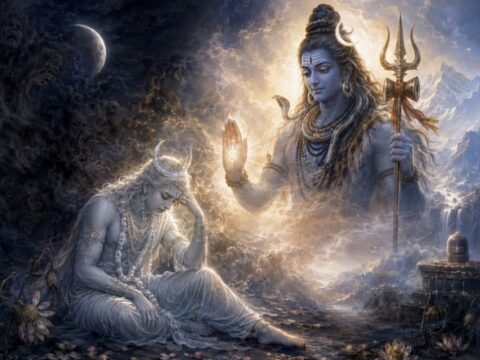
Every Tithi comprises 12 degrees, and there are two Karaṇas within it, each comprising 6 degrees. The first Karaṇa is the Divā Karaṇa, and the second is the Rātri Karaṇa. Karaṇa is karma. Candra worshipped Śiva at Somanātha for release from the curse, so we should also worship Śiva for release from our curse on K14, or Śivarātri.
ईशा॑नः सोम वि॒श्वत॑ः ॥
ईशानः सोम विश्वतः ॥
īśānaḥ soma viśvataḥ ||
6 syllable mantra removes the sins
Oṃ Namaḥ Śivāya
ॐ नमः शिवाय
Oṃ Īśānāya Namaḥ
ॐ ईशानाय नमः
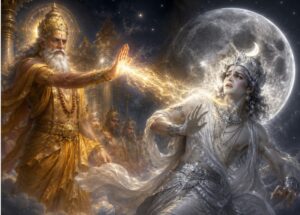 Here it is important to mention that these cursed tithi are about our actual birth. As manushya we are produced from Karka rashi, who’s Lord is Candra and this rasi represnts the manas. 3° Vṛṣabha falls in Kṛttikā nakṣatra, specifically Kṛttikā, 2nd pāda. From that nakṣatra human beings are coming with the most valuable gift of the rishis -powerful MIND. Gayatri mantra is associated with this nakṣatra hence its recitation is sharpening your mind.
ॐ भूर्भुवः स्वः तत्सवितुर्वरेण्यं भर्गो देवस्य धीमहि धियो यो नः प्रचोदयात् ॥
All cureses bring a blessing with them also. For starting a blessing we need Bṛhaspati and Savitur Gayatri.
बृहस्पतिं वरेण्यम् ॥
bṛhaspatiṁ vareṇyam ||
The Brahma Purāṇa, Chapter 7, gives a more elaborate version.
O Brahmins, the father of Soma, the saintly lord Atri was the mind-born son of Brahmā who was desirous of creating subjects.
Formerly, Atri performed a great penance for three thousand divine years. So we have heard.
His semen attaining the state of Soma juice rose up. Water exuded from his eyes in ten directions and illuminated the ten quarters.
The ten delighted goddesses of the quarters conceived that foetus. They held it collectively but they were unable to do so any longer.
When the ten quarters were unable to uphold the foetus, it fell down to the Earth along with them.
On seeing Soma fallen to the Earth, Brahmā, the grandfather of the worlds, made him ride in a chariot for the welfare of the worlds.
It continues confirming that the birth of Soma was for the nourishement and sustanence of the world.
The splendour of the refulgent Soma who was being eulogised, was spread all round for the nourishment of the worlds.
The Soma of excessive fame, circumambulated the ocean-girt Earth twenty-one times by means of that important chariot.
His splendour that exuded reached the Earth and turned into the medicinal herbs whereby the universe is sustained.
After Brahma Purāṇa describes that Soma performed penance for hundreed thousand billion years and that is how he got his reflugence and has become the ruler of plants and medical herbs, waters and Brahmins.
-
Lord Soma acquired refulgence through the eulogies and holy rites. The highly blessed lord performed penance for hundred thousand billion years.
Thereafter, O excellent sages, Brahmā, the foremost among those who know the Brahman, offered him kingdom of seeds, medicinal herbs, Brahmins and waters.
After acquiring that extensive realm, Soma, the most excellent of those who possess gentleness, performed the Rājasūya sacrifice with hundreds and thousands of gold pieces as sacrificial gifts.
O Brahmins, we have heard that Soma distributed the three worlds as gifts to those important Brahminical sages who had assembled there for sacrifice.
The Ṛtvik was Hiraṇyagarbha Brahmā, Atri and Bhṛgu Adhvaryus. Hari, together with many sages, was the participant.
Nine goddesses who served him—Sinivālī, Kuhū, Dyuti, Puṣṭi, Prabhā, Vasu, Kīrti, Dhṛti, Lakṣmī.
After the Avabhṛtha ablution, the overlord Moon, who was unexcited and who was worshipped by Devas and sages, shone excessively, illuminating the ten quarters.
The word “avabhṛtha” itself carries the sense of “carrying away” or “removing.” Symbolically, the bath washes away:
- ritual impurity;
- fatigue and tension accumulated during the Yajña;
- remaining defects or faults in the performance;
- the temporary ritual identity assumed by the sacrificer.
So Brahma Purana continues :”shone excessively, illuminating the ten quarters” – all ten directions. We can see the connection to D10 and karma.
Is there any secret meaning refering to the mind? Maybe. The words from Sri Caitanya –caritāmṛta come to the mind:
darśana-snāne kare jīvera mukati
bhāgīrathī hana sākṣāt jala-brahma-sama
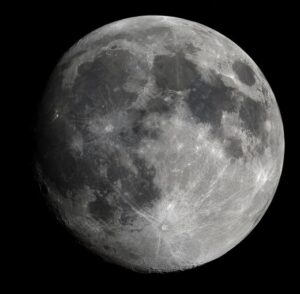 National geographic gives interetstingd facts: rather than originating from water, the Moon formed from ancient magma oceans. A catastrophic collision between the early Earth and a Mars-sized planet called Theia vaporized this molten rock. The ejected material trapped in orbit eventually clumped together to create the Moon.
All Grahas are karmic energies that have their own purpose and destination. The word Graha is connected with grahaṇa, which means something that seizes or eclipses.
Candra arose from the Kṣīrābdhi—the Ocean of Milk—during Samudra Manthana, the churning performed by the Devas and Asuras. This episode is associated with the Mahābhārata, Ādi Parva, Chapter 18, and the Viṣṇu Purāṇa 1.9.
Therefore, we can say that the Moon was born in Mīna Rāśi, as it appeared from the ocean.
Paṇḍit Sanjay Rath, in his book Bṛhat Nakṣatra, described the Janma Nakṣatras of the Grahas, as well as their Janma Tithis. It has been revealed that the Janma Nakṣatra of a Graha is a point of the greatest discomfort for that Graha. For the Moon, it is Citrā.
Citrā means “the Bright One,” “the Brilliant One,” or “the Beautiful and Variegated One.” The Sanskrit word citra also conveys the meanings wonderful, striking, colourful, artistic, and resembling a beautiful picture.The name reflects its principal star, Spica, one of the brightest stars near the ecliptic.
Spica, the brightest star in the constellation Virgo, serves as an important reference point in several systems of sidereal astrology. Tropical astrology begins its zodiac from the vernal equinox, a mathematical point that gradually shifts in relation to the fixed stars because of precession. Sidereal (Nirayana) astrology, by contrast, measures the zodiac against the stellar background.
In systems based on the Citrā Pakṣa ayanāṃśa, Spica—identified with Citrā Nakṣatra—is placed near 0° Tulā. This stellar position establishes the reference from which the sidereal zodiac is calculated. In the tropical zodiac (Sayana), however, Spica is currently located at approximately 24° Tulā. Thus, the difference between its tropical (Sayana) and sidereal (Nirayana) positions reflects the ayanāṃśa separating the two zodiacal frameworks.
From a metaphysical standpoint, Spica is traditionally connected with abundance, fertility, prosperity, and the fulfilment of potential. Its symbolism recalls the harvest, when sustained effort finally produces visible results. For this reason, the star is often associated with productivity, careful workmanship, discipline, and the ability to bring plans to completion. Its influence encourages purposeful action, precision, and integrity in the pursuit of one’s goals.
Spica is also understood as a source of spiritual illumination rather than merely material success. Its energy is associated with higher knowledge, intuitive perception, and the capacity to comprehend subtle or complex truths. Meditation and contemplative practices connected with Spica are believed to support clarity of vision and deeper inner awareness. In this sense, the star represents transformative insight—the kind of understanding that can guide a person toward spiritual maturity, self-knowledge, and a more profound relationship with the universe.
The Janma Nakṣatra shows the expansion of the Graha’s potential and influence for the spiritual growth of the individual, as well as the suffering connected with that Graha.
The Janma Tithi of the Moon is Kṛṣṇa Caturdaśī, and theft, fraud, and numerous upheavals are considered among its negative effects.
This information is used for understanding Graha-Janma-Tithi Doṣa. Refer to Chapter 8 of Bṛhat Nakṣatra by Paṇḍit Sanjay Rath for its application and a deeper understanding.
A Vrata, or fasting, on the appropriate Tithi removes the negative influence of the Grahas, and the mind is released from the problems caused by the Graha in the natal chart.
Unlike Tithi Doṣa, the Janma Nakṣatras of the Grahas act as combustion points for spiritual revelation. They also function at the level of the Tattvas and are not limited by Daśā or time.
As a remedy for Caturdaśī, the worship of Śiva is prescribed.
Candra is far more than a celestial body. As Soma, he nourishes plants, waters, the body, and the mind; as the Lord of Manas, he carries memory, emotion, karma, and the impressions of previous lives. His waxing and waning reveal the continuous movement between growth and decline, blessing and curse, bondage and release.
The teachings connected with Candra show that the mind can become the source of suffering, yet it can also become the path to spiritual illumination. Through Vrata, mantra, the Gāyatrī, and the worship of Śiva on Kṛṣṇa Caturdaśī, the burden of past karma may be reduced and the mind gradually purified. When Candra becomes peaceful, Manas becomes clear, and the light of Soma can once again nourish both worldly life and spiritual growth.
Candra is born from the mind of Puruṣa, which shows that the Moon represents Manas—the inner faculty of thought, memory, emotion, imagination, and reflection. Spiritually, this means that the mind is not merely a psychological instrument; it is a cosmic principle arising from the Universal Being. The individual mind is therefore a small reflection of the cosmic mind