Inspired by Rashi lessons, 2015 by Guruji Pt Sanjay Rath.
I offer this work at the lotus feet of my Guru. Whatever knowledge shines through these words is the grace of my Guru and the Rishis. Any mistakes in understanding or expression are entirely my own.
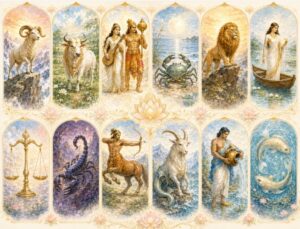 In the Vedic tradition, the twelve Rāśi are not merely markers on the wheel of the sky. They are, as Pandit Sanjay Rath teaches, a map of consciousness itself — a configuration of the mind and the heart through which every soul learns to meet the world. Each sign is a lens, a chamber of experience, through which our karma takes shape and our character finds its particular grain.
To study the Rāśi with sincerity is to study the self. The ram’s courage, the crab’s tenderness, the scales’ careful weighing — these are not decorations borrowed from nature. They are instructions. Pt. Rath reminds us that by watching how each creature actually behaves in the world, one begins to understand how a person born under that sign thinks, feels, and moves through life.
What follows is a walk through the twelve signs — not as astronomical divisions, but as twelve distinct teachings on how the soul learns to carry its karma with grace.
1. Aries (Meśa) — The Courage to Begin
Aries opens the wheel as the sign of the pioneer, symbolized by the ram. It carries the raw will to begin, the fire of initiative. Yet its deeper teaching is one of balance — the ram walking narrow mountain ledges, sure-footed even where the ground is treacherous. Aries asks us to temper headstrong impulse with steadiness, to let courage be guided rather than reckless, so that the first step of any journey is also a wise one.
2. Taurus (Vṛṣabha) — The Ground of Stability
Represented by the bull, Taurus is the seat of Sthira — fixedness, endurance, the patient accumulation of what is good. It is closely tied to the blessings of Shiva, and to prosperity earned not through haste but through steadfast devotion. Taurus teaches that abundance is a fruit of patience, and that the foundations we build slowly are the ones that hold.
3. Gemini (Mithuna) — Protection and Creation
Gemini is the sign of duality held in partnership — the pairing of protector and creator. It carries the presence of Hanuman, guardian and devotee, alongside Sarasvati, the goddess of art, music, and creative wisdom. Gemini’s teaching is that our closest relationships are the very ground on which we learn to defend what we cherish and to bring new things into being.
4. Cancer (Karka) — The Heart’s Capacity to Heal
The crab carries its home upon its own body, and Cancer is, correspondingly, the sign of the mother — deep feeling, emotional memory, and the quiet power to heal. Guruji notes its shadow side too: a tendency toward jealousy or the pull to diminish others rather than nurture them. Cancer’s lesson is to choose tenderness over comparison, to let the heart’s depth become a source of care rather than a wound.
5. Leo (Siṁha) — Sovereignty of the Self
Ruled by the lion, Leo speaks of territory, leadership, and the instinct to protect what is one’s own. Philosophically, it is a teaching in rightful sovereignty — not domination over others, but mastery over one’s own inner kingdom. To be a Leo is to learn what it means to rule wisely, beginning with the self.
6. Virgo (Kanyā) — The Discipline of Purity
Virgo is imaged as a lady upon a boat — untouched by the water she crosses. It is the sign of purity, celibacy in its truest sense, and meticulous cleanliness of both body and mind. Virgo teaches that clarity of consciousness is not accidental; it is cultivated, carefully, the way one keeps a boat from taking on water.
7. Libra (Tulā) — The Law of Balance
Symbolized by the scales, Libra governs trade, business, and the delicate art of relationship. Its wisdom lies in reciprocity: life asks us continually to weigh our own needs against the needs of others, and to find, again and again, the fair measure between them.
8. Scorpio (Vṛścika) — Facing the Hidden
Scorpio holds what is unseen — the hidden karmas carried from lives and moments we do not consciously recall. It is, by its nature, one of the harder signs to understand, precisely because its work is done in the dark. Scorpio’s teaching is one of courage of a different kind: the willingness to face one’s own shadow, and in understanding others’ hidden depths, to understand one’s own.
9. Sagittarius (Dhanura) — Between the Temple and the Battlefield
Sagittarius is dual in nature, standing between the library or temple of sacred study and the battlefield of struggle. Linked to the sage Vyāsa, it is the house most closely tied to the Guru and to the pursuit of dharma. Sagittarius teaches that life is a continual choice between the path of wisdom and the path of contest — and that true progress lies in choosing, again and again, to be a student of truth.
10. Capricorn (Makara) — The Ledger of Karma
Represented by the Makara, Capricorn is the record-keeper — patient, exacting, unmoved by excuse. It holds the account of every action and its consequence. Capricorn’s teaching is maturity: the willingness to accept responsibility for the past, and the discipline to work, deliberately, toward balancing the ledger.
11. Aquarius (Kumbha) — The Flow of the Heart
Aquarius governs the management of water — and, metaphorically, the circulation of feeling, especially matters close to the heart. Its teaching is that emotion, like water, must move. What is held too still turns stagnant, even harmful. Aquarius calls us to find healthy channels for love and feeling, so that they nourish rather than poison.
12. Pisces (Mīna) — The Freedom to Choose
Pisces closes the circle with two fish, one drawn toward material attachment, the other toward Mokṣa — spiritual liberation. It is the final and perhaps most tender teaching of the zodiac: that we are, in every moment, free to choose. The material world is not condemned, nor is the spiritual world guaranteed — the choice is perpetually ours to make.
Your configuration. The Lagna, or rising sign, shapes how the mind is configured to perceive the world. By observing the true nature of the animal or symbol tied to one’s sign — how it actually moves, protects, hungers, and rests — a person can come to understand their own instinctive patterns with far greater honesty than through reflection alone.
Awareness becomes choice. Pisces, the twelfth house, carries the zodiac’s most essential lesson: awareness itself is what allows choice. Until we see clearly where our energies are flowing — toward attachment or toward liberation — we cannot choose our direction. Once we see, the choice becomes ours to make.
The integration of head and heart. Ultimately, Guruji’s teaching returns to a single point of integration. The brain may chart the course, but it is the heart that keeps the purpose alive. A life lived only in the intellect is incomplete; a life is fulfilled only when wisdom and love move together.
The twelve Rāśi, then, are not a wheel we stand outside of — they are the very shape of the mind through which we meet our own becoming. To know one’s sign is to know the room in which the soul does its particular work.