
Written by Pushpanjali Bandyopadhyay
Guru and Guide: Pandit Sanjay Rath
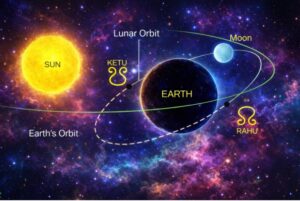 Eclipses occur when the Sun, Earth, and Moon align precisely along the same plane, the ecliptic, at the points called Rāhu and Ketu, the lunar nodes. Solar eclipses happen at Amāvasyā (New Moon) when the Moon passes directly between Earth and the Sun, blocking sunlight. Lunar eclipses happen during Pūrṇimā (Full Moon) when Earth comes between the Sun and Moon, casting its shadow on the Moon. These alignments only occur when the Moon is near one of its nodes (Rāhu or Ketu), because that’s where its orbit intersects the Earth’s orbital plane. Because the Moon’s orbit is tilted (~5°), these intersections slowly drift retrograde, completing a full cycle in approximately 18.6 years. But the Moon’s orbit is not stable — it wobbles due to gravitational forces (primarily the Sun). This wobble is the root of the Mean vs. True distinction.
True Node Position
The true node value gives the astronomical position at a given moment, that is including the Moon’s swaying motion. Although the value is usually retrograde, it also sometimes slows, stations, or briefly moves directly and therefore results in an irregular path due to oscillations.
The True Node calculation is meant to capture the dynamic, moment‑to‑moment astronomical reality, but causes difference in position of the nodes up to approximately 1.5°, which is enough to shift the nodes into a different nakṣatra pada and change divisional chart placements of the nodes.
Mean Node Calculation
The mean node value is a mathematically averaged position of the node that removes all short‑term oscillations. It is always retrograde and moves at a uniform rate (~3° per day). Therefore, they never are stations or go direct, instead they produce a smooth, predictable arc through the zodiac.
The Mean Node aligns with the rhythmic, averaged cosmic order assumed by classical predictive frameworks. This is why all classical siddhāntas (Sūrya Siddhānta, Āryabhaṭīya) rely on only the mean node computation. Parāśara, Varāhamihira, and all pre‑modern Jyotiṣis used the Mean Node. Therefore, those who follow a Jyotiṣa Paramparā, which is rooted in tradition, use the mean node calculation in prediction and analysis.

Beautiful – clear explanation to a question so many of us have had for many years! Thank you