Written by Sabrina Agapova, inspired by the teachings of Gurujī Paṇḍit Sanjay Rath
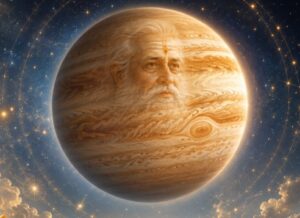 Guru gives knowledge and noble thoughts to everyone. Guru governs harmony and peace in the world. He bestows good fortune. He gives optimistic thoughts—thoughts connected with happiness and tranquility. Guru is the most tolerant Graha. He is like the heavens. The heavens are the ākāśa-tattva. There is a place for everyone in the heavens.
Guru is a very righteousGraha. He possesses many ethical and moral values. Whatever Graha or bhāva Guru touches, he imparts moral value to it.
For example, if Guru is with Sūrya, whatever the father may be like—even if he has a bad character—we will value the father; we will respect him. We will respect his role. We may not love his personality, but we can be righteous sons.
If Guru is with Mercury, we will not misuse money. Money will not become the main motive in our life.
If Guru is with Śukra, we will have moral values in relationships; we will have a sense of the value of relationships. We will not wish to deceive our partner, and even if we do so due to other combinations, we will feel guilt for it and will struggle with it internally.
In the Praśna Mārga, the sage Harihara says that wherever Guru is placed (in whatever sign and bhāva), it is a blessing of Lord Śiva—even if he is debilitated.
Guru is the teacher of all the devas. He is the greatest brāhmaṇa and the teacher of all the Vedas. He is the only one who knows the Lord, and for this reason his name is Pati, meaning “ruler.” We say that Śukra is a great benefic Graha for saṃsāra, but Guru is the most benefic Graha because he is not only favorable for saṃsāra but also for the soul. His guṇa is sattva. Therefore, he is not so good for rajas, passion, and enjoyment in the material world. Yet he will give you all the resources to live happily. Śukra will give you joy, but Guru will give peace, tranquility, and contentment. He will give you wisdom because he is the third eye of Śiva.
Guru has the largest magnetic field and attracts everyone in this saptaloka. This is the special quality of the ākāśa-tattva. Ākāśa-tattva unifies everything. Without the ākāśa-tattva, our body would fall apart.
In the human body, Guru governs fat. And fat is nothing but storage. When we place something into storage—that is Guru. When we stuff the fridge with food—that is Guru. When we put clothes into a wardrobe—that is Guru. When we put something away for safekeeping—that is Guru. So, your wallet, where you keep what is important to you (money), is also Guru. Therefore, you need a good wallet to store this energy of Guru. Even the color of the wallet matters (determined by the placement of Guru).
Guru is the dhana-kāraka—the kāraka for various kinds of wealth. Wealth is nothing but storage and accumulation. There are eight types of wealth. Any graha connected with Guru will indicate a particular kind of wealth. Different people have different conceptions of wealth. For a brāhmaṇa, wealth is knowledge (his dhana). Do not think of Guru only in terms of money.
Guru is responsible for value. In our tradition, we say that whatever Guru touches becomes valuable. Everything he touches turns to gold; he adds high moral values to everything. Wherever Guru is placed, he gives the native pure, good thoughts that are good for everyone—good intentions and good knowledge for all—because he governs knowledge in all spheres. Guru governs nobility. He gives the inner happiness that comes from the realization of knowledge. Śukra is a somewhat different happiness. “I bought a new car, and I am very excited inside.” But that feeling will last only for a while, and then it will go away. The peace and happiness that do not depend on any external objects—the inner happiness from knowledge, which never leaves—that is Guru. That is what is known as real sukha (happiness), which comes only through knowledge and spiritual realization.
So, the question of who is the greater benefactor—Śukra or Guru—is a matter of debate. But we know that for people in sattva, it is Guru.Most people prefer Śukra because that is rajas.
Guru is the chief priest in the planetary cabinet. He is also the counselor, for he gives counsel to Sūrya. If the president is number one in a state, his counselor is Guru. If the president is not number one (depending on the state), his counselor is Śukra, because number two is Candra, and Śukra gives counsel to Candra.
Guru is a masculine planet. He also governs physical strength. He is like an elephant.
Guru may be strong but may not be connected to the Lagna, which is what actually gives intellect. For example, Guru in the 4th house does not mean that you are intellectual. The mother may be intellectual. But for you to be intellectual, Guru must be connected to the Lagna.
Praśna Mārga says that Guru in any sign is God. In whatever bhāva or rāśi Guru is placed, in that bhāva you will see the blessing of God—at least once in your life. You will see good fortune and happiness in that bhāva or when that bhāva manifests in your life.
Suppose you have Guru in the 7th bhāva. You may not be fortunate or happy before marriage. The 7th house must manifest in your life. In the 5th house, your fortune and happiness will increase after the arrival of children. So, quickly activate the house where Guru is placed.
The dispositor of the house in which Guru is placed is the Guru-pati. The Lord of that house is none other than Śiva. This person is the best for you.
If Guru is in the 7th, the lord of the 7th—your partner—is Śiva.
If Guru is in the 9th, your Guru or father is your Śiva.
If Guru is in the 4th, your mother or friend can be like Śiva for you.
If Guru is in the 5th, the child can be like Śiva.
If Guru is in the 11th, then it is an elder sibling or friends. That is, among your friends you may find someone who can be like Śiva for you.
If Guru is in the 10th house, the boss is your Lord.
Never play with Guru and the Guru-pati. Do not cast these people out of your life, because a great blessing and good fortune come to you through them. Through these people, God speaks to you; these people are your telephone to God. Listen to these people because Guru is the best counselor. Even if they tell you something bad, it is the Lord speaking to you. Therefore, worship your Guru-pati.
If you have Guru in the 4th, the mother can give very valuable advice because the Lord will speak through her. If Guru is in the 4th house, it is called Mahānta Yoga. The person’s heart will be very pure. There is something very good in this person. The best planet for the 4th house is Guru.
Note Guru in the chart. Great fortune exists in whatever bhāva he is placed. Fortune will smile upon you in that bhāva when it manifests. The blessing of Śiva will come.
Do not delay that bhāva. Do everything to make that bhāva manifest.
If Guru is in the 7th—until you marry, you will not have good fortune.
Guru in the 10th—start working; otherwise, there will be no fortune.
Guru in the 11th—until you meet a friend, you will not have fortune; life will lack meaning.
Guru in the 2nd—engage with your family.
Guru in the 4th—change your house, make your home, and your fortune will begin.
Guru in the 5th or 9th (female chart)—have a child.
Guru in the 6th—start working; otherwise, fortune will not come.
Guru in the 12th—go abroad, begin meditating, or start visiting an ashram.
Guru is Bhagavān, Lord Śiva. His dṛṣṭi is known as triśūla dṛṣṭi. Where Guru sits in the chart, there sits God, Bhagavān. Guru gives pūrṇa dṛṣṭi to the 5th and 9th bhāvas from himself—the koṇas. That is, Guru is most interested in the koṇas, in knowledge and blessings. He is the only graha who has pūrṇa dṛṣṭi on the koṇas.
He gives 3 pāda dṛṣṭi to the 3rd and 10th houses (upacaya dṛṣṭi) because he is hardworking and very interested in growth. If you look from Guru at the 3rd and 10th houses, these houses will have 3-pāda dṛṣṭi from Guru.
Most people regard the 7th from Guru as pūrṇa dṛṣṭi, which is not correct. That dṛṣṭi has only 2 pādas.
Guru is the most benefic planet. He gives dṛṣṭi of only 1 pāda to the 4th and 8th from him. He does not protect himself but protects others. He is very poor in self-defense; he is divine and sacrificial. Caturaśraya dṛṣṭi is a selfish dṛṣṭi—“this is mine.”
Thus, you can see how benefic Guru is. He protects himself with only 1 pāda. This means he is not selfish because he protects others. Compare this with people (the dṛṣṭi of the inner grahas). Guru’s dṛṣṭi is a dṛṣṭi of values—values and a divine touch (grace).
We come back to them again. This is a source of good fortune. However, if we look at Guru’s Navāṃśa, it is an even stronger influence (than in the rāśi chart), because the navāṃśa is the karma of the past. It is fixed karma. These are the seeds that will sprout.
Dhanu Navāṃśa is Bhukta, which also means “fruit.” It is all bhoga (enjoyment, or rather the good things coming from the past; one can also use the word “prosperity”). It is the source of the nava-nidhi (the nine treasures). That is, Grahas in the Dhanu Navāṃśa promise wealth. If Śukra is there, then one of the partners (not necessarily the first marriage; it could be the second) will be a source of wealth. This is guaranteed because a seed has already been planted here. If Candra is here, then the family, mother, or the bhāva that Candra rules in the rāśi chart will indicate the source of wealth and good fortune.
However, the Dhanu Navāṃśa is also very strict and dharmic. Every graha here possesses knowledge. It is the sthiti-dhana-kāraka. Sṛṣṭi—creation; sthiti—maintenance; saṃhāra—destruction.
The Moon in Dhanu Navāṃśa may give a mother or an entire family that imposes many restrictions on you—but with a good purpose.
Mīna Navāṃśa is Svastha. To be healthy, relaxed, in one’s own sign—like being self-contented and peaceful. It gives stability. The Grahas here also give knowledge and skills—this is the blessing of Sarasvatī. You will be very happy with those grahas there.
Both Navāṃśas give wealth. If you have Guru here—who is the dhana-kāraka (kāraka of wealth)—it is guaranteed that you will always have some kind of income; you will never be poor. Mīna Navāṃśa always gives wealth and maintenance.
In a strī-jātaka, both of these Navāṃśas grant marriage. Any Graha in either Navāṃśa can make a girl marry. It gives a seed for marriage. So, in that Antardaśā there will be some kind of seed. Open your eyes and do not ignore this seed.
Guru’s position will show the level and subject of your knowledge. It will show what your values in life are and how lucky you are in life (sheer luck). It is the fortune coming from past good deeds (destiny), distinctly opposite to personal happiness and peace signified by the Moon. Every planet in conjunction with Guru will improve or ruin luck and will put its mark on the value system, for better or worse. For example, Rāhu in conjunction with Guru will definitely distort the value system, and a person becomes a “Cāṇḍāla,” or one who breaks moral and social laws. A person will have a wrong understanding of moral values and issues. This conjunction will also show periods of bad luck and sudden changes in fortune, and luck may go awry at any point in time. If Guru is conjoined with Maṅgala, then Maṅgala will protect the value system, and a person is very righteous. However, if Maṅgala is not well placed, such a position may show that fighting and conflicts can ruin luck or fortune, because the person will fight intensely for his own system of values and may feel that his own views are the only righteous views.
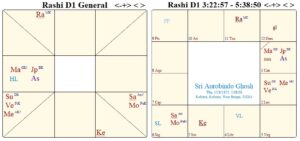
In this chart, exalted Guru is conjoined with debilitated Maṅgala (10th- and 5th-lord). Śrī Aurobindo was a freedom fighter against British rule. He had the bad fortune to be accused of murder and ended up in jail. However, that was a hidden spiritual blessing due to the exaltation of Guru as the 9th lord. Nevertheless, from the worldly viewpoint, there was bad fortune caused by Maṅgala (fighting), as explained in this principle.
On the other hand, Guru will add value to any Graha, and if Śukra is conjoined with Guru, a person can value and respect women or the wife. Each planet will also influence a person’s luck. Luck will definitely increase if that planet is well placed. For example, if Candra conjoins Guru, the mother or home (family) may be the source of good luck and happiness.
If Maṅgala is conjoined with Guru, younger siblings may be the source of good luck, while if Ketu is conjoined with Guru, a sādhu or tradition can be a source of good luck.
Sūrya conjoined with Guru makes the father or boss a source of good luck. However, Rāhu and Śani conjoined with Guru may ruin good luck by giving shocks (Rāhu) or disease, poverty, or death (Śani).
Guru is a very important Graha, and he is the Kāraka for four bhāvas in the chart (2, 5, 9, and 11).
Influences on Guru, as well as his position, will also reveal the knowledge we have. Guru in his own sign or exalted may give broad knowledge and mastery of one subject, while Guru conjoined with Budha gives mastery of languages, lecturing, finance, etc.
If Guru is alone, study the sign/bhāva. Guru with Śani may give knowledge of disease (the subject indicated by Śani). However, this is a broad example, and the exact area of education/learning should be studied through the vidyā-bhāvas and vidyā-varga (D24). Vidyā here indicates learning/training, which can be understood as formal education in modern society.
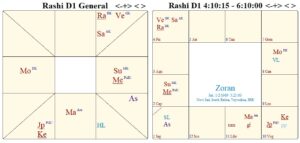
In this chart, Ketu is conjoined with Guru (R) in the 10th house. He got immense fortune through the boss of tradition (Paramparā). His boss is his Lord. His boss is Sanjay Rath. This combination is formed by LL Guru and the 4th- and 12th-lord Ketu in the 10th house. Lagneśa in the 10th bhāva is Siddhi Yoga. Through foreign (12L) vidyā (4L), with the blessing of his boss, he will achieve knowledge, skill, and success in his work.
शरीरं सुरूपं तथा वा कलत्रं
यशश्चारु चित्रं धनं मेरुतुल्यम् ।
मनश्चेन्न लग्नं गुरोरङ्घ्रिपद्मे
ततः किं ततः किं ततः किं ततः किम् ॥ १॥
śarīraṃ surūpaṃ tathā vā kalatraṃ
yaśaścāru citraṃ dhanaṃ merutulyam
manaścenna lagnaṃ guroraṅghripadme
tataḥ kiṃ tataḥ kiṃ tataḥ kiṃ tataḥ kim
English translation:
One may have a beautiful body, a lovely spouse, excellent fame, and wealth as vast as Mount Meru; but if the mind is not attached to the lotus feet of the Guru, what is the use? What is the use?
कलत्रं धनं पुत्रपौत्रादि सर्वं
गृहं बान्धवाः सर्वमेतद्धि जातम् ।
मनश्चेन्न लग्नं गुरोरङ्घ्रिपद्मे
ततः किं ततः किं ततः किं ततः किम् ॥ २॥
kalatraṃ dhanaṃ putrapautrādi sarvaṃ
gṛhaṃ bāndhavāḥ sarvametaddhi jātam
manaścenna lagnaṃ guroraṅghripadme
tataḥ kiṃ tataḥ kiṃ tataḥ kiṃ tataḥ kim
English translation:
Wife, wealth, sons, grandsons, house, and all relatives—one may have all these; but if the mind is not attached to the lotus feet of the Guru, what is the use? What is the use?
षडङ्गादिवेदो मुखे शास्त्रविद्या
कवित्वादि गद्यं सुपद्यं करोति ।
मनश्चेन्न लग्नं गुरोरङ्घ्रिपद्मे
ततः किं ततः किं ततः किं ततः किम् ॥ ३॥
ṣaḍaṅgādivedo mukhe śāstravidyā
kavitvādi gadyaṃ supadyaṃ karoti
manaścenna lagnaṃ guroraṅghripadme
tataḥ kiṃ tataḥ kiṃ tataḥ kiṃ tataḥ kim
English translation:
Even if the Vedas with their six limbs and the knowledge of all scriptures are on one’s lips, and one can compose excellent prose and poetry; but if the mind is not attached to the lotus feet of the Guru, what is the use? What is the use?
विदेशेषु मान्यः स्वदेशेषु धन्यः
सदाचारवृत्तेषु मत्तो न चान्यः ।
मनश्चेन्न लग्नं गुरोरङ्घ्रिपद्मे
ततः किं ततः किं ततः किं ततः किम् ॥ ४॥
videśeṣu mānyaḥ svadeśeṣu dhanyaḥ
sadācāravṛtteṣu matto na cānyaḥ
manaścenna lagnaṃ guroraṅghripadme
tataḥ kiṃ tataḥ kiṃ tataḥ kiṃ tataḥ kim
English translation:
One may be honored in foreign lands, blessed in one’s own country, and peerless in righteous conduct; but if the mind is not attached to the lotus feet of the Guru, what is the use? What is the use?
क्षमामण्डले भूपभूपालवृन्दैः
सदा सेवितं यस्य पादारविन्दम् ।
मनश्चेन्न लग्नं गुरोरङ्घ्रिपद्मे
ततः किं ततः किं ततः किं ततः किम् ॥ ५॥
kṣamāmaṇḍale bhūpabhūpālavṛndaiḥ
sadā sevitaṃ yasya pādāravindam
manaścenna lagnaṃ guroraṅghripadme
tataḥ kiṃ tataḥ kiṃ tataḥ kiṃ tataḥ kim
English translation:
One’s lotus feet may be constantly served by kings and emperors of the entire earth; but if the mind is not attached to the lotus feet of the Guru, what is the use? What is the use?
यशो मे गतं दिक्षु दानप्रतापा-
ज्जगद्वस्तु सर्वं करे यत्प्रसादात् ।
मनश्चेन्न लग्नं गुरोरङ्घ्रिपद्मे
ततः किं ततः किं ततः किं ततः किम् ॥ ६॥
yaśo me gataṃ dikṣu dānapratāpāj-
jagadvastu sarvaṃ kare yatprasādāt
manaścenna lagnaṃ guroraṅghripadme
tataḥ kiṃ tataḥ kiṃ tataḥ kiṃ tataḥ kim
English translation:
My fame has spread in all directions through generosity and prowess, and everything in this world is in my hands by grace; but if the mind is not attached to the lotus feet of the Guru, what is the use? What is the use?
न भोगे न योगे न वा वाजिराजौ
न कान्तामुखे नैव वित्तेषु चित्तम् ।
मनश्चेन्न लग्नं गुरोरङ्घ्रिपद्मे
ततः किं ततः किं ततः किं ततः किम् ॥ ७॥
na bhoge na yoge na vā vājirājau
na kāntāmukhe naiva vitteṣu cittam
manaścenna lagnaṃ guroraṅghripadme
tataḥ kiṃ tataḥ kiṃ tataḥ kiṃ tataḥ kim
English translation:
The mind is not drawn to pleasures, nor to yoga, nor to kings and horses, nor to the face of the beloved, nor to wealth; but if it is not attached to the lotus feet of the Guru, what is the use? What is the use?
अरण्ये न वा स्वस्य गेहे न कार्ये
न देहे मनो वर्तते मे त्वनर्घ्ये ।
मनश्चेन्न लग्नं गुरोरङ्घ्रिपद्मे
ततः किं ततः किं ततः किं ततः किम् ॥ ८॥
araṇye na vā svasya gehe na kārye
na dehe mano vartate me tvanarghye
manaścenna lagnaṃ guroraṅghripadme
tataḥ kiṃ tataḥ kiṃ tataḥ kiṃ tataḥ kim
English translation:
My mind dwells neither in the forest, nor in my own home, nor in work, nor in the body, nor in priceless things; but if it is not attached to the lotus feet of the Guru, what is the use? What is the use?
फलश्रुति (Fruit of Recitation):
गुरोरष्टकं यः पठेत्पुण्यदेही
यतिर्भूपतिर्ब्रह्मचारी च गेही ।
लभेद्वाञ्छितार्थं पदं ब्रह्मसंज्ञं
गुरोरुक्तवाक्ये मनो यस्य लग्नम् ॥
guroraṣṭakaṃ yaḥ paṭhet puṇyadehī
yatir bhūpatir brahmacārī ca gehī
labhed vāñchitārthaṃ padaṃ brahmasaṃjñaṃ
guroruktavākye mano yasya lagnam
English translation of the fruit:
Whoever recites this Gurvaṣṭakam—be it a saint, a king, a celibate student, or a householder endowed with merit—if their mind is fixed on the words of the Guru, they obtain all desired goals and attain the state of Brahman.
Om tat sat