Om Gurave Namah
Written by Dana Khanina, inspired by the COVA teachings of Guruji Pandit Sanjay Rath. All mistakes are mine, all knowledge belongs to the Guru.
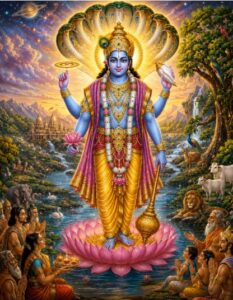 Marriage is one of the central themes of human life. Yet in Kali Yuga, people have forgotten that the true foundation of marriage is Dharma. It is Dharma—not mutual attraction or physical chemistry—that sustains a marriage. Attraction can play a cruel trick and may even become the first warning sign that a marriage will not last.
Because of this substitution of values, society’s attitude toward marriage has become deeply troubling. Women increasingly refuse to marry and create families, while men avoid taking responsibility for the family and move further away from traditional values.
In Vedic astrology, marriage is studied through the Navāṃśa chart. Why specifically the Navāṃśa? The Navāṃśa is a divisional chart connected with the ninth house of the Rāśi chart and serves as a kind of magnifying glass for that house. In Jyotiṣa, the ninth house is known as Dharma Bhāva. As the name suggests, it represents a person’s Dharma and Bhāgya.
Dharma is often understood as law, usage, practice, custom, ordinance, statute, religious or moral merit, virtue, and righteousness. Dharma is also mentioned as one of the epithets of Viṣṇu.
In simplified terms, Bhāgya means good fortune—the portion of past-life merit that we have earned through our actions. It determines the degree of fortune we experience in this life.
Thus, we may conclude that Maharṣi Parāśara, by instructing us to study the Navāṃśa in order to understand marriage, points to Dharma as its true foundation.
The result of any house is seen through the eleventh house from it. The seventh house is the house of the spouse. That which is opposite to us is situated directly across from us. The seventh house is also the heart—the one to whom we give our heart.
Being the eleventh house from the ninth, the seventh house is an upacaya, a house of growth. Therefore, marriage was originally intended to contribute to the growth and strengthening of Dharma. Paṇḍit Sanjay Rath mentions in COVA: “For this reason, at a Vedic wedding, the bridegroom, as the family’s son-in-law, is honored as Viṣṇu, because his arrival in the bride’s family leads to an increase in Dharma.”
Now, the result of every marriage shall be seen in the 11th bhāva from the 7th, and it is the 5th bhāva—it means that the result of every marriage is the birth of a child.
In Vedic tradition a son is considered as a true wealth. First of all, son/putra is considered as continuation of this life and lineage.
Aitareya Upaniṣad 2.3
आत्मानमेव तद् भावयति एषां लोकानां सन्तत्यै ।
एवं सन्तता हीमे लोकाः ॥
sa yat kumāraṃ janmano ’gre ’dhi bhāvayati
ātmānam eva tad bhāvayaty eṣāṃ lokānāṃ santatyai |
evaṃ santatā hīme lokāḥ ||
“When a person nourishes the child, he thereby nourishes his own self,
for the continuation of these worlds. For through such continuity,
these worlds continue.”
Manusmṛti adds a very important point to that:
Manusmṛti 9.137–138
अथ पुत्रस्य पौत्रेण ब्रध्नस्याप्नोति विष्टपम् ॥पुन्नाम्नो नरकाद् यस्मात् त्रायते पितरं सुतः ।
तस्मात् पुत्र इति प्रोक्तः स्वयमेव स्वयंभुवा ॥
putreṇa lokāñ jayati pautreṇānantyam aśnute |
atha putrasya pautreṇa bradhnasyāpnoti viṣṭapam ||puṃnāmno narakād yasmāt trāyate pitaraṃ sutaḥ |
tasmāt putra iti proktaḥ svayam eva svayaṃbhuvā ||
“Through a son one conquers the worlds; through a grandson one attains continuity;
and through the grandson of one’s son one reaches the realm of the sun.Because the son is said to rescue his father from the condition called Put,he is called putra.”
Hence, Vedic tradition considers putra the one who, by living a dhārmic life and performing the last rites of the father in a proper way, may cause even his mukti and be a blessing for any lineage. Manusmṛti 9.130 adds: “As the son is one’s own self, so the daughter is equal to the son.” The subsequent verses also state that there is no dhārmic difference between a son’s son and a daughter’s son in their capacity to continue the lineage and make ancestral offerings.
Grahas in the 5th bhāva have a tendency to cause a “forced marriage,” as children force people to marry. Sometimes marriage is the wish of the soul of a child to come, and that soul has the capacity to make the parents meet. We also consider this influence to give an arranged marriage, as in many traditional Hindu families.
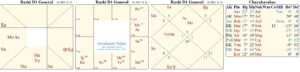
As you can see in J. Nehru’s example, Sūrya is in the 5th bhāva, casting rāśi dṛṣṭi on the 7th bhāva. Jawaharlal Nehru’s marriage to Kamala Kaul was arranged by their families. They married in Delhi on 8 February 1916. Jawaharlal was twenty-six; Kamala was approximately sixteen or seventeen. Sūrya is his 2nd Lord, so the family, kula, arranged the marriage.
So, we have understood what creates marriage, and now, if everything has an end, what is the end of marriage? Every 12th bhāva is loss. So, the loss of Dharma is the 8th bhāva; hence, grahas, especially malefics in the 8th bhāva, can cause the marriage to break. Loss of Dharma and trust—the 12th bhāva is also about faith and trust—will cause vivāha to break. The 8th is also māraka, the 2nd bhāva from the 7th house.
When one says Dharma, the picture that arises in the mind is of Śrī Rāma, the Avatāra connected to Sūrya. Sūrya is the graha that represents Dharma, and the one eclipsing it is Rāhu; hence, it is adharma. So, we can say that Sūrya is never bad for marriage. It rules the seasons; it is a graha having power over rajas, being able to control the rajas of Śukra and Budha and performing the job of Brahmā in Bhū-loka, representing the creator. But Rāhu will cause a lot of doubts, shocks, and lies. So, the influence of Sūrya on Upapada Lagna, though it is a krūra graha, is good. Sūrya is the one-wife-husband principle. It is like Śrī Rāma—one wife for the whole life. Rāhu is a widow, so it can cause the breakage of marriage/widowhood.
Whenever we want to understand the influence of grahas on marriage, we should look at them from two sides—whether they are friendly and supportive to Sūrya, representing Dharma, and what they are kārakas for.
For example, in the case of Maṅgala, though it is a friendly graha to Sūrya, Maṅgala is also a kāraka of the 6th bhāva—brahmacarya. He is a soldier who is far from home for many months. Guruji Paṇḍit Sanjay Rath also mentioned: “Thus, Maṅgala [Mars] is described as the cause of the first fault, or doṣa, in his role as the kāraka [significator] of natural procreation.”
If we speak of Śukra, it is vīrya; it is the kāraka supporting marriages and the birth of children. Śukra Acchādana is the 5th bhāva from itself, indicating children. Śani is inimical to Sūrya and is the kāraka of the 8th bhāva, which represents the loss of Dharma and marriage. In that manner, you may think about whether the graha is supportive or not in marriage matters.
Indeed, Guru is a very dhārmic graha, so it will always support marriage and Dharma and will be interested in giving children, as it is a kāraka for Putra Bhāva, the 5th bhāva. Candra is interested in having babies, so, for sure, it will be on Sūrya and Guru’s side.
Budha, instead, was born from Candra and Tārā in an adhārmic way, outside marriage, so we can say that he is really not good in matters of marriage.
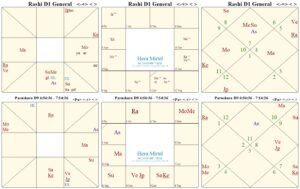
So, let us examine the chart of Héra Mirtel. If you have a look at her Navāṃśa, you will see that the 7th bhāva is empty, and there is exalted Śani and Ketu in the 9th bhāva, aspected by Rāhu, the Lagna Lord. Ketu is in parivartana with Śukra, the 10th Lord. Śani and Ketu are together, forming Turagādi Yoga, bringing affliction to Dharma as well as Upapada Lagna. Ketu is the Lord of UL, and it is in parivartana with Śukra. Śani casts graha dṛṣṭi on Sūrya, the 7th Lord, and Rāhu also casts its dṛṣṭi on Sūrya, creating an eclipse combination. Sūrya is in the 2nd house from UL, which, with both malefic aspects, will cause the marriage to break through both Vāyu grahas. We can expect a 100% fall in Dharma in that chart.
She was accused of killing her 2nd spouse, and the 1st one was claimed to have committed suicide. Now, if we look carefully at the chart, Ketu is in parivartana with Śukra, coming to the 2nd Lord Jupiter, and Maṅgala casts rāśi dṛṣṭi on that Jupiter. Moreover, they both cast dṛṣṭi on the 6th bhāva. Not only can we expect a fall in Dharma, but also, by the rule, if Maṅgala and Ketu conjoin or aspect the 2nd or 6th bhāva, the native kills the spouse.
Héra Mirtel’s second husband was Georges Weissmann-Bessarabo, also known as Georges Bessarabo. He disappeared in the summer of 1920. On 4 August, police found his body inside a trunk at Nancy railway station. He had been shot in the head, and the trunk had been sent by train from Paris. Investigators traced it to Héra Mirtel and her daughter Paule. Héra Mirtel claimed that Georges Bessarabo had squandered money belonging to her and her daughters. Shortly before his death, they allegedly argued over a large commission—reportedly connected with the sale of property or business interests in Mexico—which she believed he owed her.
You see how dangerous adharma can be.
Now one more rule that can shows fall in morals is that if “Chandra and Budha are placed in mutual trines in the Navamsha, there may be moral decline or a violation of marital vows”. So, one should carefully examine the Navāṃśa to understand the results.
As we have gone through very dirty case we shall move to a very spiritual and Dharmic personality.
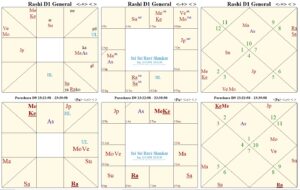
In the chart of Śrī Śrī Ravi Shankar, the 9th bhāva has Sūrya in Dhanu, which is a very strong Sūrya, being the 5th Lord in the 9th bhāva. It receives rāśi dṛṣṭi from Rāhu in aush debility, and Guru from its own sign, Mīna, casts dṛṣṭi. This combination is Dakṣiṇāmūrti Yoga. Dakṣiṇāmūrti represents the supreme cosmic-guru aspect of Lord Śiva, embodying wisdom, meditation, and the ultimate mastery of yoga. Sūrya is his Ātmakāraka, so this bhāva is Kārakāṃśa itself.
Marriage matters are troubled: the 7th bhāva is under Pāpa Kartarī Yoga of Śani and Rāhu in aush debility, aspected by Maṅgala, representing brahmacarya. The 4th Lord, Candra, is in Upapada but in dig-kṣīṇa—zero digbala, in other words—with the kāraka of marriage, Śukra whish is also in dig-kṣīṇa The person is in no way interested in marriage and creating a home; Guru is in the 12th bhāva—priest. From childhood, Gurudev said that a lot of people were waiting for him. So, there was no chance for marriage. Instead, Dharma is extremely strong. The 9th bhāva is the whole world and our job that we are supposed to do in the world according to our Dharma. And look what a powerful combination arises there.
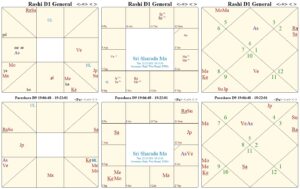
Next, we shall examine Śrī Śāradā Mā’s example. In the Navāṃśa, the 7th bhāva contains retrograde Śani in its own sign and is aspected by Maṅgala—an extremely pure marriage. Śukra, bringing the result to the Lagna, confirms that her spouse will be a very spiritual person (Śani in tattva is like a Guru, some sādhu type). It is in mutual aspect with Śani, so usually people with such combination will not believe in love and marriage. Śani is an old man as Graha. Why would he like to marry?
The 9th bhāva is ruled by Maṅgala, who is sitting in the opposite rāśi and is under the dṛṣṭi of Śukra and Śani, so the spouse is influencing her Dharma. How interesting.
After Ramakrishna’s death in 1886, she became the main spiritual guide and leader of the emerging Ramakrishna monastic order, giving spiritual initiation to thousands of people. Having no biological children, she became the spiritual mother to all of Ramakrishna’s followers. She cooked for them daily, cared for their health, and managed the household.
In conclusion, marriage in Jyotiṣa is not merely a union based on attraction, but a path through which Dharma, family continuity, and spiritual responsibility are fulfilled. The Navāṃśa, the 7th and 9th bhāvas, Upapada Lagna, and the influence of the grahas reveal whether marriage supports or weakens Dharma. When Dharma, trust, and responsibility are strong, marriage becomes a source of growth, children, and continuity of the lineage; when adharma prevails, the bond becomes vulnerable to conflict, separation, and decline which can result in terrible crime and loosing your own life path.
Written by Dana Khanina, inspired by the COVA teachings teachings of Guruji Pandit Sanjay Rath. All mistakes are mine, all knowledge belong to the Guru.
OM TAT SAT
Om Shanti, Shanti, Shanti