Written by Dana Khanina on the bases of the teachings of Guru and Guide: Pandit Sanjay Rath
I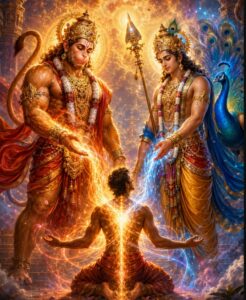 n recent years, the teaching of ācchādana has become more widely known because certain principles preserved in the oral tradition of Kaliṅga have been shared for the benefit of society. This knowledge is connected with the lineage of Maharṣi Kapila, whose sacred land is also associated with the tradition of our Guru.
Knowledge received from a Ṛṣi is not merely intellectual information. It is a form of ṛṣi-prasāda, the grace or gift of the seer. When such knowledge is received with humility and applied correctly, it can transform one’s understanding of life and help one live with greater awareness, protection, and purpose.
What does Ācchādana mean
The Sanskrit word ācchādana (आच्छादन) may convey several related meanings:
- covering or concealment;
- a protective covering or sheath;
- clothing or a garment;
- a mantle or cloak;
- disappearance through being covered;
- the wooden framework of a roof;
- a sheet or bed covering.
At first, these meanings may appear unrelated to Jyotiṣa. Why should clothing, a roof, or a covering have anything to do with the influence of a Graha?
The connection becomes clear when we consider their purpose.
Why do human beings wear clothes? Clothes cover and protect the body. Why does a house need a roof? The roof shelters and protects those who live beneath it.
Thus, the essential meaning of ācchādana is not simply “clothing.” It is protective covering
For this reason, ācchādana should not be understood as an ordinary planetary aspect. The expression ācchādana dṛṣṭi may have been adopted because the word dṛṣṭi, “sight” or “aspect,” is already familiar to students of Jyotiṣa. Yet ācchādana is more accurately understood as a Graha extending its protective covering over another point in the horoscope.
It is an auspicious gift arising from hṛdaya, the heart. The Graha protects because it possesses an inward impulse to bestow something that belongs to its own nature.
Although the Lagneśa, the lord of the Ascendant, represents the intelligence and wisdom of the native, every Graha signifies a particular form of intelligence.
A human being may therefore be compared symbolically to a ten-headed being: the Navagrahas together with the Lagna form ten distinct centers of awareness. Each “head” perceives life differently and carries its own form of knowledge.
Every Graha should be understood as a conscious representative of divine order. A Graha is not an independent or accidental force. It is a servant of the Divine and a kāraka, an instrument through which destiny becomes manifest.
Each Graha establishes a particular relationship with the Lagna and influences the intelligence represented by it. In simplified terms, the Grahas affect our dhī—our power of understanding, discernment, and inner intelligence.
Within this framework, Lagna may be contemplated as pure dhī.
- Lagna as the meeting of sky father and earth mother. Astronomically, Lagna is the point of the zodiac rising on the eastern horizon at the moment of birth. It has no physical body of its own. It is the meeting point of the sky above and the earth below. Symbolically, the sky is the father and the earth is the mother. Their meeting at the eastern horizon may be contemplated as the union of Śiva and Pārvatī. In this sense, Lagna resembles a Śivaliṅga, the sign through which the creative union of consciousness and nature becomes manifest.That is why, according to Parāśara, any planet in the Lagna must be worshiped.
So this Lagna is what created you, this Prasava Kāraṇa Devatā, Savitur who gave you a gift of intelligence. Dhi is something permanent in us, the one thing that should not change. Thus, rāśi dṛṣṭi representing permanent things not like Icchā (desire), graha dṛṣṭi, of the Graha impacts the Lagna.Same principle we use for all the Grahas as we can have horoscope drawn from Ve taken as Lagna or Mangal or any other Graha. So this is how all these heads are functioning.The various Graha-Lagnas are therefore like different heads or channels through which a person interacts with the world.Now we are coming to Ācchādana.
Now we understood that Ācchādana is an auspicious gift of 6 grahas (from Su to Ve, excluding Sa, who is fond of giving sorrow – nobody wants such a gift).
We also came to a conclusion that each graha has a Lagna. Each graha is a hand of God, a kāraka. What is kāraka? We can define it in another word than hand of God; we can say Destiny instead.
This graha lagna is the bridge in interaction between us and society. So, for marriage, you will need Śukra lagna, for war – Maṅgala, for karma – Budha and so on. So it’s an activation of the graha in some rāśi for some activity.
Let’s just remind the rule from tradition for finding Ācchādana of the graha.
Place Su in the 7th house and, using the Maṇḍūka jump (3 steps from the graha), put the planets in vāra order: Su-Mo-Ma-Me-Ju-Ve (Sa we exclude).
So you will get Su in 7th, Mo in 9th, Maṅgala in 11th and so on. That’s the easiest way to remember it, that has been taught from tradition.
You will ask, what about the nodes? Easy: you don’t want Rāhu’s desire – it might be bad. For Ketu – he is a mokṣa kāraka, he can’t have any desire.
One more important thing to remember: as the hand of God, a graha does not need a special daśā to give something to you.
So we’ve got to know how to identify ācchādana drishti of the Graha and found out that Mangal has it in 11th bhava from itself. This ācchādana dṛṣṭi should not be confused with the standard Parāśari special aspects of Maṅgala—the fourth and eighth graha dṛṣṭis.
So, any graha in 11th bhāva is given a gift of Mangal. And what is this gift about? Mangala is a warrior, what can this warrior give you as a present?
According to Parāśara 11th bhāva is called Lābha – income. Lābha (लाभ) means gain, profit, benefit, acquisition, or attainment. But is it a material profit we are talking here? Can I also use it for my sadhana? Can I use it for tapas?
Which profit Mangal can give as a warrior? He is a very strong Graha, auspicious. It’s Agni tattva planet and we know that Agni has two parts to it – one is Sūrya, which is the light and one is Mangal, which is the fire, energy. What do we need the energy for? For strength. We are not strong if we don’t have an energy. We can’t do anything in life without energy. Without energy you are not energized to open the eyes, śava and spend your whole life in śavāsana.
In other words, Maṅgala gives you what it possesses—bala, or strength. As a kāraka, it represents the strength of Kālapuruṣa..
Now we need to understand that Bala can be used for material purpose as well as spiritual purpose.
Mangala is Sura, he is following the Sun and Sun is not only about creation, it’s the Kāraka for spirituality. So we come to a point that from sansara point of view Mangal is a dire malefic. But what about spiritual purposes? It’s the next best benefic in this case after Guru.
Sun is a soul, it gives direction to a soul, Moon is the mind – it gives direction to the mind to obtain happiness. What is Mars?
Ma is Bala, strength as we already found out. He rules this whole Bhu-Loka. He Lords Aries – the sign which represents royal power, authority, position, fame. You should not forget that it is a part of the body also which is getting empowered by Mangal.
If this gift is beyond the Daśā, so how can we activate it? How can we get it?
When you hear Mangal – what is the first Devatā which is coming to your mind? Hanuman, Kartikeya – these are all the aspects of Mangala. Worship them and Mangala Ācchādana will get activated.
Let us examine some examples to understand how this principle works in practice in a chart
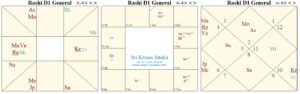
Traditionally in Parampara every study must be done from the chart of Śrī Kṛṣṇa.
Let us look at his Mangal. Mangal is in the 3d bhava and 11th from there is Lagna with the Moon. Shukra is the Lagna Lord. So what is protected? Vrishabha is protected and Chandra in Vrishabha is also protected. So can we say that Śrī Kṛṣṇa will protect women?
Ve, the Lord of Vrishabha is attacked by Ra, so for sure Śrī Kṛṣṇa will come to protect this Ve. Who is Rahu? Does Ra represent Rakshasas or demons? For shure we can say this Ma will fight Rahu and here Ra can’t do kuja stambhana on Mangal (it simply means take out all his fire).
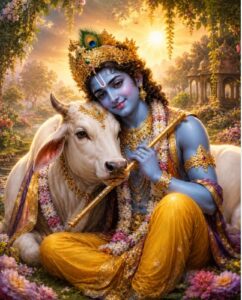
It is a promiss of Śrī Kṛṣṇa to protect this Ve and Mo. So if you are a woman and need protection – pray to Krishna. Mangal never breaks his word.
Now we shall see another interesting example of Hanuman Jataka.
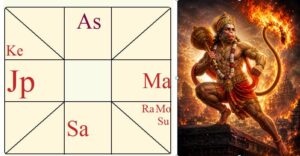 Hanuman is Meṣa Lagna, and Maṅgala is exalted in the tenth bhāva. What can we say about this placement? There is an immense fire in the tenth bhāva. Most people would say, “Fantastic! Maṅgala in the tenth bhāva possesses digbala.”
It is also the Lagna lord placed in the tenth bhāva, forming a siddhi-yoga.
Hanuman possessed the Aṣṭa-siddhis:
- Aṇimā — the power to become extremely small.
- Mahimā — the power to become immense or infinitely large.
- Laghimā — the power to become extremely light.
- Garimā — the power to become extremely heavy.
- Prāpti — the power to reach or obtain anything.
- Prākāmya — the power to fulfil any desire or accomplish whatever one wills.
- Īśitva — lordship or mastery over nature and its forces.
- Vaśitva — the power to control or bring beings and forces under one’s influence.
The Hanumān Cālīsā calls him “Aṣṭa-siddhi nava-nidhi ke dātā”—the bestower of the eight siddhis and the nine treasures—and states that Jānakī, or Sītā, granted him this boon. Thus, Hanuman is traditionally understood not only to possess these powers but also to be capable of bestowing them.
However, according to Maharṣi Kapila, Maṅgala is a tāmasika graha. Here, Maṅgala is extremely strong. You will not work with Ma in 10th house. Mangal tends to destroy 12th bhāva from it’s position.
Therefore, before Hanumān met Śrī Rāma and attained Self-realization, his life must have been very different.
Now, returning to ācchādana dṛṣṭi: Maṅgala is placed in the tenth bhāva, so its ācchādana dṛṣṭi falls upon the eighth bhāva. No Graha is placed there, and the eighth bhāva is Vṛścika rāśi. How interesting: Mangal here puts ācchādana to Vṛścika upon it’s svakshetra which is co-Lorded by Ke. Just like Śrī Rāma
What does this mean?
- exceptional endurance and survival power;
- protection during danger or crisis;
- the ability to overcome profound transformations>> self-realisation
- hidden strength and mastery of secret knowledge;
- power connected with the mysteries of life, death and regeneration.
The eight protective forms of Hanumān are traditionally known as the Aṣṭa Mahāvīras, the guardians of Purī-dhāma. For the protection of Śrī Mandira, the sacred temple of Śrī Jagannātha, Hanumān guards the four directions of the temple. Phate Hanumān stands at the eastern entrance, the Siṁha-dvāra, or Lion Gate. Vīra-Vikrama Hanumān guards the western gate, Tapasvī Hanumān guards the northern gate, and Kānapātā Hanumān, together with Baḍa Bhāi Hanumān, guards the southern gate.
What is the lesson we get? Mangal is protector, he is police, Ma is the ruler of Narkas as well. So you can’t go to Jagannath, if Hanuman doesn’t allow,instead, he will decide your punishment.
Thus, Hanumān guards the gate because all his bala, courage and siddhis are dedicated to divine service.
Mangal puts rashi drishti on it’s own bhava – is it related to a power of strategy? He can create any strategy immediately to fight the enemy. Mangal and Rahu are two senapaties in Jyotish, so we can say, these are two big generals. For a general strategy is important.
So if we take Ke, it’s debilitated in the 3d bhāva.
Conceptually, Ketu represents separation, renunciation, past-life mastery, intuition, spiritual insight and the power to cut attachments. When debilitated, these qualities may function in an unbalanced or confused way:
- detachment may become isolation or rejection;
- spiritual insight may become doubt, fear or disorientation;
- the person may struggle to understand what must be released;
- past karmic abilities may exist but be difficult to use consciously;
- Ketu may produce sudden breaks, dissatisfaction or a feeling of incompleteness in the matters of its bhāva
So here we see that Ma empowers Ke, 12th L. Who is the enemy of Ke, why does he need protection? Ra is the enemy. And here we get two important points. Rahu is a natural badhaka, it’s also representing black magic, so we can say that Hanuman can protect from black magic as this Mangal is he himself?
Ketu is also Moksha Karaka, so we can say that Hanuman is not interested in our return. Hanuman is an ultimate Guru who teaches us to use our bala to fight our past karmas and debts (which also refer to 8th bhava also ruled by Ke). If you want Vedic knowledge, go to Hanuman and pray.
हनुमुख सिद्धिरस्तु॥
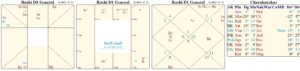
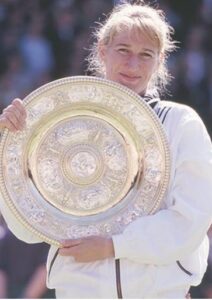 Stefanie Maria Graff known professionally as Steffi Graf is a German former professional tennis player. She was ranked as the world No. 1 in women’s singles by the Women’s Tennis Association (WTA) for a record 377 weeks, and finished as the year-end No. 1 a record eight times.
Now, let’s look at her Mangal. She is Mithuna Lagna, Ma is in Vrischika, strong in tattva.
Here we see Ju and Ke in 11th bhava from Mangal. They are in the 4th bhava, so which part of the body is Empowered by Mangal?
Shoulders are empowered (If we speak of the hand, we shall divide it in 3 parts – 4th house is the upper hand – shoulder, 5th is the middle part and the palm is the 6th house). So we can say her shoulders have been empowered. For tennis player it is really important.
Which rashi is empowered? Kanya rashi. Me is the lord. Very fast, extremely fast. Green grass, field – that is what you think of in Kanya and Me loves to play, he is a kid. It is 4th bhava – Kendra, so we can say that she will start playing from a very yong age. She began practicing on a court at the age of four and played in her first tournament at five.
Now let’s look at Grahas there. Ke 6th and 10th Lord is there and it is MKS and Ju 7th and 10th L is there. So can we say that Mangal will protect you from those 6th L – enemies who are dying to win? He will empower you to win instead.
Both Ke and Ju are in parivartana with Ra. Being 10th Lords and exchanging with the 4th, Ra is also 9th L they form a peculiar yoga here which grants a person a kingdom. Stefanie Maria Graff founded the charitable foundation Children for Tomorrow in 1998 (Ju –Ra)
It supports children and families affected by war, persecution, displacement (KE MKS) and severe psychological trauma. She also serves as the foundation’s chairwoman. Ma also empowered her to do very good things.
So in her example we saw how beautiful can be the gift.
Parivartana study. Stefanie Maria Graff
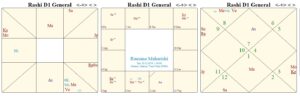
Now let us observe some spiritual cases. This is the case of Ramana Mahrishi.
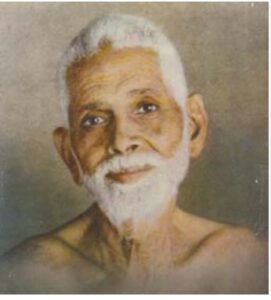 He is Tula Lagna, Mangal is in MKS in 7th bhava. What does it basically mean? It means, this Mangal will destroy 6th bhava, being 12th from it – enemies, shadripu, servants and will empower 5th bhava – mantra bhava.
Ju is in Kumbha, so Kumbha rashi is Himalayas and who does live in Himalayas? Rishi live in the high mountains. Ju in the 5th and Ju is knowledge, 5th is self-knowledge, natural Lord is Su- sarvatma ca divakara. 5th bhava is connected with Shiva. So can we say that the person will protect the knowledge of the rishis? He will protect the knowledge connected to Shiva? How can you protect it? You can teach it. 5th bhava is also a bhava of shishya, Putra bhava, so he will give you shishyas for sure.
5th Bhava is also citta of the person, dharma of your citta (10th ) is in the 5th, so we can say that . Citta is a Sanskrit word referring to the “perception, attention. Citta or Cittavaśitā refers to the “mastery of mind” . So actually, Mangal will empower your citta, will empower you mind, your buddhi (3d and 6th L Ju aspecting Lagna) and it will make you a master of your citta.
5th bhava is Gārhapatya Agni.
Skanda Purāṇa, Chapter 22, states:
This Gārhapatya Agni begot two splendid sons named Padmaka and Śaṅku. Both of them were excellent Agnis.
Gārhapatya Agni stayed on the banks of Narmadā and performed great penance and propitiated Rudra. He had great concentration and self-control.
He thus performed severe austerities for ten thousand years. The delighted Bull-emblemed great Lord spoke to him: “O highly esteemed one, tell me what you have in your mind. Even if what you desire is something very difficult to get, I shall undoubtedly bestow it on you.”
So this represents blessings of Shiva (Rudra will be correct) as well.
Ramana Maharshi believed that only by abiding in Self-awareness will the vāsanās, which create the sense of a separate self, be destroyed, and sahaja samadhi be attained.
Let’s have a look at an example of a general.
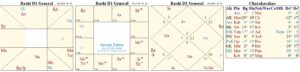
 Vṛṣabha Lagna, with Maṅgala in the fourth bhāva, gives a strong-willed and exceptionally determined personality.
The eleventh bhāva from Maṅgala is occupied by Śani. It falls in Mithuna Rāśi, which is ruled by Budha. Budha is placed in the house of war—the seventh bhāva. As the lord of the second bhāva, Budha empowers speech. This is the general who can compel his soldiers to advance and fight through the sheer power of his words.
Budha also produces rapid, bold, and forceful speech. Patton was known for his swift offensives and his exceptionally tough personality.
Patton’s colourful image, hard-driving personality, and success as a commander were at times overshadowed by his controversial public statements. His philosophy of leading from the front and his ability to inspire troops through attention-grabbing, vulgarity-laden speeches—such as his famous address to the Third Army—were received favourably by his soldiers, but much less so by the sharply divided Allied high command.
His decision to send the ill-fated Task Force Baum to liberate his son-in-law, Lieutenant Colonel John K. Waters, from a prisoner-of-war camp further damaged his standing with his superiors. Nevertheless, his emphasis on rapid and aggressive offensive action proved highly effective, and he was held in great regard by his opponents in the German High Command.
His physical strength was certainly pronounced, with Śani contributing endurance, discipline, and toughness. Patton was physically fit and athletic, practised fencing, and competed in the modern pentathlon at the 1912 Olympic Games.
Through these examples, we can see that Maṅgala Ācchādana does not produce one fixed external result. Maṅgala always gives what belongs to his essential nature—bala, courage, energy, endurance, the power to act, and the capacity to protect. Yet the form taken by this gift depends upon the rāśi, bhāva, graha, and kāraka receiving his protective covering.
Therefore, the gift of Maṅgala should not be judged only from a material or worldly perspective. The same fire that may produce struggle in saṁsāra can become tapas, discipline, protection, courage, and spiritual transformation when directed toward dharma.
Ācchādana also teaches us that a graha does not necessarily wait for its own daśā before giving protection. As a kāraka and an instrument of divine order, it may extend its gift whenever that gift is required.
The practical question is therefore not merely, “What will Maṅgala give?” We should ask: “What has Maṅgala promised to protect, where has he placed his bala, and for what purpose should that strength be used?”
True bala is not given only for personal victory. It is given so that one may overcome weakness, protect dharma, fulfil one’s duty, and place one’s strength in the service of the Divine.
May the strength bestowed by Maṅgala become courage, protection, tapas, and righteous action.
OM TAT SAT
Om Shanti, Shanti, Shanti