Written by: Namita Bhaladhare
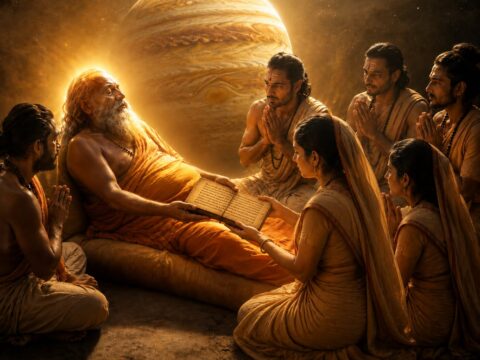
Guru and guide: Pandit Sanjay Rath
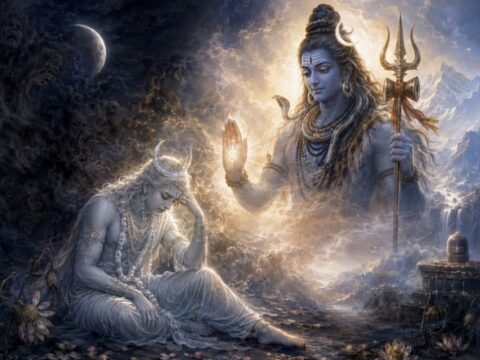
In Vedic thought, Ketu is not merely an astronomical node; it is a symbol of detachment, karmic residue, and spiritual liberation. Classical Jyotisha, especially in the tradition of sages like Sanjay Rath, often explains Ketu not through dry abstraction but through vivid mythic memory. One such powerful narrative is the encounter between Lord Gaṇeśa and Chandra Deva, which quietly encodes the essence of Ketu.
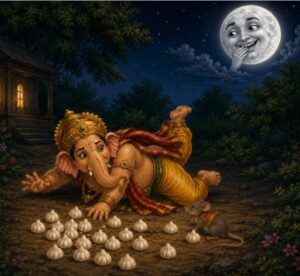 On a Caturthī night, after a grand celebration in honor of Lord Gaṇeśa, the deity of wisdom and obstacle removal, the atmosphere was filled with abundance. Gaṇeśa had partaken generously of modakas, the sweet symbol of bliss and fulfillment. Whether offered by Kubera, Chandra Deva, or lovingly prepared by Devī Pārvatī, the offering reflected devotion and celebration.
But divinity, too, has rhythm. Overindulgence brings imbalance.
Seeking relief under the night sky, Gaṇeśa set out on His vehicle, Mūṣika. The journey, however, was disrupted when a serpent crossed their path, startling the mouse. In the sudden movement, Gaṇeśa fell, and the modakas scattered upon the earth.
For a moment, the cosmic play turned humble.
Chandra Deva, the Moon, witnessed this and laughed.
That laughter became a turning point.
Gaṇeśa, in divine authority, was angered—not by the fall, but by the arrogance behind the laughter. The Moon’s beauty had become pride; his witnessing turned into mockery.
In response, Gaṇeśa pronounced a curse: the Moon would lose its radiance and disappear from the sky.
Instantly, cosmic order trembled. Without the Moon, rhythm collapsed, night lost its guidance, and the worlds fell into imbalance.
Realizing the gravity of his action, Chandra Deva sought forgiveness. Gaṇeśa, ever compassionate, softened the curse. The Moon would not disappear permanently—but would wax and wane.
Thus, time itself began to breathe.
In Jyotisha, Ketu represents the cutting away of pride, illusion, and attachment. It is the tail of the cosmic serpent—what remains after experience has burned away form.
This story is deeply Ketu-like in symbolism.
- The Moon represents mind (Manas)—beauty, emotion, reflection, but also ego and fluctuation.
- Gaṇeśa represents higher intelligence (Buddhi)—discernment beyond emotion.
- The laughter of Chandra represents egoic awareness mistaking itself for superiority.
- The curse represents karmic correction through separation.
Ketu is that force which removes false brightness. It does not destroy for punishment but for purification.
Where Rahu inflates desire and pride, Ketu dissolves it.
In this myth, the Moon’s humiliation is not destruction—it is transformation into cycles. The waxing and waning become a perpetual reminder that no state is permanent, not even brilliance.
A key teaching derived from this story is the Caturthī taboo: it is said that looking at the moon on Gaṇeśa Caturthī brings false accusations or distortion.
Astrologically, this reflects a deeper truth. Caturthī is the fourth lunar phase—associated with emotional instability and subtle ego disturbances. The Moon, already symbolic of the mind, becomes vulnerable when it is out of alignment with higher intelligence (Gaṇeśa).
Thus, the story encodes a psychological insight:
When perception is clouded by ego or timing is misaligned, even truth appears distorted.
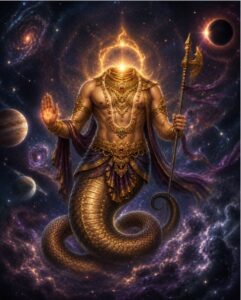 Ketu’s function in spiritual astrology is not comfort—it is clarity.
It teaches:
Knowledge without humility becomes distortion
In this narrative, Chandra does not lose his existence—he loses his pride. And in losing pride, he gains rhythm.
That is the essence of Ketu: removal without annihilation, loss that becomes liberation.
The lunar phases we observe today are not merely astronomical mechanics. They are living reminders of a divine correction—an eternal teaching encoded in sky and story.
Gaṇeśa’s act is not anger alone; it is instruction wrapped in consequence. Chandra’s humiliation becomes humility. And the Moon, once full and unchanging in pride, becomes ever-changing in grace.
Thus, the sky itself becomes scripture.
And within that scripture, Ketu stands silently—not as darkness, but as the wisdom that remains when everything unnecessary has been removed.
Om Gurave Namah