All knowledge belongs to the Guru; any errors or omissions in interpretation are entirely mine.
This article is inspired by the teachings of Pandit Sanjay Rath, particularly the discussions on Jyotisha Parampara in Crux of Vedic Astrology, Nārāyaṇa Daśā, and the Vedic Astrology Tradition 2025 lecture series.
ॐ गुरवे नमः — Om Gurave Namaḥ
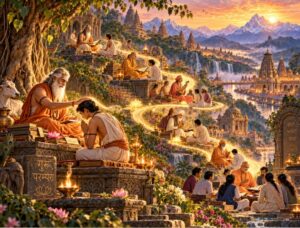 There is a profound difference between knowing something and receiving knowledge. In the modern world, knowledge is increasingly treated as information: it can be downloaded, recorded, stored, copied and transmitted instantly. The Vedic tradition approaches knowledge very differently. Sacred knowledge is not merely information to be accumulated; it is a living current that passes from one consciousness to another. This living transmission is called Parampara.
The word Parampara signifies an unbroken succession, particularly the transmission of knowledge from Guru to Shishya, teacher to disciple. The disciple does not merely receive a collection of doctrines. He or she receives a way of seeing, a discipline, a method of practice and, above all, a responsibility to preserve what has been received and transmit it without distortion. In this sense, Parampara is less like a library and more like a river. The water changes at every moment, yet the river remains the same river.
This idea is particularly important in Jyotisha. The classical tradition was not originally designed as a system to be learned merely from books. Its deepest principles were preserved through instruction, observation, practice and initiation. Sanjay Rath describes his own lineage as coming through a traditional family of astrologers of Puri whose lineage traces itself to Sri Achyutananda; his own training was received from his uncle, Pandit Kasinath Rath, and his grandfather, Pandit Jagannath Rath, was known as a Jyotish Ratna of Odisha. The significance of such a lineage is not simply historical. It illustrates what Parampara means in practice: knowledge becomes embodied in a person before it is transmitted to another person.
Sri Achyutananda Dasa occupies a particularly fascinating place in this story. He was one of the Pañca Sakhā, the five great spiritual figures associated with the religious and literary renaissance of medieval Odisha: Balarama Dasa, Jagannatha Dasa, Ananta Dasa, Jasobanta Dasa and Achyutananda Dasa. Their importance was not limited to theology. They helped bring sacred literature and spiritual teachings into the Odia language, making knowledge accessible beyond the small circle of Sanskrit scholars. Historical accounts also preserve the association of these five figures with Sri Chaitanya and Puri.
Within the tradition represented by Sanjay Rath, this history acquires a specifically Jyotish dimension. The lineage is traced to Sri Achyutananda, and the Pañca Sakhā are regarded as important initiators of spiritual and knowledge lineages in Odisha. Thus, Parampara is not merely a genealogy of teachers. It is a genealogy of dharma—a succession through which knowledge is kept alive.
The word Guru is frequently translated as teacher, but within the traditional framework its meaning is considerably deeper. A teacher can provide information. A Guru transforms the student’s relationship with knowledge.
This is why the Guru-Shishya relationship cannot be reduced to an academic arrangement. The disciple learns through listening, questioning, observation, practice, correction and surrender. The Guru, in turn, carries the responsibility of determining what should be taught, when it should be taught and whether the disciple is prepared to receive it.
The relationship therefore contains both adhikara—fitness or qualification—and responsibility.
This becomes especially important in Jyotisha. The horoscope may be calculated by anyone with the correct astronomical data, but interpretation requires a different order of understanding. One must learn how the symbols interact, how different layers of the horoscope speak to one another, how classical principles are reconciled and, perhaps most importantly, how to distinguish a genuine principle from one’s own projection upon the chart.
The Parampara therefore protects not only knowledge but also the method of knowing.
From the perspective of Jyotisha, the symbolism of Parampara can be contemplated through the relationship between Jupiter and Saturn.
Jupiter, Devaguru Brihaspati, signifies wisdom, teaching, philosophy, sacred knowledge and the expansion of consciousness. Saturn, meanwhile, carries associations of antiquity, discipline, continuity, endurance and that which has survived the passage of time. When these principles come together, a striking symbolic picture emerges: wisdom that has endured.
This is the deeper idea behind what some Jyotish traditions describe as Brahma Yoga in connection with Jupiter and Saturn. Rather than treating the combination as a mechanical promise of becoming a scholar, it can be contemplated as the meeting of Guru-tattva and the weight of tradition. Jupiter gives meaning; Saturn gives continuity. Jupiter teaches; Saturn preserves. Jupiter expands knowledge; Saturn tests whether that knowledge can survive discipline.
The symbolism is particularly appropriate for Parampara. A tradition survives not simply because somebody possesses knowledge, but because somebody has the discipline to preserve it accurately and the wisdom to transmit it appropriately.
Another important symbolism arises through Jupiter and Ketu.
Jupiter represents the Guru, philosophy and higher wisdom. Ketu represents separation from worldly identification, spiritual insight and the impulse to penetrate beneath appearances. Their association with the Lagna or relevant spiritual indicators can therefore be examined when considering an individual’s attraction toward ancient sciences, Jyotisha, mantra, scripture and esoteric disciplines.
But again, the principle should not be reduced to a simplistic formula: “Jupiter + Ketu = astrologer.”
The deeper symbolism is that knowledge becomes a means of looking beyond the visible. Jyotisha itself is a language of symbols. The planets are not merely physical objects in the sky; within the traditional framework they become grahas, carriers of meaning through which the relationship between cosmic order and human life can be contemplated.
Ketu asks the student to look beyond the surface of the symbol. Jupiter teaches the student how to interpret what lies beneath it.
This brings us to one of the most beautiful ideas in the system of Varga charts.
The Chaturvimsamsa, or D-24, traditionally called Siddhamsa, is associated with learning and educational accomplishment. Sanjay Rath’s presentation of the divisional charts specifically associates D-24 with education, while D-20 is associated with spirituality and the Guru-Shishya relationship.
But learning in the Vedic worldview is larger than formal education.
We inherit knowledge from a civilisation. We inherit language, scripture, rituals, philosophical categories, mathematics, astronomy, music and methods of contemplation from those who lived before us. Thus, education is not merely what happens in a classroom. It is a form of cultural inheritance.
This is why D-24 can be contemplated as a chart of knowledge received from the collective heritage of society and tradition. In a student of Jyotisha, the D-24 invites an important question: What kind of knowledge is the native capable of receiving, assimilating and ultimately perfecting?
The question is not simply whether the person will obtain a degree. It is whether knowledge can become siddhi—accomplished understanding.
If D-24 concerns learning, Vimsamsa, or D-20, takes us deeper into the territory of Upasana.
Traditional Jyotish sources associate D-20 with spirituality and with Guru-Shishya or Upasana, while D-24 is associated with teachers, students and Siddhi.
This distinction is profound.
One can learn about a deity without worshipping the deity. One can study a mantra without allowing the mantra to transform one’s consciousness. One can read about meditation without meditating.
D-20 therefore belongs to a different dimension of knowledge—the movement from information to practice.
The Sanskrit word Upasana literally carries the sense of drawing near, of approaching the Divine. The student therefore ceases to be merely an observer of spiritual knowledge. Knowledge becomes a discipline of living.
This is also where the idea of Diksha becomes significant. In the traditional framework, initiation is not simply permission to repeat a sacred sound. It establishes a relationship between the disciple, the mantra, the deity and the lineage through which that practice has been transmitted.
The mantra therefore becomes another river of Parampara.
Within the Odisha spiritual tradition associated with Jagannatha and Sri Achyutananda, there are teachings and oral explanations concerning a mysterious blue or grey-blue radiance associated with the sacred atmosphere of Puri. In contemporary presentations of this tradition, including teachings associated with Sanjay Rath, this imagery is interpreted symbolically through Akasha—space or ether—and the relationship between the earthly realm and the transcendental.
Such descriptions should be understood within their traditional and symbolic context, rather than presented as an empirically established astronomical or physical phenomenon.
Yet symbolism does not become meaningless simply because it is symbolic.
The blue light can be contemplated as an image of transmission between worlds. The temple becomes the meeting point between Bhuloka and the transcendent; the visible and invisible meet; the human being turns toward that which cannot be grasped merely through the senses.
In this reading, the light becomes an image of Parampara itself.
Knowledge descends. The disciple receives it. The disciple is purified through practice. Then the disciple becomes a vessel through which the same light can continue.
The tradition survives because the light is not allowed to stop with one person.
One of the most beautiful concepts associated with traditional spiritual practice is Ahoratra—the complete cycle of day and night.
Spiritual practice is not confined to a particular hour in which one sits before an altar. The purpose of Ahoratra is continuity of remembrance. Awakening and sleeping become two thresholds at which consciousness can be consciously turned toward the Divine.
The teaching of beginning and ending the day with remembrance of the Lord therefore has a psychological as well as spiritual significance. What occupies the mind at the beginning of the day influences the direction of consciousness; what occupies it before sleep becomes the final impression carried into the night.
The principle is simple: do not allow sacred remembrance to become an isolated activity; allow it to surround the day.
This is Parampara at the level of practice.
Within the tradition presented in these teachings, the Shadakshari mantra—a six-syllabled mantra associated with Rama and Krishna—is given significance as a protective and elevating spiritual practice.
The number six also invites a Jyotish contemplation. The sixth house is traditionally associated with ṛṇa, ṛipu, roga, service, struggle and the processes through which one confronts conditions that disturb equilibrium. In the spiritual interpretation presented by this lineage, the sixfold mantra becomes a means of guarding consciousness against such disturbances.
Whether one approaches the practice through theology, mantra-shastra or Jyotish symbolism, the underlying principle remains the same: repetition creates continuity.
The mind ordinarily wanders from object to object. Mantra gives it a thread.
And Parampara is itself such a thread—a thread connecting the present practitioner with those who practised before him.
The story of the Pañca Sakhā reveals another essential dimension of Parampara.
Transmission is incomplete if knowledge remains inaccessible.
The five great figures associated with Odisha’s spiritual renaissance helped communicate sacred ideas through the regional language and literary culture. Their works contributed to the preservation and popularisation of spiritual knowledge in Odisha.
This is a powerful lesson for modern Jyotish.
Tradition does not mean refusing to communicate with the modern world. Tradition means preserving the tattva while finding an appropriate language through which that tattva can be understood.
A Sanskrit verse can be preserved exactly as received, while its explanation may be given in English. A traditional Jyotish principle can retain its integrity while being taught through contemporary examples.
The vessel changes.
The water does not.
The symbolic interpretation of the seventh house as the field of conception and union offers another fascinating bridge between cosmology and the horoscope.
In the teaching described in this tradition, the seventh house becomes a meeting point between the celestial and terrestrial principles—the union through which consciousness enters embodied existence. The symbolism of Dyaus or the sky-father and Bhumi, the earth-mother, provides a mythic language for understanding how the transcendent becomes immanent.
Jyotisha repeatedly asks us to contemplate this mystery: How does the infinite become an individual?
A human being is simultaneously cosmic and earthly. There is something within us that reaches upward toward meaning, while another dimension remains rooted in body, family, environment and material existence.
The horoscope itself mirrors this paradox.
It is a map of planetary symbolism, yet it describes a human life.
It belongs simultaneously to the sky and to the earth.
Perhaps the greatest misunderstanding of Parampara is to imagine that belonging to a lineage gives one authority.
Traditionally, the opposite is closer to the truth.
Parampara gives responsibility.
The disciple receives something that existed before the disciple and must therefore be handled with humility. One must study the source texts, understand the teachings, honour the Guru, practise what is taught and distinguish personal interpretation from what has actually been transmitted.
This is particularly important in Jyotisha, where it is easy for personal opinions to become mixed with classical principles.
A true student must continually ask:
What did the tradition actually teach?
What is my Guru’s interpretation?
What is my own observation?
Where does the scripture end and my inference begin?
These questions are not limitations. They are safeguards.
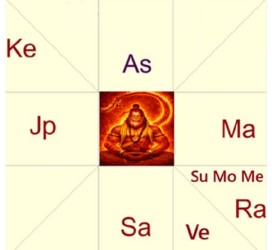
If Parampara were to be expressed through a horoscope, it would not belong to one planet alone.
Jupiter would represent the Guru and the wisdom that expands consciousness.
Saturn would represent continuity, discipline, antiquity and the preservation of what has endured.
Ketu would represent the inward turn—the ability to penetrate beyond external appearances.
The ninth house would evoke Dharma, teachers, blessings of previous merit and the transmission of higher principles.
The fifth house would speak to mantra, intelligence, sacred learning and the continuity of what is carried forward.
D-24 would show the field of learning and accomplishment in knowledge.
D-20 would take us toward spiritual practice, Upasana and the Guru-Shishya dimension.
And beyond all these symbols lies the most important principle: a chart may indicate capacity, but Parampara is awakened through relationship, practice and grace.
The deepest meaning of Parampara is therefore not that something ancient must remain frozen.
It is that something essential must remain unbroken.
Sri Achyutananda belongs to a historical and spiritual world very different from our own. Yet the questions that animated that world remain remarkably contemporary. How does knowledge survive? How does wisdom move from one generation to another? How does a human being transform information into realisation? How does the student become worthy of becoming a teacher?
The answer offered by the Vedic tradition is not simply through books.
It is through Guru, Shastra and Sadhana—teacher, sacred knowledge and disciplined practice.
The Guru opens the door.
The Shastra gives direction.
The Sadhana makes the teaching one’s own.
Then comes the final responsibility: to keep the door open for the next seeker.
That is Parampara.
It is not merely the inheritance of the past.
It is the promise made to the future.
And perhaps this is why the image of a light is so powerful. Whether contemplated as the sacred radiance of Jagannatha, the inner light of consciousness, or simply the light of knowledge passing from Guru to Shishya, the message remains the same:
The light is not ours to possess. We are only its temporary custodians.
To receive it is a blessing.
To understand it is a discipline.
To live it is a sadhana.
And to transmit it without diminishing its essence—that is the sacred responsibility of Parampara.
ॐ गुरवे नमः
Om Gurave Namaḥ.
ॐ शांति शांति शांति