ॐ गुरवे नमः
This article is inspired by Bṛhat Nakshatra by Pandit Sanjay Rath. All knowledge belongs to the Guru; any errors or omissions in interpretation are entirely mine.
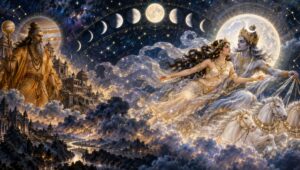
In the sacred genealogical records of the Purāṇas, Candra (Soma) is born from the concentrated Tapas of the sage Atri and his consort Anasūyā. In the psychosomatic mapping of the Ṛṣis, Candra is designated as the “Lord of the Night,” governing the subtle tides of the human consciousness. Within the cosmic tripod that sustains the manifest being—comprising Sūrya (Supply and Production), the Lagna (Utilization and Absorption), and Candra—the Moon serves the vital function of Demand, Storage, and Elimination (Excretion).
His movement is traditionally measured against the Nakṣatra Mālā (Creation Rosary). This celestial string of stars consists of 27 lunar mansions in the manifest physical realm, though a 28-star scheme is recognized for spiritual purposes. In this latter framework, Abhijit serves as the “intercalary” head bead, bridging the gap between material existence and the spiritual void. Functionally, Candra is the controller of the “Gaṅgā” flow (the flow of life-fluids) through the human system, ensuring that the spirit remains conjoined to the body through the dissolution of waste and the storage of vital essence.
This sacred narrative reveals the inherent flaw in the Manas (the active mind). The myth centers on the kidnapping of Tārā, the goddess of spiritual splendor and the personification of Intelligence (Lagna Navatārā). Tārā was the devoted spouse of Bṛhaspati (the planet Guru), who represents Divine Wisdom, Law, and the Absolute Truth.
On the dark night of Amāvāsyā (the 15th Kṛṣṇa tithi), Candra—driven by the impulse of the Active/Desiring Mind—abducted Tārā from the realm of Wisdom. Seeking to evade the consequences of this cosmic transgression, Candra hid within the “plants and trees.” This union produced the illegitimate child, Budha (Mercury).
Upon realizing the magnitude of his error, Candra released Tārā at the exact end of Amāvāsyā. This precise moment of release and restoration is technically known as “Amṛta,” the nectar of immortality that arises when transgression is surrendered to grace. This myth provides a profound psychological contrast:
- Bṛhaspati (Guru): The stabilizing force of Divine Wisdom and established Truth.
- Candra (Soma): The disjointed spirit, caught between the voice of the soul (conscience) and the raw, externalized desires of the mind.
-
Tārā: The “guiding star” of Intelligence that the mind seeks to possess but can only truly honor through the guidance of Wisdom.
Budha (Mercury) represents the synthesis of Candra’s mental activity and Tārā’s intelligence. In Jyotiṣa, Budha is symbolized by a four-pointed square, representing perfect balance and stability amidst the flux of the universe. Symbolically, his nature is described as “merging triangles,” representing the union of man and woman in a state of harmonic equilibrium.
Despite his birth through transgression, Budha was adopted and imbibed with the wisdom of Bṛhaspati (and Viṣṇu). He governs the Mahar Loka, the first spiritual plane that bridges the material worlds (Bhū, Bhuva, Svarga) and the higher spiritual realms.
Attribute Comparison: Candra vs. Budha
| Attribute | Candra (Mind/Soma) | Budha (Intelligence/Mercury) |
| Loka (World) | Janar Loka (2nd Spiritual Plane) | Mahar Loka (1st Spiritual Plane) |
| Tattva (Element) | Jala (Water/Fluid) | Pṛthvī (Earth/Solid) |
| Symbolic Form | Two points / Half-moon | Four points / Square |
| Functional Role | Demand, Storage, and Elimination | Balance and Stability |
| Humor (Dosha) | Kapha (Phlegm) | Mixed (Intelligence-based) |
Note on Tattva Relationship: While Candra represents Jala (water) and Budha represents Pṛthvī (earth), they are considered friends in this context. Just as water is retained and contained within a solid vessel, Budha provides the necessary container to stabilize Candra’s inherent fluctuations.
The perpetual waxing and waning of the Moon are the result of two primary divine curses that govern the mind’s fall into matter.
- The Curse of Gaṇeśa: Born of arrogance, Candra once laughed at the distended belly of Lord Gaṇeśa. This mockery of the “remover of obstacles” resulted in a curse of periodic fall. In the zodiac, this is reflected in Candra’s state of Nīca (debilitation) in Vṛścika (Scorpio), where the mind loses its clarity and strength.
- The Curse of Dakṣa Prajāpati: Candra was wed to the 27 daughters of Dakṣa (the Nakṣatras). His obsession and favoritism toward Rohiṇī Nakṣatra led to the neglect of his other wives. Consequently, Dakṣa Prajāpati (Brahma) cursed him with Kshaya (Consumption).
These curses created the physical and energetic phenomenon of the lunar cycle. The waning Moon represents the “downward flow” of cosmic fluids, leading to Kshaya (shortage of resources and life force). The waxing Moon represents the “upward flow,” signifying the restoration of surplus and the replenishment of medicinal potency.
The total annihilation of the Moon by the curse of consumption was stayed by Lord Śiva (Rudra). During Kṛṣṇa Caturdaśī (the 14th waning day), as Candra faced extinction, Śiva protected him by hiding him within medicinal herbs and eventually placing the crescent Moon upon His own head.
This act of grace established the legacy of Somanāth (the Lord of Soma). In Jyotiṣa, Śiva worship is the paramount remedy for Moon-related afflictions. The goal of this remedy is to balance the flow of breath in both nostrils—the Suṣumnā nāḍī. When the breath is balanced in the Suṣumnā, the mind is no longer a victim of fluctuation; it reveals the “perfect truth” through the “perfect utilization of resources,” effectively stabilizing the mind’s “Demand” process.
The myth of Tārā and Candra provides the key to understanding the Mithuna-Dhanus (Gemini-Sagittarius) axis.
- The Begging Mind: Candra’s star, Mṛgaśīrā, resides in Mithuna (Gemini). The Vedāṅga Jyotiṣa etymology for this star is mṛta, meaning “begging,” “departed,” or “seeking.” This reflects the mind’s “grass is greener” mentality, where the Manas is perpetually begging for external splendor (Tārā) rather than finding internal peace.
- The Law of Guru: Opposite Mithuna is Dhanus (Sagittarius), the sign of Guru (Bṛhaspati). This is the site of Law and Divine Order. The axis represents the struggle to move the mind from the site of desire (Mithuna) to the site of Wisdom (Dhanus).
- The Viśuddhi Dynamics: Candra governs the Viśuddhi (Throat) Cakra and the pumping of blood and emotions. In the Tri-Nāḍi analysis, any blockages to this “Gangā flow” are not merely psychological; they can lead to death or severe illness as the psychosomatic integrity of the individual collapses.
Remedial Lessons for Practitioners
- Vessel over Void: The practitioner must use the “solid vessel” of Budha (disciplined intelligence/Pṛthvī) to contain the “waters” of Candra (Jala). This prevents the mind from wandering into paths of transgression.
- Amṛta vs. Kshaya: One must distinguish between the “Consumption” (Kshaya) of the waning phase, where resources are wasted on external desire, and the “Nectar” (Amṛta) of the waxing phase, where the mind is redirected toward spiritual growth.
- Suṣumnā Stability: The only permanent remedy for a disjointed spirit is the stabilization offered by the Guru or Śiva. By balancing the breath and the internal “pumping” of Candra, the seeker moves from the state of “begging” to the state of “perfect utilization of resources.”
The abduction of Tārā remains a perpetual celestial drama. The waxing and waning Moon serves as a reminder that the mind is a “disjointed spirit,” susceptible to both the curse of its own obsessions and the saving grace of the divine.
In this cosmic cycle, Tārā remains the “guiding star.” She is the Intelligence that, when properly conjoined with Wisdom (Guru) rather than stolen by Desire (Candra), leads the soul out of the paths of suffering. By understanding the moment of Amṛta, the seeker learns to navigate the tides of the mind, ensuring that the internal “Gangā” flows toward spiritual realization rather than material consumption.
ॐ शांति शांति शांति