ॐ शं शनैश्चराय नमः
The Lord of Karma — Nature, Placements, Strength, Remedies and Grace
Written by Prema Raj , inspired by the teachings of Guruji Pandit Sanjay Rath
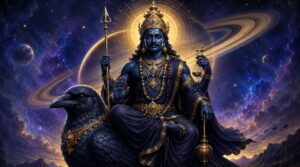
Before starting this article about Śani, I would like to start with a hymn in praise of Sani dev to get his blessings.
Tradition holds that when Śani was about to transit into Rohiṇī nakṣatra — an event described in the Purāṇic accounts as the ‘Rohiṇī-Śakaṭa-Bhedana’, foretokening a twelve-year drought — King Daśaratha of Ayodhyā, father of Śrī Rāma, rode his chariot into the heavens to intercede on behalf of his people. Rather than confront Śani in battle, he offered him a hymn of praise, acknowledging Śani’s fearsome forms and supreme authority as dispenser of karma, and begged his grace ‘for the welfare of all beings.’ Pleased by this courage and humility, Śani granted Daśaratha’s boon. This episode is recorded in the Purāṇic tradition (Padma Purāṇa, Uttara-khaṇḍa) and is the source of the verse still recited today as the most trusted opening invocation to Śani.
śanaiścaro devatā | triṣṭup chhandaḥ ||śanaiścara-prītyartha jape viniyogaḥ ||daśaratha uvāca ||
nityaṃ smṛto yo harate ca pīḍāṃ tasmai namaḥ śrī-ravinandanāya || 1 ||surāsurāḥ kimpuruṣoragendrā gandharva-vidyādhara-pannagāśca |
pīḍyanti sarve viṣamasthitena tasmai namaḥ śrī-ravinandanāya || 2 ||narā narendrāḥ paśavo mṛgendrā vanyāśca ye kīṭa-pataṅga-bhṛṅgāḥ |
pīḍyanti sarve viṣamasthitena tasmai namaḥ śrī-ravinandanāya || 3 ||deśāśca durgāṇi vanāni yatra senā-niveśāḥ pura-pattanāni |
pīḍyanti sarve viṣamasthitena tasmai namaḥ śrī-ravinandanāya || 4 ||tilair yavair māṣa-guḍānna-dānair lohena nīlāmbara-dānato vā |
prīṇāti mantrair nija-vāsare ca tasmai namaḥ śrī-ravinandanāya || 5 ||prayāga-kūle yamunā-taṭe ca sarasvatī-puṇya-jale guhāyām |
yo yogināṃ dhyānagato’pi sūkṣmas tasmai namaḥ śrī-ravinandanāya || 6 ||
anya-pradeśāt svagṛhaṃ praviṣṭas tadīya-vāre sa naraḥ sukhī syāt |
gṛhād gato yo na punaḥ prayāti tasmai namaḥ śrī-ravinandanāya || 7 ||
sraṣṭā svayambhūr bhuvana-trayasya trātā harīśo harate pinākī |
ekas tridhā ṛg-yajuḥ-sāma-mūrtis tasmai namaḥ śrī-ravinandanāya || 8 ||
śany-aṣṭakaṃ yaḥ prayataḥ prabhāte nityaṃ suputraiḥ paśu-bāndhavaiśca |
paṭhet tu saukhyaṃ bhuvi bhoga-yuktaḥ prāpnoti nirvāṇa-padaṃ tad-ante || 9 ||
kona-sthaḥ piṅgalo babhruḥ kṛṣṇo raudro’ntako yamaḥ |
sauriḥ śanaiścaro mandaḥ pippalādena saṃstutaḥ || 10 ||
etāni daśa nāmāni prātar utthāya yaḥ paṭhet |
śanaiścara-kṛtā pīḍā na kadācit bhaviṣyati || 11 ||
छायामार्ताण्डसम्भूतं तं नमामि शनैश्चरम् ॥
chāyā-mārtāṇḍa-sambhūtaṃ taṃ namāmi śanaiścaram.
Meaning: “I bow to Śanaiścara (the slow-moving one), who is dark like collyrium or a rain-cloud, the son of the Sun (Ravi-putra), the elder brother of Yama (the lord of death), and born of Chāyā (the shadow-consort) and Mārtāṇḍa (the Sun).”
Purpose of the Mantra
- Composed as an act of surrender and honest acknowledgment — Daśaratha names Śani’s fearsome, gaunt, dark form truthfully rather than flattering him, because Śani is the impartial judge of karma who cannot be deceived.
- Recited to pacify Śani during Sāḍe-Sātī (the 7½-year transit cycle), Śani Mahādaśā/Antardaśā, Aṣṭama-Śani, and Kaṇṭaka-Śani (4th/8th house transits from Moon), and generally on Saturdays.
- Its stated fruit, per tradition, is that Śani becomes gentle (“manda”, the slow and mild one) toward the reciter and removes obstruction, delay, and unmerited suffering, rewarding sincerity rather than pomp.
Source: Padma Purāṇa (Uttara-khaṇḍa), preserved in the Navagraha-stotra corpus; recension quoted in Dashrath-kṛta Śani-stotra collections.
Basic Nature (Svabhāva) and Guṇa
Bṛhat Parāśara Horā Śāstra (BPHS) describes Śani as the son of Sūrya and Chāyā, elder to Yama, ruler of Makara (Capricorn) and Kumbha (Aquarius), exalted in Tulā (Libra) and debilitated in Meṣa (Aries). He is classed as a Pāpagraha (natural malefic) — in fact the most severe of the malefics — yet he is simultaneously revered as a Karmic teacher rather than a purely destructive force.
| Attribute | Classification | Attribute |
| Guṇa (quality) | Tamas (inertia/discipline) | Varṇa (caste) |
| Element (Tattva) | Vāyu (Air) | Śūdra |
| Gender | Napuṃsaka (neuter/eunuch) | Deha (body type) |
| Disposition | Cruel / malefic (Krūra) | Lean, tall, large teeth, tawny/rough hair |
| Direction (Digbala) | West | Strongest in 7th house |
| Colour | Black / dark blue | Metal — Iron / steel |
| Taste (Rasa) | Astringent / pungent (Kaṣāya/Tikta) | Gemstone |
| Day | Saturday | Blue Sapphire (Nīlam) |
Source: BPHS, Ch. 3 (Grahaguṇa-adhyāya — description of the natural karakatva, colour, taste, guṇa, digbala of the grahas); Saravalī, Ch. 2–3 (Graha-svarūpa).
Qualities and Significations (Kārakatva)
As per BPHS and Saravalī, Śani governs the following:
- Longevity (Āyuṣ-kāraka) — the principal significator of the length and quality of life, and of old age itself.
- Sorrow, grief, delay, obstruction, chronic and hidden disease, poverty, misfortune (Duḥkha-kāraka).
- Servants, labourers, the working and disenfranchised classes, agriculture, and manual industry.
- Discipline, restraint, austerity (tapas), renunciation, detachment, and truthfulness born of hardship.
- Justice, law, karma-phala-dātā (the giver of the fruits of past karma), timing, and structure.
- The 8th and 12th houses in general signification: obstacles and loss/isolation.
- Bones, joints, nerves, teeth and hair — the skeletal/structural systems of the body; also chronic and wasting ailments.
- As Sade Sati/Dhaiya karaka, Śani governs the 7½-year and 2½-year transit cycles that test character.
Source: BPHS Ch. 3 (Kārakatva of grahas); Jātaka Pārijāta, Ch. 1 (significations of Śani); Phaladīpikā and Saravalī corroborate this list.
Classical authorities (Saravalī and Jātaka Pārijāta in particular) devote separate chapters to the graha-in-bhāva and graha-in-rāśi results. A condensed summary follows; exact wording, duration and strength must be weighed against the planet’s overall shadbala and dignity in the individual chart.
| Rāśi (Sign) | Lord | Śani’s Condition | General Effects (per classics) |
| Meṣa (Aries) | Maṅgala | Debilitated (Neecha) at 20° | Weak, fear-prone, restless, health/finances strained unless neutralised by Neechabhanga; delays and struggle in early life. |
| Vṛṣabha (Taurus) | Śukra | Friendly sign | Steady accumulation of wealth through hard work, stable but slow-moving material gains, some stubbornness. |
| Mithuna (Gemini) | Budha | Friendly sign | Analytical discipline, gains through communication/trade, but can bring anxiety and overthinking. |
| Karka (Cancer) | Chandra | Enemy sign | Emotional restraint or coldness, friction with mother/domestic life, delayed emotional security. |
| Siṃha (Leo) | Sūrya | Enemy sign | Conflict with authority/father figures, pride vs. discipline tension, hard-won recognition. |
| Kanyā (Virgo) | Budha | Friendly sign | Meticulous, service-oriented, disciplined intellect; good for methodical professions. |
| Tulā (Libra) | Śukra | Exalted (Uccha) at 20° | Balanced justice, high integrity, leadership through fairness, excellent longevity and status if well placed. |
| Vṛścika (Scorpio) | Maṅgala | Neutral/mild friction | Deep, secretive discipline; research, occult or transformative capacity; internal struggle. |
| Dhanu (Sagittarius) | Guru | Enemy sign | Tension between dharma/philosophy and restriction; delays in higher learning or belief crises followed by depth. |
| Makara (Capricorn) | Śani (own) | Svakṣetra (own sign) | Strong sense of duty, authority through perseverance, excellent for career/status (10th-house strength). |
| Kumbha (Aquarius) | Śani (own) | Svakṣetra (own sign) | Humanitarian discipline, unconventional thinking applied with rigor, service to larger causes. |
| Mīna (Pisces) | Guru | Neutral | Melancholic but spiritually mature; delays followed by quiet renunciation or compassion-based service. |
Source: Saravalī, Chapters on ‘Graha rāśi phala’ (results of planets in each sign); Jātaka Pārijāta, Ch. 4 (Graha-bhāva-phala); Bṛhat Jātaka, Ch. 2 (Graha-svarūpa-phala) by Varāhamihira.
Exaltation and Debilitation in Detail
Uccha Śani — Exalted in Tulā (Libra), 20°
BPHS and Bṛhat Jātaka both affirm that Śani reaches maximum exaltation strength (parama-uccha) at 20° Tulā. An exalted Śani, especially when angular (kendra) or well aspected, confers extraordinary patience, administrative and judicial capacity, longevity, disciplined success, and the ability to rise from humble means through sheer perseverance. Such a native is often described in Jātaka Pārijāta as one who commands authority precisely because he has mastered restraint.
Nīcha Śani — Debilitated in Meṣa (Aries), 20°
At the opposite point, 20° Meṣa, Śani is at his weakest. Debilitated Śani, unless cancelled by Neechabhanga Rāja Yoga (e.g., the sign lord Maṅgala being angular from the Lagna/Moon,or sukra in Kendra from lagna/moon) tends to produce impulsive, disorganised behaviour that undermines the native’s own long-term interests — the very qualities Śani is meant to cultivate (patience, method, humility) are precisely what is lacking. Classical texts caution that Neecha Śani’s malefic potential is magnified, not simply weakened, because Meṣa is ruled by fiery, impatient Maṅgala — the temperamental opposite of Śani.
Source: BPHS, Ch. 5 (Uccha-Nīcha-bhaṅga adhyāya); Bṛhat Jātaka Ch. 1 (Rāśi-svāmī and uccha-nīcha of grahas);Jātaka Pārijāta,Ch.3.
Among the five Pañca-Mahāpuruṣa Yogas described in BPHS (Ch. 75), the yoga formed by Śani is called Śaśa Yoga. It arises when Śani occupies a Kendra (1st, 4th, 7th or 10th house from the Lagna) while being in his own sign (Makara or Kumbha) or in his sign of exaltation (Tulā).
Why does Śani in the 1st House (Lagna) specifically create such a powerful yoga?
- Digbala consideration: while Śani’s directional strength (digbala) technically peaks in the 7th house (West), the Lagna is the seat of the physical body, personality and overall life-direction — when the karma-giving, discipline-bestowing planet occupies this seat in dignity, the native’s very identity and life path become structured by disciplined effort, endurance and integrity rather than by weakness or suffering.
- Kendra + dignity = Rāja Yoga potential: a planet that is both angular (kendra-sthāna, giving power to manifest results) and in own/exaltation sign (giving the quality to manifest good results) satisfies BPHS’s twin criteria for a Mahāpuruṣa Yoga — power and virtue combined.
- Śani as Yama’s elder brother and karma-phala-dātā, when placed in the 1st house in strength, makes the person the arbiter of justice/discipline for others rather than its victim — the native embodies authority, methodical leadership, and is often placed in roles of governance, law, engineering, or large-scale organisation.
- BPHS specifically states that a person born in Śaśa Yoga is dark-complexioned (or has prominent bony structure), has strong limbs, is a chief of villages/towns, is engaged in others’ service and yet becomes a leader, is wealthy, and enjoys a long life, though not free of some hardship in early years.
- If the above conditions are not met, then Sani in first house is said to be MKS- which gives poor health, sufferings – other factors to be also considered.
Note: Because Śani is inherently a malefic and a slow, restrictive planet, even the Śaśa Yoga native typically experiences a difficult, striving early life (childhood hardship, discipline enforced early), with the promised rise to authority and stability unfolding gradually, especially after Śani’s own major periods commence — consistent with Śani’s overall nature as the ‘slow but sure’ planet.
Source: BPHS, Ch. 75 (Pañca-Mahāpuruṣa Yoga adhyāya — verses on Śaśa Yoga); Saravalī’s yoga chapters and referenced by B. V. Raman in ‘Three Hundred Important Combinations’.
Factors that Strengthen Śani
- Own signs (Makara, Kumbha), exaltation (Tulā 20°), or Mūlatrikoṇa strength.
- Placement in the 7th house (digbala) or in Kendra/Trikoṇa from Lagna or Moon.
- Vargottama Śani (same sign in Rāśi and Navāṃśa) — very stable, matured karmic results.
- Not combust (Śani combusts within roughly 15° of the Sun — but this threshold is treated more liberally for Śani in many traditions given his slow motion) and not retrograde-afflicted without benefic aspect.
- Aspected or conjoined by benefics (Guru, Śukra, or a well-placed Budha), or receiving Śani’s own special 3rd and 10th aspects (dṛṣṭi) onto benefic significations.
- Being Yogakāraka by house-lordship for certain ascendants (Vṛṣabha and Tulā Lagnas, where Śani rules a Kendra and a Trikoṇa simultaneously).
Factors that Weaken or Afflict Śani
- Debilitation in Meṣa without Neechabhanga; placement in the 6th, 8th or 12th house (dusthāna) especially if further afflicted.
- Combustion by the Sun, or affliction by Rāhu/Ketu (Śani-Rāhu forming Śrāpit or ‘cursed’ combinations in popular parlance) or by Maṅgala (Śani-Maṅgala yuti often signifies frustrated, obstructed energy).
- Retrograde Śani in a dusthāna can intensify delay, though retrograde Śani in dignity can also deepen karmic maturity — its result must be judged contextually.
- Being hemmed between malefics (pāpa-kartari-yoga) or receiving multiple malefic aspects without any benefic relief.
- Lordship of a dusthāna (6th/8th/12th from lagna) for the ascendant in question, which can make Śani function as a stronger functional malefic regardless of sign dignity (e.g., for Siṃha and Kanyā lagnas).
Source: BPHS Ch. 27–29 (Bhāvaphala and combustion/retrogression rules); Saravalī’s chapters on planetary strength (Ṣaḍbala) and Jātaka Pārijāta’s treatment of Śani’s yoga and doṣa combinations.
The classics agree that Śani, being karma-phala-dātā, cannot be bribed or bypassed — remedies work by improving one’s own conduct, discipline and service, thereby easing the manner in which Śani delivers karmic results.
Pandit Sanjay Rath ji emphasise, following the Jaimini and Parāśara traditions, that the deepest ‘remedy’ for Śani is right action (dharma) and service to those Śani represents — the poor, elderly, disabled, and labouring classes.
Mantra and Japa
- Bīja mantra: Oṃ Praiṃ Śanaiścarāya Namaḥ — traditionally repeated 23,000 times (or in multiples of 108) especially during Śani daśā/antardaśā or Sāḍe-Sātī.
- Gāyatrī: Oṃ Sūryaputrāya Vidmahe Mṛtyu-rūpāya Dhīmahi, Tanno Sauriḥ Pracodayāt.
- Recitation of the Daśaratha-kṛta Śani Stotra (given above) and the Navagraha Stotra, especially on Saturdays.
Ritual and Charity (Dāna)
- Worship at a Śani or Hanumān temple on Saturdays; lighting a sesame-oil (til-tel) lamp facing west.
- Dāna of black sesame, black urad dāl, iron, black cloth, mustard oil, and leather footwear to the needy, especially on Saturdays.
- Feeding crows, black dogs, and the elderly/disabled poor — since these are considered Śani’s living representatives.
- Worship of Hanumān (Śani is traditionally described as pacified through Hanumān’s grace, per the Rāmāyaṇa-linked tradition and popular Hanumān Chālīsā verse referencing relief from Śani’s affliction).
- Planting/watering a Peepal or Śami tree, and circumambulating it on Saturdays.
Gemstone and Ratna
Blue Sapphire (Nīlam) is Śani’s gemstone in the classical navaratna scheme, but Pandit Sanjay Rath , cautions strongly against casual use of Nīlam — it is described as the fastest-acting and most unpredictable gem, capable of extreme benefit or extreme harm within days, and should only be trialled (worn briefly, results observed) under qualified guidance, never prescribed reflexively.
Behavioural/Karma Remedies (emphasised by modern teachers)
- Sanjay Rath (in his Jaimini and Parāśara teachings) stresses that Śani rewards discipline, punctuality, humility, and long-term consistent effort — the truest upāya is aligning one’s daily conduct (especially towards subordinates, workers and the disadvantaged) with justice and fairness..
How Śani Blesses a Chart
A well-placed, dignified Śani (own sign, exalted, in Śaśa Yoga, or well-aspected in a kendra/trikoṇa) is regarded across BPHS, Saravalī and Jātaka Pārijāta as one of the most powerful sources of durable, self-earned success in a horoscope. Because Śani’s gifts are built on discipline rather than luck, they tend to be exceptionally stable: longevity, high office, judicial or administrative authority, wealth accumulated through sustained effort, mastery of a craft or profession, humility that wins deep and lasting respect, and — in spiritual terms — the capacity for genuine renunciation, detachment and tapas (austerity) that leads toward mokṣa.
Negative Effects When Śani is Afflicted (‘Cursed’)
A severely afflicted Śani — debilitated without cancellation, combust, hemmed by malefics, aspected by Rāhu/Ketu, or ruling/occupying dusthānas without relief — is described in the classics as producing:
- Chronic delay, obstruction, and a pervasive sense of being ‘held back’ despite effort (Śani-doṣa).
- Prolonged sorrow, isolation, poverty or financial instability, and susceptibility to depression or chronic illness affecting bones, joints and nerves.
- Difficult relationships with authority figures, father, or employers; friction born of excessive rigidity, fear, or resentment.
- Sāḍe-Sātī and Aṣṭama-Śani transits that, when the natal Śani is already weak, can bring markedly harder tests — loss, litigation, or protracted struggle — though even here classical and modern authorities alike stress these periods are corrective, not punitive: they dissolve what is unsustainable in one’s life so that what remains can stand on firm ground.
Sanjay Rath emphasise that Śani never gives unearned suffering — his ‘curse’ is invariably karmic accounting, and is best met with patience, humility, and continued right conduct rather than fear or resentment, which the tradition holds only prolongs the affliction.
Source: BPHS Ch. 3, 27–29 & 46; Saravalī’s yoga and doṣa chapters; Jātaka Pārijāta Ch. 1 & 4; Sanjay Rath teachings on Śani as karma-phala-dātā.
How to Earn the Blessings of Śani Dev
- Live with discipline, punctuality and integrity — Śani rewards structure, not shortcuts.
- Serve the poor, elderly, disabled and labouring classes tangibly and regularly, not merely ritually.
- Practice patience during hardship; resist the urge to blame others or fate, and instead examine one’s own karma and effort.
- Keep one’s word and honour duties/contracts fully — Śani is deeply linked to truthfulness and accountability.
- Maintain the mantra, dāna and Saturday observances given above as consistent (not occasional) practice.
- Cultivate detachment from ego and status; Śani, the karaka of the Śūdra varṇa and of humility, favours those who do not consider any honest labour beneath them.
I would like to end this article with one of my favourite sloka which I have been reciting for nearly 20years —
The devotional tradition surrounding Ādi Śaṅkarācārya’s collection of protective ślokas includes the following verse, widely recited alongside Śani-stotras as a means of dissolving Kali (here meaning misfortune, adversity and the afflictions of the current age/of a difficult planetary period, rather than the goddess Kālī):
ऋतुपर्णस्य राजर्षेः कीर्तनं कलिनाशनम् ॥
Ṛtuparṇasya rājarṣeḥ kīrtanaṃ kali-nāśanam.
Meaning: “The mere utterance or remembrance of the names of Karkoṭaka, the serpent-king; Damayantī; King Nala; and the royal sage Ṛtuparṇa destroys Kali — misfortune, adversity, and the negative influence associated with Kali.”
Context and Purpose
The verse draws on the Nala-Damayantī episode of the Mahābhārata, in which King Nala, possessed by the malevolent spirit of Kali after a moment of ritual carelessness, loses his kingdom and is transformed by the bite of the serpent Karkoṭaka into a twisted, unrecognisable form — a hardship he ultimately overcomes through patience, humility and the loyalty of Damayantī, aided by King Ṛtuparṇa. Because this story so closely mirrors Śani’s own domain — a great one brought low, made to labour in obscurity, and restored only through endurance and righteous conduct — the verse was absorbed into the Śani-stotra corpus associated with Śaṅkarācārya’s devotional compilations. It is recited for the same purpose as the Daśaratha stotra with which this document opened: to seek release from prolonged adversity, Sāḍe-Sātī, or a difficult Śani daśā, by invoking the memory of those who endured such trials and emerged purified rather than destroyed.
In this way, the document that began with Daśaratha’s plea for Śani’s mercy closes with a verse whose entire purpose is the same: not to escape Śani’s justice, but to be strengthened enough by remembrance, humility and right conduct to pass through it — which the tradition holds is the very blessing Śani Dev exists to bestow.
ॐ शनैश्चराय विद्महे छायापुत्राय धीमहि तन्नो मन्दः प्रचोदयात् ॥
Om Shanaishcharaya Vidmahe Chhayaputraya Dhimahi Tanno Mandah Prachodayat ॥