Written by Prema Raj , inspired by the teachings of Guruji Pandit Sanjay Rath
MARANA KARAKA STHANA (MKS)
The ‘Death-Inflicting’ Placements of Planets
Om Gurave Namah
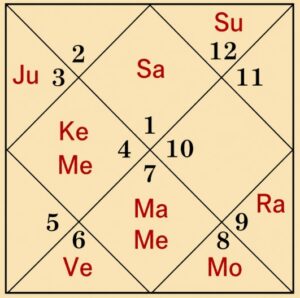 Marana Karaka Sthana, abbreviated MKS, is a classical Jyotish doctrine describing a house (bhava) in which a planet’s own nature (karakatva) is thoroughly out of place, so much so that the planet is said to be pushed toward a symbolic ‘death’ of its effective power. The term is built from three Sanskrit words:
- Marana (मरण) — death, or death-like suffering
- Karaka (कारक) — significator, that which causes or indicates
- Sthana (स्थान) — place, position, house
The classical definition and its complete list of planetary positions is found in Vaidyanatha Dikshita’s Jataka Parijata, in the chapter that also expounds the Kalachakra Dasha (Adhyaya 17), verses 34 to 36. There, the text explicitly clarifies that these positions are termed ‘karaka’ sthanas because the death-like affliction is tied to the planet’s own significations, not to its lordship of a house:
bhātṛsthānagato jīvo dārasthānagataḥ kujaḥ | tathā janmagato mando rāhurnavamarāśigaḥ || 34 ||
candro’ṣṭamagrihaṁ yātaḥ sūryo riḥphagṛhaṁ gataḥ | budhaḥ saptamabhāvastho bhārgavaḥ śatrurāśigaḥ || 35 ||
ityevaṁ maraṇasthānaṁ tasmin pāpayute’thavā | pāpadṛṣṭe’rinīcasthe durbale duḥkhamāpnayāt || 36 ||
Rendered in English: Jupiter occupying the third house (house of siblings), Mars the seventh (house of the spouse); Saturn the lagna (birth-house), Rahu the ninth house; the Moon reaching the eighth house, the Sun the twelfth; Mercury standing in the seventh house, Venus an enemy sign — these are the marana-sthanas. When conjoined by malefics, aspected by malefics, in an enemy or debilitated sign, or otherwise weak, the person experiences sorrow.
Source: Vaidyanatha Dikshita, Jataka Parijata, Adhyaya 17, verses 34–36 (Sanskrit and translation as preserved in Pt. Sanjay Rath’s Sri Jagannath Center teaching lineage)
The Cause
Every graha carries an intrinsic temperament (svabhava) and natural significations (karakatva), while every bhava carries a fixed thematic identity regardless of which zodiac sign occupies it. MKS arises purely from this bhava-karakatva mismatch — it is judged from house position counted from the Lagna (or, in Jaimini analysis, from the Atmakaraka and other chara karakas), and is entirely independent of the planet’s dignity by sign (exaltation, own sign, debilitation), which is a separate, rasi-based measure of strength.
The Effect
Because the graha is denied a house in which it can act according to its own nature, its significations become strained, and the house it occupies also comes under the pressure of the ‘death’ theme. The Jataka Parijata verses immediately preceding this list (verses 32–33) specify the type of affliction each planet’s suffering takes when the MKS condition is compounded by malefic association:
agnibādhā ravau vidyāccandre jvalanabādhakam | bhaume śastrakṛtā pīḍā vāyubādhakaraṁ budhe || 32 ||
gurau codarabādhā syāt śukre’gnibhayamāpnayāt | śanau gulmena bādhā syād rāhau viṣakṛtāṁ rujam || 33 ||
In translation: affliction to the Sun brings trouble from fire, the Moon from fevers and heat, Mars from injury by weapons, Mercury from disorders of air (vata), Jupiter from stomach ailments, Venus from fear of fire, Saturn from abdominal/colic complaints, and Rahu from poison-like afflictions. This shows that the classical tradition treats MKS not as an abstract weakness but as a specific, graha-appropriate type of suffering when the affliction is compounded.
Source: Jataka Parijata 17.32–33.
These are the most malefic positions capable of causing death-like suffering, and when such a ‘death inflictor’ is joined by or aspected by malefics, or sits in an inimical or debilitated sign, great grief follows.
In practice, the severity a jataka experiences depends on layered analysis rather than the bare placement alone:
- Whether the MKS planet is additionally joined by, or aspected by, natural malefics (Mars, Saturn, Rahu, Ketu, a waning/afflicted Moon) — this is the single most decisive escalating factor in the classical text.
- Whether the planet sits in an enemy sign, debilitation, or is otherwise weak (durbala) at the same time — compounding sign-weakness with house-weakness produces the full ‘sorrow’ (duhkha) described in verse 36.
- Which houses the MKS planet rules elsewhere in the chart, since Jataka Parijata frames the doctrine around karakatva — the significations of the planet itself, and by extension the houses it lords, come under strain.
- The dasha or antardasha of the MKS planet, when its results become most active and visible in the native’s life.
Checkable factors that soften or worsen an MKS placement before a firm judgment is made:
- Absence of malefic conjunction/aspect: Per Jataka Parijata 17.36 itself, if the MKS planet is not joined by or aspected by malefics, and is not in an enemy or debilitated sign, the ‘sorrow’ clause does not trigger in full — the placement remains uncomfortable but not devastating.
- Dignity by sign: A planet exalted, in its own sign, or otherwise strong (bala) while in MKS can still work through the discomfort with effort, as opposed to a planet that is both MKS and additionally weak.
- Strength of the bhava karaka: Visti Larsen’s SJC teaching stresses worshipping and strengthening the natural significator (karaka) — not the lord — of the afflicted house, since the affliction is a karakatva problem; a strong, well-placed karaka for that house cushions its themes even while the MKS planet itself struggles.
- Number of malefic influences: severity by whether one or two-or-more malefics are involved — two or more malefic influences on the MKS planet’s sign is treated as a materially worse condition than one.
- Placement of the Atmakaraka: In Jaimini analysis, MKS is also examined from the Atmakaraka (the soul-significator planet), not only from the Lagna — a planet, karaka, or lordship falling in the MKS house counted from the Atmakaraka is described as being ‘rejected by the Atma,’ meaning that its significations are difficult for the native to experience even if they exist in the chart.
Source: Pt.Sanjay Rath Teachings – Visti Larsen, ‘Marana Karaka Sthana’ lecture and reader responses, Sri Garuda / Jaimini SJC, 2007; Vaidyanatha Dikshita, Jataka Parijata 17.36.
| Graha | MKS House | Classical Source |
| Surya (Sun) | 12th House | Jataka Parijata 17.35 |
| Chandra (Moon) | 8th House | Jataka Parijata 17.35 |
| Mangala (Mars) | 7th House | Jataka Parijata 17.34 |
| Budha (Mercury) | 7th House (primary); 4th House (alternate view) | Jataka Parijata 17.35; alt. Jataka Parijata 2.72 |
| Guru (Jupiter) | 3rd House | Jataka Parijata 17.34 |
| Shukra (Venus) | 6th House | Jataka Parijata 17.35; Jaimini Sutra dictum “Shasta Shukra Marana Karaka” |
| Shani (Saturn) | 1st House / Lagna | Jataka Parijata 17.34 |
| Rahu | 9th House | Jataka Parijata 17.34 |
| Ketu | Not given in Jataka Parijata 17.34-36
4th House |
Later traditional addition (commonly 4th house) |
Rahu in the 9th House
Rahu signifies adharma and is held to be the cause of rebirth arising from misdeeds of a past life. The 9th house is the seat of dharma, pilgrimage, and sacred shrines. When the significator of adharma is forced into the house of dharma, it is described as feeling utterly dejected by its own accumulated sin, to the point of a death-wish born of remorse. 9th house’ karaka is Jupiter (Devaguru) is enraged at the desecration of holy ground by Rahu’s presence and delivers punishing results. This is reinforced by the fact that Rahu debilitates in Sagittarius — Jupiter’s own fire sign — in the natural zodiac, a sign whose fire is held capable of burning away sin.
Ketu in the 4th House
Ketu represents detachment, headless wandering, isolation and complete cutting off material ties- vairagya . 4H is sukha Bhāva rules domestic happiness, homeland, comforting, nurturing nature of the mother. Putting ketu in 4H is like asking a detached ascetic to live in a cosy emotional family home. Ketu suffers – dies in this house because it completely starves & destabilises the emotional security, home life and foundational comfort the 4H is meant to provide.
Chandra (Moon) in the 8th House — Chandrastama
The Moon is karaka for the mind and for the overall post-birth (janma) horoscope, governing the ego’s sense of embodied identity. The 8th house is the seat of death and transformation, part of the Moksha trikona. When the Moon — the very principle that sustains the illusion of a continuous bodily self — is placed there, it is described as receiving a profound shock at confronting mortality and impermanence, unsettling both health and the mind. This is reinforced by the Moon’s debilitation in the 8th sign of the natural zodiac (Scorpio), ruled by the 8th house’s own karaka Saturn, the principle of disease and hard labour, directly opposed to the 2nd house of sustenance.
Surya (Sun) in the 12th House
The Sun is the upholder and protector of dharma. The 12th house governs the pleasures of the bed, signified by Venus, and is Venus’s own sign of exaltation in the natural zodiac (Pisces). The Sun’s essential duty is to remain apart from sensory pleasure and diligently perform dharma; placed in the house of pleasure, that duty cannot be exercised. Among the six inner enemies (shadripu) that cause the fall of dharma, desire (kama/matsarya) is held to cause the greatest fall — precisely the terrain the Sun is forced onto in the 12th house.
Guru (Jupiter) in the 3rd House
The 3rd house governs valour (parakrama), union (maithuna). Its natural karaka is Mars. Jupiter, the peace-loving Devaguru who signifies universal harmony and wisdom, is rendered ineffective under Mars’s violent temperament there — matching the fact that Jupiter debilitates in Capricorn, Saturn/Mars-related terrain, in the natural zodiac. Jupiter is also called Jiva, the life-force principle, while Mars is Mrityu-karaka, the significator of death; placing the life-force in a house ruled by the death-significator diminishes vitality. Additionally, Rahu’s ayana (directional path) runs opposite Jupiter’s, and Rahu is exalted in Gemini — the 3rd sign of the natural zodiac — further weakening Jupiter’s command of that house.
Shukra (Venus) in the 6th House
Jaimini gives this placement its own dictum: Shasta Shukra Marana Karaka — ‘Venus in the sixth is Marana Karaka.’ The 6th house governs service, and in the natural zodiac is the sign of debilitation, symbolised by Virgo, the untouched, pure figure. Venus, the karaka of pleasure and enjoyment, becomes incapable of expressing its own karakatva when made to serve rather than enjoy. The 6th house’s own karakas are Mars (enemies) and Saturn (servitude and hard labour), both fundamentally opposed to Venus’s pleasure- and luxury-seeking nature — in the Kalachakra scheme, Mars is said to directly obstruct Venus’s ayana.
Shani (Saturn) in the Lagna
Saturn is karaka for the destruction of intelligence (dhi-nasha) and stands opposed to the principles of Jupiter (satya, truth) and the Sun. The Lagna represents intelligence and the health of the native, and its natural karaka is the Sun — the very two principles Saturn is opposed to. Reinforcing this, Saturn debilitates in Aries, the first sign of the natural zodiac, precisely where the fiery Sun is exalted. Saturn is the Sun’s son through Chhaya; owing to a perceived betrayal by his mother, the Sun cannot fully accept him, so wherever the Sun’s karakatva is strong — as at the Lagna — Saturn is rendered weak.
Mangala (Mars) in the 7th House
The 7th house is a maraka (killer) to the 8th house of longevity, since it is the 12th (house of loss) counted from the 8th; when the native’s focus is fixed on 7th-house matters — desire and union — longevity itself is said to diminish, since strong desire draws down the life-force. Mars is the karaka of independent courage and chastity; placed in the 7th, the native feels they are not practising enough restraint or purity, making Mars uncomfortable in a house that asks for compromise and yielding rather than solitary assertion.
Budha (Mercury) in the 7th House — and the Alternate 4th-House View
The primary Jataka Parijata verse places Mercury’s MKS in the 7th house. The 7th house is a maraka to the 6th house — the natural house of Virgo, signifying purity and the power of discrimination (viveka) — Mercury in the 7th is held to damage judgment specifically through the pull of desire.
A distinct, separate verse in the same text — Jataka Parijata, Adhyaya 2, shloka 72 — gives an alternate scheme in which planets become ‘barren of effect’ in different houses, including Mercury in the 4th from the Lagna. Mercury MKS through the 4th house’s relationship to the 3rd: the 4th (Vidya-sthana, formal study) is a maraka to the 3rd (the natural house of Gemini — play, experimentation, and self-directed learning), since the 4th is the 12th (loss) from the 3rd. Mercury, signifying the inquisitive, playful child, is described as being at its most uncomfortable when forced into formal, structured study, sometimes causing the native to dislike classroom settings even when Mercury is otherwise dignified.
Taught by Pt. Sanjay Rath is precise on one point that is often missed: the remedy is directed at the karaka (natural significator) of the afflicted house — not at the lord of that house, and not always at the MKS planet itself. The logic follows directly from the doctrine’s own definition: since MKS is a karakatva affliction, strengthening the relevant karaka restores the house’s vitality even while the MKS planet continues to struggle with its own placement.
| Graha in MKS | Bhava Karaka to Worship (not the MKS planet itself) | Nature of Remedy |
| Surya (12th) | Shani (karaka of 12th) | Mantra japa to Shani’s ruling principle; if Sun is also cursed or badly afflicted, worship of Shiva as Rameshwara/Sambasadashiva |
| Chandra (8th) | Shani (karaka of 8th, disease/hard work) | Mantra japa to Shani; strengthening the 8th lord and any benefic aspecting the Moon |
| Mangala (7th) | Shukra (karaka of 7th, marriage/partnership) | Mantra japa to Venus’s ruling principle; worship supporting Venus’s dignity |
| Budha (7th or 4th)
Ketu (4H) |
Shukra (if 7th) or Chandra (if 4th)
Chandra |
Mantra japa to the relevant karaka; for the 4th-house form, strengthening of the Moon and of learning/Saraswati |
| Guru (3rd) | Mangala (karaka of 3rd, courage) | Mantra japa to Mars’s ruling principle; disciplined, courage-building practice |
| Shukra (6th) | Shani (karaka of 6th, service) | Mantra japa to Shani; service-oriented (seva) practice to soften Venus’s resistance to the 6th house |
| Shani (1st/Lagna) | Surya and Guru (karakas of Lagna/intelligence) | Mantra japa to the Sun and to Jupiter’s ruling principle; Surya Namaskar and Aditya worship |
| Rahu (9th) | Guru (karaka of 9th, dharma) | Mantra japa to Jupiter’s ruling principle; worship at a place of pilgrimage/shrine to settle Rahu’s dejection in the house of dharma |
Supporting principles from the same teaching lineage:
- Grade the severity first: check whether the MKS planet is joined by or aspected by one or more natural malefics, and whether it sits in an enemy or debilitated sign, before prescribing any remedy — per Jataka Parijata 17.36, a clean, unafflicted MKS placement does not need the same intensity of remedy as a compounded one.
- Worship the karaka, not the lord.
- Nakshatra-lord worship as a general support: within this lineage, worship of the ruling deity of one’s own birth Nakshatra lord is also recommended as a lifelong, general remedy that supports a smoother expression of any afflicted placement, including MKS.
- Jyotirlinga worship for the Atmakaraka’s MKS: where the affliction is examined from the Atmakaraka rather than the Lagna, the recommended base remedy is japa of the Jyotirlinga mantra associated with the sign the Atmakaraka occupies.
‘Reviving’ an MKS planet means restoring functional strength to the house it occupies and to its own significations.
- Step 1 — Confirm affliction, not just placement: Per Jataka Parijata 17.36, check specifically for conjunction with or aspect from malefics, and for enemy-sign or debilitated status. A bare MKS placement without these is a mild condition; a compounded one is where classical ‘sorrow’ (duhkha) is expected.
- Step 2 — Read the graha-specific symptom: Use Jataka Parijata 17.32–33 to identify the type of affliction indicated (fire for the Sun, fevers for the Moon, weapon-injury for Mars, air/vata disorders for Mercury, stomach trouble for Jupiter, fire-fear for Venus, colic for Saturn, poison for Rahu) as a guide to where the strain is likely to surface.
- Step 3 — Identify the correct karaka to strengthen: identify the natural significator (not the lord) of the house occupied by the MKS planet, and begin mantra worship directed at that karaka’s ruling principle.
- Step 4 — Check sign dignity for resilience: a planet in MKS that is also exalted or in its own sign, tends to work through the discomfort with visible effort rather than collapse under it — this shapes how much remedial intensity is warranted.
- Step 5 — Examine from the Atmakaraka as well as the Lagna: if a planet, karaka, or lordship falls in the MKS house counted from the Atmakaraka, add Jyotirlinga worship for the Atmakaraka’s own sign as a foundational, lifelong practice.
- Step 6 — Track results through dasha: the doctrine’s effects, and the results of any remedy undertaken, become most visible during the mahadasha or antardasha of the MKS planet itself.
MKS indicates a real functional strain, but its severity always depends on affliction by malefics, sign dignity, and dasha timing — the placement is a tendency to be worked with through karaka worship and conscious effort, not a fixed sentence.
- Vaidyanatha Dikshita, Jataka Parijata, Adhyaya 17 (verses 32–36) and Adhyaya 2 (shloka 72).
- Sanjay Rath Ji teaching.