ॐ गुरवे नमः
This article is inspired by Bṛhat Nakshatra by Pandit Sanjay Rath. All knowledge belongs to the Guru; any errors or omissions in interpretation are entirely mine.
The North Node of the Moon, known in Vedic astrology as Rāhu, occupies a unique and formidable position in the pantheon of celestial influencers (grahas). Unlike physical planets such as Mars or Jupiter, Rāhu is a shadow entity (chāyā graha)—a mathematical intersection of the orbital paths of the Sun and Moon. In classical Jyotiṣa, as expounded in Sanjay Rath’s Brhat Nakshatra, Rāhu is not merely a indicator of malefic disruption; it represents the primary cosmic force of illusion (māyā), unquenchable worldly obsession (bhoga), radical innovation, taboo-breaking, foreign expansion, and statecraft. Understanding Rāhu requires examining its ancient Puranic genesis, its functional behavior across specialized astrological frameworks, and its manifestation in both historical horoscopes and contemporary life.
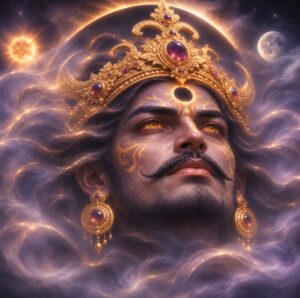 The foundational origin of Rāhu is rooted in the Puranic narrative of the Churning of the Cosmic Ocean (Samudra Manthana). To regain their lost splendor and immortality, the celestial deities (devas) and the anti-gods (asuras) entered into a temporary alliance to churn the primordial ocean of milk using Mount Meru as the churning rod and the great serpent Śrī Ananta (Vasuki) as the rope.
When the divine nectar of immortality (amṛta) finally emerged, Lord Viṣṇu assumed the enchanting form of Mohinī Avatāra to ensure that the nectar was distributed exclusively to the devas, preserving cosmic order (dharma). However, a sharp and ambitious asura named Swarbhānu, the son of Siṁhikā, perceived the illusion. Disguising himself as a deva, Swarbhānu slipped unnoticed into the row of gods and sat directly between Sūrya (the Sun God) and Candra (the Moon God).
Just as Mohinī poured the divine nectar into Swarbhānu’s mouth and he took a sip, Sūrya and Candra recognized his true identity and alerted Lord Viṣṇu. Instantly, Viṣṇu hurled His divine discus, the Sudarśana Cakra, severing Swarbhānu’s neck. Because the nectar had passed through his throat, both severed halves remained immortal:
- The upper head retained the unquenchable desire for enjoyment and became Rāhu.
- The headless lower body became Ketu, representing the headless seeker of spiritual liberation (mokṣa).
Having been exposed by Sūrya and Candra, Rāhu swore eternal enmity against the two luminaries. Periodically, Rāhu pursues and attempts to swallow the Sun and Moon, creating the astronomical phenomenon of eclipses (grahaṇa). Because Rāhu possesses no body or stomach, the swallowed luminaries eventually emerge from his severed neck, restoring light to the Universe.
✦ Cosmic Ocean Churning ✦
Samudra Manthana
Svarbhānu Drinks Amṛta
Disguised among the Devas
Exposed by Sūrya & Candra
Viṣṇu’s Sudarśana Cakra
Severs Svarbhānu’s Neck
| ↙ | ↘ |
|
☊
RĀHUImmortal, Obsessive Head Desires Consumption & Power |
☋
KETUThe Headless Body Seeks Liberation & Mokṣa |
In the human psyche and worldly experience, Rāhu operates as the ultimate catalyst of obsession and shadow projections. While physical planets represent tangible organs and elemental structures, Rāhu governs the subtle psychological currents that drive individuals beyond established boundaries.
Obsession and Unquenchable Desire
In the traditional classification of Nakṣatras detailed in the text, each planet reflects a distinct core philosophy toward life:
- Sūrya maintains relationships out of duty (dharma).
- Śani holds on out of a fear of loneliness.
- Guru operates on the principle of selfless wisdom (“if you love something, set it free”).
- Rāhu, conversely, operates purely on obsession: Rāhu becomes compulsively fixated on holding onto whatever it covets.
Because Rāhu is a head without a body, it experiences perpetual hunger without the physiological capacity to feel satisfied. When Rāhu dominates a natal chart or an active planetary period (daśā), it generates an irresistible urge to acquire wealth, political dominance, technological mastery, or unconventional status.
The Power of Illusions (Māyā) and Taboo-Breaking
Rāhu is the master of camouflage, foreign environments, and boundary dissolution. It governs foreign travel, cross-cultural unions, taboo subjects, espionage, and artificial representations of reality. Where Sūrya represents straight-talking authority and truth, Rāhu operates through shadows, strategic diplomacy, smoke, and deception.
Sanjay Rath’s Brhat Nakshatra outlines several advanced diagnostic tools that reveal how Rāhu operates far beyond basic zodiac sign placements.
Mānasa Nakṣatra: The Mind’s Throne and Statecraft
The 25th Nakṣatra reckoned from the natal Moon or Lagna is designated as the Mānasa Nakṣatra, representing the core throne of the human mind, willpower, and psychological endurance. The text classifies planets into “hot” and “cold” categories:
- Hot planets (Sūrya, Maṅgala) in Mānasa Nakṣatra can generate internal heat, anger, manic drive, or fierce spiritual renunciation.
- Cold planets (Rāhu, Śukra, Budha) are welcomed in Mānasa Nakṣatra because they cool the mind, conferring diplomatic poise, strategic patience, and statecraft.
When Rāhu occupies or rules Mānasa Nakṣatra, it grants an extraordinary ability to navigate complex political landscapes, manage foreign affairs, and maintain composure under immense public pressure.
Queen Victoria: Diplomatic Mastery and Imperial Expansion
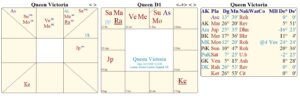
In the horoscope of Queen Victoria, Rāhu occupies Revatī Nakṣatra in the sign of Pisces (Mīna), which serves as her Mānasa Nakṣatra (the 25th star from both Lagna and Moon). Furthermore, Rāhu is vargottama (occupying the same sign in both the natal chart and the Navāṁśa).
| Astrological Factor | Placement in Queen Victoria’s Chart | Life Manifestation |
| Mānasa Nakṣatra Lord/Occupant | Rāhu in Revatī (Pisces / Mīna) | Cool diplomatic poise, supreme statecraft, and mental resilience under grief. |
| Vargottama Status | Exalted strength in Pisces | Expansion of the British Empire across oceans (“the empire on which the sun never sets”). |
| 10th & 11th House Linkages | Associated with Āmātyakāraka Guru & 10th Lord | Governed wise advisers, prime ministers, and vast foreign territories. |
As documented in the text, despite suffering deep personal depression after the death of her husband Prince Albert, Queen Victoria’s Rāhu in Mānasa Nakṣatra ensured that her political mind remained exceptionally sharp. Rāhu as a bhogi (enjoyer) promised prosperity and expansion beyond the seas for her nation.
In the 21st century, the energy of Rāhu has become more prevalent than in any previous era. As humanity transitions deeper into digital networks and global integration, Rāhu manifests across several modern domains:
Contemporary Spheres of Rāhu
- Artificial Intelligence and Virtual Reality: Generating convincing illusions, synthetic media, deepfakes, and virtual environments that blur the line between truth (satya) and illusion (māyā).
- Global Media and Viral Fame: Sudden, explosive public recognition that rises rapidly without traditional lineage or institutional backing.
- Biotechnology and Genetic Engineering: Taboo-breaking manipulation of cellular codes, cloning, and artificial organ synthesis (mirroring Rāhu’s association with unconventional physical forms).
- High-Stakes Geopolitics and Intelligence: Covert operations, cyber warfare, mass surveillance, and international diplomacy.
Traditional Remedial Measures for Neutralizing Rāhu
When Rāhu manifests negatively—causing chronic anxiety, paranoia, sudden financial reversals, or marital discord—classical Jyotiṣa prescribes specific spiritual protocols to harmonize its energy:
- Worship of Lord Śiva: Lord Śiva is the ultimate ruler who controls and consumes all poisons (Hālāhala). Regular worship of a Śiva Liṅga with cold milk and water neutralizes the burning shadow of Rāhu.
ॐ शांति शांति शांति