Om Gurave Namah
 In Vedic astrology, the 6th, 8th, and 12th houses are traditionally known as the duṣṭhānas—the most challenging areas of the birth chart. These houses are associated with illness (āgantuka roga and nija doṣas as the cause), conflict, debt, loss, isolation, and experiences that seem to lie beyond our control. Because of this, they are often treated with fear. When a person sees strong duṣṭhāna influences in a horoscope, the immediate reaction may be to ask: How can this be corrected? How can the negative effects be reduced?
Yet the duṣṭhānas are not simply signs of misfortune. They also reveal how difficult karma can be understood, processed, and transformed. The birth chart often contains both the challenge and the remedy. A benefic planet, a dispositor, an aspect, a kāraka, or a particular way of living may show how a person can work constructively with the themes of a difficult house. In this sense, the horoscope contains not only the diagnosis, but also the medicine.
When a theme is deeply rooted in the natal chart and activated by a planetary daśā, it may continue to appear in different forms. A conflict may end, only for a similar conflict to arise with someone else. One health issue may be resolved, while another forces the person to reconsider their lifestyle. A financial loss may be followed by an emotional loss. One relationship may end, but the same pattern may repeat in the next. An external obstacle may disappear, while the inner fear, anger, or attachment remains unchanged. This does not necessarily mean that the remedy has failed. Sometimes the purpose of the experience is to transform the consciousness of the person living through it. You will ask: “Do upāyas work?” If you work, they will also work to improve your consciousness and remove karma, or at least to go through the challenging time with wisdom. We always have a choice: to run away from karma or to live through it.
Candra represents the mind, emotional sensitivity, memory, nourishment, habits, receptivity, and our instinctive response to life. Because the Moon reflects rather than generates light, it is highly sensitive to its environment. Its placement shows what the mind absorbs, where emotional attention naturally flows, and what a person needs in order to feel safe and supported.
When Candra is placed in the 6th, 8th, or 12th house—Ari, Randhra, or Vyaya Bhāva, respectively—the emotional life may become closely connected with the themes of that duṣṭhāna. This does not automatically make the Moon weak or unfortunate. The final result depends on many factors: whether the Moon is waxing or waning, its sign, nakṣatra, dignity, aspects, conjunctions, house rulership, dispositor, and the planetary period currently operating.
The kārakas of 6-8-12 are Maṅgala and Śani (depending on the tradition you are following, it may be Śani for all three duṣṭhānas). Candra is a jala-tattva graha, and when influenced by the energies of Maṅgala and Śani, it lacks mental peace and can become depressive. Candra is a social graha, a śānti graha; it does not have enemies. Hence, fiery and warlike Maṅgala, as well as old, melancholic, and lonely Śani, are not the company the Moon prefers. The 6-8-12 bhāvas have the energy of Rudra and are willing to punish us through the topics they reflect.
In his discussion of dangers surrounding birth and early childhood, Parāśara describes a serious configuration involving Candra placed in the 6th, 8th, or 12th house and afflicted by a malefic aspect. The Moon’s presence in a duṣṭhāna alone is not enough to produce the full indication. The severity arises when additional affliction is present and benefic protection is weak or absent.
Parāśara also notes that a benefic aspect can reduce or counteract the danger. This teaching belongs specifically to bālāriṣṭa, which concerns dangers during infancy and childhood. It should therefore not be removed from its original context or interpreted as a universal prediction of death for adults who have the Moon in the 6th, 8th, or 12th house. That is a separate topic and should be taught by a Guru to prevent distortion and ensure it is not used incorrectly.
The naisargika 6th house is called the ṣaḍripu house, as it tells us about our weaknesses and enemies. Here, we are talking about inner enemies as well. It is associated with illness, enemies, competition, obligations, service, and daily work. Its influence may appear through constant practical challenges: managing health problems, dealing with conflict, maintaining discipline, or fulfilling responsibilities that cannot be avoided. The 6th bhāva is an upacaya—the house of growth. Candra is a natural benefic, and it will follow the formula for benefics in the 6th bhāva: not enough. As it represents food, care, and emotions, it will show their lack in the thinking of the person. It is the stomach area, and a person tends to have stomach issues with Candra in the 6th bhāva from childhood unless the kāraka is strong.
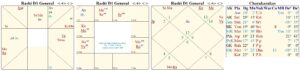
Peggy Ann Garner was an American actress. Her Candra is in the 6th bhāva with Rāhu, aspected by Śani and Maṅgala, and Mercury, which is afflicted by Ketu. It is in the 8th bhāva from functional AL.
Candra in the 6th bhāva will tend to have a problem in the stomach area, so we need a strong kāraka to protect it. But in this case, Śani kāraka is itself weak, being nīca with mārakeśa Maṅgala, who is in his own sign and will give the māraka role to nīca Śani. Together, they create a combination called Yama Yoga. The 4th bhāva from the Moon is also ruled by Maṅgala, so we cannot expect a cure.
Her childhood health struggles were primarily related to emotional and psychological pressure, and the Moon being the 5th lord confirms that the root of the problem could be in undigested emotions.
The 8th house is associated with sudden change, secrets, fear, inheritance, shared resources, psychological depth, and events that cannot be fully controlled. It challenges our belief that life can always remain stable and predictable. Under strong 8th-house influences, a person may face experiences that cannot be resolved through willpower alone: a relationship crisis, betrayal, a family secret, a psychological wound, financial dependence, loss of trust, or a profound inner transformation.
Though many people consider the 8th-house placement of Candra bad, many people in helping professions will have it: healers, astrologers. Ketu and Maṅgala are the lords of natural Vṛścika—like Gaṇeśa and Kārttikeya. Hence, good astrologers can be created.
Candra in the 8th bhāva is under the energy of Rudra. The natural 8th bhāva is Vṛścika and is considered an MKS placement for the Moon. Candra is in the well there. It is also called Candrāṣṭama. Candra is the graha that gives rayi, which includes prāṇas and sustains life. So its placement in the 8th bhāva is problematic. In this matter, we should look at the house ruled by Candra—where the prāṇa will be depleted from, where the person indicated by the bhāva will not have peace and sukha (happiness). This position of Candra will also give problems with the mother. Randhra Bhāva will punish for adharma committed in a past life toward the mother or society in general.
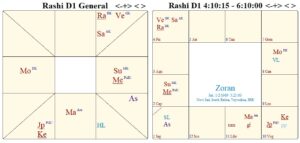
As you can see in the example of Zoran Radosavljevic, a well-known Jyotiṣi of our paramparā, his Candra is placed in the 8th bhāva. Candra is in his own sign; hence, it will not allow the Candrāṣṭama doṣa. Instead, it will make him a very loving and caring person, giving him the knowledge of how to fight disease and sorrow. Though a benefic graha, it tends to protect by losing its own significators. Here, it is about ripu-roga, as the āyuṣ of the person will be lost, and Candra tends to protect it.
Kāraka Śani is in Mīna rāśi with Rāhu and exalted Śukra (anitya of Candra) in the 9th from Candra. It is the person who can fight all the storms of life in people’s hearts and minds. Rāhu afflicts Śukra, and together they tend to afflict Candra; adding to that, Candra is in his own sign, and Śukra will give its result. Śukra is under the pressure of three malefics and, being the dispositor of the 8th lord, is cursed. It gets dṛṣṭi from Guru. Though for some time the paramparā (Guru + Ketu) protects, as both bhāvas relate to caturasra (4-8) and the cleansing of the blood and creation of blood cells, it will indicate a problem. Maṅgala is in the sign of Śukra and in the 4th from Candra. He will play the role of khara and create more problems along with cursed Śukra. Śukra, being the dispositor of Candra, will show a problem with the lymphatic system.
12th house is associated with expenses, solitude, sleep, foreign lands, hospitals, āśramas, charity, retreat, and the completion of worldly cycles.
On the material level, it shows what leaves our hands: money, time, energy, relationships, possessions, or social identity. Yet not every loss is a failure. Sometimes the 12th house removes something to which we have become excessively attached. For the mind, it creates a period of solitude so that it can recover from constant external stimulation. It is an extremely important bhāva for the mind trine 4-8-12, where our manas gets rest and recharges. Candra here has a tendency toward solitude and loneliness.
Sleep and dreams may be especially important. When the mind is disturbed, sleep may become irregular or filled with vivid dreams. When the Moon is supported, dreams may provide inspiration, emotional release, or symbolic insight. Candra in the 12th house can also indicate emotional connections with foreign countries, distant places, hospitals, retreats, monasteries, charitable institutions, or people who are isolated from ordinary society.
The 12th bhāva is a very important bhāva that shows faith, and it will indicate whether we trust people and have faith or not. It will also show people who will always protect us if a benefic graha is there.
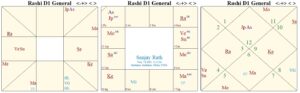
This is the chart of Pandit Sanjay Rath. His Candra is the 5th lord in the 12th bhāva. In one of the interviews, he said that when he left his government job and wanted to teach, he faced a problem. He enjoyed distance from society and preferred solitude. He was a very decent person, so he had to start teaching in a Krishna temple to overcome all that and to fulfill a promise to teach. You see the tendency—the person is always willing to be alone; he does not need anyone around.
Does he trust people? The 12th-bhāva Candra says yes, he does, and there are people who will protect him. Candra is the mother, and here, being in the 12th, it is also the wife.
So you see how Candra can influence the mind of the person.
Rudra is a powerful Vedic Devatā associated with pranas, healing, transformation, and the fierce forces of nature. Both feared and revered, he is invoked as the divine archer who removes suffering while also protecting life and restoring balance. In later Hindu tradition, Rudra became closely identified with Śiva, embodying the paradox of destruction as a necessary path to purification, renewal, and spiritual liberation. Though they are differnt. Tradition teaches that Śiva can’t come down to our realm. So Rudra can give relief to Candra in duṣṭhāna and give pranas back, help you with work, financies, protect your dear and near ones.
For Candra in duṣṭhāna chant this mantra daily 108 times:
कद् रुद्राय प्रचेतसे मीळ्हुष्टमाय तव्यसे
वोचेम शन्तमं हृदे
kad rudrāya pracetase mīḻhuṣṭamāya tavyase
vocema śantamaṁ hṛde
Written by Dana Khanina, inspired by the teachings of Guruji Pandit Sanjay Rath. All mistakes are mine, all knowledge belongs to the Guru.
OM TAT SAT
Om Shanti, Shanti, Shanti