Written by Radhakrishnan (Ramananda R Das) inspired by the teachings of Guruji Pandit Sanjay Rath
Om Gurave Namah
Translation by R Santhanam:
 The 5th from Jupiter and the Lagna is examined for the obtainment of progeny, their well-being, their prosperity, etc. (For a female, the 9th from the Lagna and from Jupiter in connection with children are to be scrutinized.)
From the Lagna, the 5th house shows how your brain is functioning. It shows one’s nature toward children. What one will experience in the relationship is seen from the 5th from Jupiter, as well as the attitude and relationship between the children and the person.
In the assessment of children and parent relationships, it is important to distinguish between the indications of the 5th house from the Lagna and the 5th house from Jupiter. Although both are connected with progeny, they reveal different matters of the subject. The 5th house from the Lagna primarily reflects the native’s own mindset, intelligence, emotional disposition, and natural attitude toward children. Since the 5th house is the seat of buddhi (intelligence), it reveals how a person thinks, nurtures, guides, and interacts with their children. Thus, the 5th house from the Lagna describes the person’s nature in relation to children. The 5th house from Jupiter, however, provides a different perspective. Jupiter is the Jīva-kāraka, the significator of living beings, and is also the naisargika putra-kāraka (natural significator for children). Therefore, the 5th house counted from Jupiter reveals the nature of the relationship that develops between the native and the child after birth. It shows the child’s attitude toward the parent, the degree of affection and harmony between them, and the overall experience the native derives through their children, specifically, whether the native can remain with, maintain a bond with, and raise the child, etc.
An important principle is that Jupiter is not primarily responsible for conception or pregnancy. Matters relating to fertility, conception, and the establishment of pregnancy are judged through other factors, particularly the Moon. Jupiter’s role becomes prominent only after the possibility of childbirth has been established. Once a child is born, Jupiter assumes the role of sustaining and nurturing the bond between parent and child. It governs whether the native is able to remain connected with the child, participate in the child’s upbringing, provide guidance, and maintain a meaningful relationship throughout life. In many cases, Jupiter indicates the blessings that allow a child to grow, prosper, and continue the family lineage. The special 5th-house aspect (pañcama dṛṣṭi) of Jupiter carries significant symbolism in this context. Jupiter’s aspect nourishes, protects, and promotes growth. Its influence on the 5th house from itself signifies the expansion and preservation of life, helping the child mature and develop in the world. This is why Jupiter is associated with the continued welfare, education, moral development, and prosperity of children rather than with the initial act of conception.
Therefore, when judging matters related to children, one should clearly differentiate between these two references:
The 5th house from the Lagna shows the native’s own nature and mentality toward children.
The 5th house from Jupiter shows the quality of the parent-child relationship, the child’s disposition toward the native, and the experiences that unfold after the child is born.
In essence, the 5th house from the Lagna describes how the parent approaches the child, while the 5th from Jupiter describes how the relationship itself develops and how the child becomes a source of experience, joy, responsibility, and growth in the native’s life. Jupiter’s role is the nurturing, protection, guidance, and continuation of the parent-child bond throughout life.
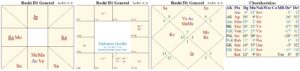
Gandhi’s 5th house from the Lagna is Aquarius. No Graha has Graha dṛṣṭi on it, but Jupiter, the Moon, and Rahu, as well as the sign lord, have Rāśi dṛṣṭi on it. There is no planet in it. Its lord, Saturn, is in the 2nd house and can give more children, while Rahu is in the 10th house with the Moon. Saturn is in an inimical sign and is in an exchange with Ketu, which is in MKS. Saturn is also aspected by Rahu, and there are two malefics behind it. Hence, his nature toward his son may not be good. It is said that Gandhi’s nature toward his son was a mixture of deep affection, high expectations, strict discipline, and ideological rigidity. Gandhi also imposed on himself simplicity, self-restraint, celibacy, service, and sacrifice. But his sons, especially the eldest one, desired a more conventional life and felt denied opportunities that others received.
The relationship with the son is seen from the 5th from Jupiter, which is Leo. Its lord, the Sun, is in the maraṇa-kāraka-sthāna (MKS) in the 12th house. It shows that there must be a completely difficult relationship with him. Gandhi was against his son’s foreign studies and made him become involved in Gandhi’s movement, which later affected their relationship. He descended into alcoholism, financial instability, and periods of estrangement from the family. In 1936, he briefly converted to Islam, taking the name Abdullah Gandhi, and later returned to Hinduism. All these are connected with the Sun in MKS in the 12th house in Virgo. Gandhi openly admitted that he may have failed as a father in some respects. Leo is the 5th sign from the Ārūḍha Lagna, showing the sattva sign, and the native will be forced to experience the events associated with it and may not have much control over them.
Since Mahatma Gandhi had four children, the mere affliction of a putra-related factor does not by itself identify which child would become the focal point of difficulty. This determination requires an analysis of the Saptāṃśa, including the role of the Garbha Grahas and the relevant kārya-bhāva. As the principal challenges in Gandhi’s life concerning progeny were connected with his eldest son, Harilal Gandhi, the Sun should be expected to have a significant connection with the relevant kārya-bhāva in the Saptāṃśa, thereby distinguishing the first child from the others.
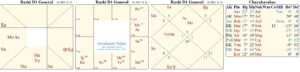
In the chart of Jawaharlal Nehru, the 5th house from Lagna is Scorpio and contains the Sun, the 2nd lord. The 5th house represents one’s intelligence and attitude toward children, while the 2nd house signifies family legacy, values, and personal objectives. When the 2nd lord is placed in the 5th house, children often become closely connected to the native’s family mission and long-term goals.
The Sun in the 5th house can indicate an authoritative and influential approach toward children. Such a placement may cause the native to guide or direct children according to his ideals and objectives. The Sun is also in Sankranti Doṣa, being less than one degree within the sign, suggesting that its significations may manifest with certain complexities. The Sun is the dispositor of Saturn, the 6th and 7th lord, linking children with duty, service, and public responsibilities. This is reflected in Nehru’s relationship with his daughter, Indira Gandhi, who became actively involved in his activities. From an early age she participated in the freedom movement and later provided personal, administrative, and political support. Thus, the placement indicates that Nehru’s daughter became an important part of his mission, legacy, and public life.
The 5th house from Jupiter falls in Aries which is rajas sign from Arudha lagna, whose lord Mars is placed in Virgo in the 3rd house. Mars in Virgo often manifests through intellectual effort, writing, communication, and practical action. This symbolism is reflected in the relationship between Nehru and Indira. Because Nehru was frequently imprisoned during the freedom movement, much of their interaction took place through letters. These letters later became famous as the book Letters from a Father to His Daughter. Indira gradually became Nehru’s close political companion and confidante, assisting him in political and social responsibilities. By the 1950s and 1960s, she had emerged as an influential figure within the Indian National Congress, carrying forward many aspects of her father’s political legacy.
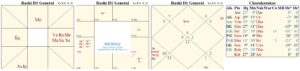
Bill Bixby, who was an American actor, had a six-year-old son, Christopher. Christopher died while on a skiing vacation at Mammoth Lakes with Benet. He went into cardiac arrest after doctors inserted a breathing tube when he suffered from acute epiglottitis.
Jupiter is placed in the Lagna, and the 5th house from it is Capricorn. The 5th house signifies not only children but also one’s relationship with them. Capricorn is heavily occupied by six planets—Saturn, the sign lord; Mercury, the Putra-kāraka; Venus; the Sun; Mars; and Rahu—creating an unusually concentrated and complex influence on matters of the 5th house.
Saturn and Mercury are combust, while Mars and Rahu are in a close conjunction, or yuti. The presence of A2, the Dhana Pāda, further links family and relationship matters with the affairs of this house. From the Ārūḍha Lagna, Capricorn falls in a tāmasika sign, suggesting challenging experiences and emotional burdens connected with 5th-house significations. Venus’s involvement indicates that marital and relational issues may become intertwined with matters concerning children.
In 1980, a divorce occurred, activating the planets in the heavily afflicted 5th house. Shortly thereafter, tragedy struck when six-year-old Christopher died following complications from acute epiglottitis during a skiing vacation at Mammoth Lakes. The conjunction of Mars, the 8th lord from the Lagna, with Rahu in the 5th house can show the breakdown of the marriage and consequently involve the loss of a child. The sequence of events brought profound emotional distress, and approximately a year later, the former spouse died by suicide, deepening the tragic manifestation of these difficult karmic indications.
Hence, severe affliction to the 5th house from Jupiter may indicate difficulties in the father–child relationship. In some cases, it can suggest prolonged separation from the child, limited involvement in the child’s upbringing, or circumstances that prevent the native from spending a significant portion of the child’s life together. The exact manifestation depends upon the condition of the 5th house, its lord, the Putra-kāraka, and the relevant daśā periods.
This case is often cited as an example of how severe afflictions to the 5th house, its significators, and associated Ārūḍha influences can coincide with intense suffering connected with children and family relationships.
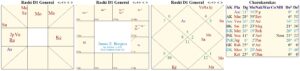
James was killed by his own son, Steve. The nature of the person may be examined through the 5th house from the Lagna, which falls in Sagittarius. Although the 5th house is unoccupied, its lord, Jupiter, is placed in the 12th house in conjunction with Rahu and Venus. The Jupiter–Rahu conjunction is known as Guru-Cāṇḍāla Yoga and is considered a significant affliction to Jupiter’s significations. Since Jupiter is also the 5th lord, this affliction can adversely affect matters related to children. The conjunction of Rahu and Jupiter also influences the Lagna lord, the Sun. The impact is taken by the Sun.
The son’s relationship with his father can be examined from the 5th house from Jupiter, which falls in Scorpio. Scorpio corresponds to the 4th house from the Lagna. Its lord, Ketu, is placed in the 6th house of conflict and enmity, while Mars occupies the 8th house and is aspected by Rahu, forming Kuja Stambhanam. Mars has a severe Māṅgalika influence. In the Navāṃśa, Mars is connected with the 12th house, linking it to loss and potentially violent circumstances.
The tragic manifestation of these combinations was seen when James was fatally stabbed by his son. The indication that the son was the elder is supported by the 5th lord, Jupiter, being conjoined Rahu and Venus, with Venus being the relevant kārya-bhāva lord, the 5th lord in the Saptāṃśa.
From the Ārūḍha Lagna, Cancer is in the 4th house and is a rājasika sign from the Ārūḍha Lagna. Also, these afflicted planets in kendras from the Ārūḍha Lagna can damage one’s public image, domestic harmony, and perceived stability. In this case, these afflictions appear to have manifested through severe disruption within the family, ultimately culminating in a tragic outcome.
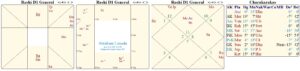
Abraham Lincoln and Mary Todd Lincoln had four sons: Robert, Edward (Eddie), William (Willie), and Thomas (Tad). Of the four children, only Robert Todd Lincoln survived to adulthood and went on to have a successful public career. Eddie died at the age of three, Willie died at eleven while Lincoln was serving as President, and Tad died at eighteen, several years after his father’s assassination. The repeated loss of children brought profound personal sorrow to the Lincoln family throughout their lives.
The nature of the person is first examined from the 5th house from the Lagna. In Lincoln’s chart, the 5th house is empty, while its lord, Mercury, is placed in the Lagna with directional strength (Digbala) and is conjoined the Sun. This generally indicates an affectionate, gentle, and patient nature toward his children, often spending time playing with them. However, to understand Lincoln’s personal experience with children, it is necessary to examine the 5th house from Jupiter.
The 5th house from Jupiter is in Cancer, whose lord, the Moon, is placed in the 12th house of loss and separation. The Moon is further afflicted by the aspect of Saturn and by the influence of the afflicted Mars with Rahu. Such heavy affliction to the lord of the 5th from Jupiter suggests sorrow, anxiety, and loss connected with children. The fact that Lincoln witnessed the deaths of two sons during his lifetime, while all three deceased sons died before reaching full adulthood, reflects the distress indicated by these afflicted planets. The continuity and sustenance of children were therefore significantly challenged.
From the Ārūḍha Lagna, Cancer is in a tāmasika sign, indicating that the native’s experience regarding children would be marked by emotional difficulty and suffering rather than fulfilment. Thus, despite having children of good character and ability, Lincoln’s personal experience of fatherhood was overshadowed by repeated bereavement and profound grief.