
Authored by: Dr. Kunwar Shailen Dev Singh Guleria, Petra Pintaric, Deena Pranav Shah under guidance of Guruji Pt. Sanjay Rath
“आलस्यदुरितक्रान्त्यै वािं कल्पितवान्प्रभुुः” [1]
Lord Śiva discusses the creation of the 4th weekday in this shloka of Śivamahāpurāṇa (14.151/2) where we get to know about the presiding deity of Buddhvāra/Wednesday i.e. Viśvakarmā and Budha/Mercury itself. Viśvakarmā/Viśvadeva is he who gives freedom from “ālasya” (idleness, sloth, lazy, aimless). By his grace native will never be idle/sloth/lazy/aimless. He who teaches everybody work/how to work/where to work and the planet ruling this day is Mercury (Budha). This graha has the power to fight idleness/laziness/sloth/aimlessness conferred by the Tamas Grahas (Mars, Saturn, Rāhu, Ketu).
When native has total freedom from ālasya, person becomes a “karma yogi” something that Lord Kṛṣṇa wants us to be. Thus, Mercury represents much more than intelligence or communication. It is the force that opposes inertia. It is the faculty that converts thought into organized action. Through discrimination, reasoning and proper judgement, Mercury guides the individual away from error and toward effective participation in society. A person free from ālasya naturally becomes a karma yogi, a state repeatedly praised in the Bhagavad Gītā.
In this article, we examine the specific manifestations that arise when a planet of such vital importance occupies the Maraṇa Kāraka Sthāna(MKS) within a native’s chart.
DEFINITION.
The term Maraṇa Kāraka Sthāna consists of three words. Maraṇa means death, decay or gradual movement towards non-existence. It can indicate something that is vanishing from native’s consciousness, sight or memory. A synonym for Maraṇa is Mṛtyu मृत्यु, which can be seen as the final result of the process of Maraṇa.
Kāraka refers to the significations represented by a graha. We must reflect deeply upon the fact that “not everything pertaining to the planet “dies” when it’s in MKS. So the obvious question(s) that follow are:
- Graha kārakatva: What part of the signification of a graha dies? For ex. In case of Mercury, does career/work die or intelligence/learning/speech/communication suffers or maternal uncle dies? Does Mercury in 4th house show a person who does nothing? Or Mercury in 7th house shows a person who orders others to do work, like a manager or top businessman who has people under him to work and himself does nothing? They make other people work?
- Bhāva kārakatva: Ex. When Mercury is in 4th House, does the kārakatva of 4th house i.e. Mother/Moon is getting afflicted? 4th house kārakatva can be social norms, our culture, our behavior in society, our schooling, what our mother taught us? Or maybe it hits the home? Or when Mercury is in 7th house, does the marriage suffers? Or business deals suffer?
- Ādhipatya kārakatva: Ex. in case of Mercury in 7th house, are the domains ruled by the houses owned by Mercury (Gemini & Virgo) also getting afflicted?
Our parampara teaches us that not everything pertaining to the kārakatva (of both graha and bhāva) dies. Let’s uncover this in detail.
Sthana means place or position. Therefore, MKS is not merely a state of debilitation or mathematical weakness; it represents a highly vulnerable, decaying state where the planet’s natural significations lose their vitality/are ruined and its consciousness becomes obscured under the destructive influence of Rudra. The one who stops the signification to die/decay is Bhairava. According to the teachings of our parampara, a planet in MKS behaves exactly like a drowning entity. In its desperate struggle for survival, the dying planet will clutch at any graha conjoining it. While this “drowning” mechanism may allow the MKS planet to periodically recover its breath and survive, the accompanying planet often suffers immensely, pulled under by the weight of the dying graha’s panic. Food for thought from our parampara:
GRAHAS & THEIR MKS POSITIONS: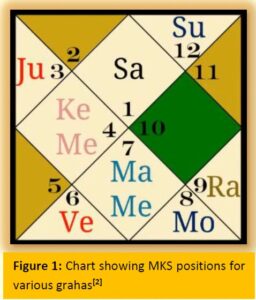
MKS is fundamentally house-specific, not sign-specific. It arises from an ontological conflict between a planet’s inherent nature (Kāraka) and the specific environmental requirements of the house. When the planet’s core purpose is antithetical to the house’s environment, “Kāraka decay” is the result.
Our parampara emphasizes a fact that “Rāhu is the naisargika (natural) marana graha or we can say kāraka/significator of MKS”. One can imagine the graha in MKS to be in possession of Rāhu & its qualities. Each MKS placement acts as a “boil” on the chart. Just as a physical boil forces the entire consciousness to focus on a single point of pain, an MKS placement ensures the individual’s attention is perpetually drawn to the dysfunction of that specific house, often leading to decisions made under duress.
Table 1: Grahas & context of their MKS positions[4]
| Graha (Planet) | MKS Position (House) | Reason / Context |
| Saturn (Shani) | 1st House (Lagna) | It can cause a death-like effect on the lagna, posing a danger to intelligence, longevity (especially in childhood), or cause a person to break away from their family and cultural roots. |
| Jupiter (Guru) | 3rd House | Spiritual Guru goes to Marana in the 3rd house (significator Mars) of parakrama (bravery), maithuna (copulation) and death. |
| Ketu | 4th House | It causes an affliction to the home or affects the mother. |
| Mercury (Buddh) | 4th House and 7th House | Mercury is a dualistic planet with two fathers (Moon and Jupiter), giving it two MKS positions. It feels horrible in the 7th house (the house of Venus). In the 4th house, it can indicate a person who breaks established social norms. |
| Venus (Shukra) | 6th House | Venus is the goddess of marriage and feels highly uncomfortable in the 6th house, which is the house of celibacy. |
| Mars (Mangal) | 7th House | Mars is a warrior planet that rules celibacy, making it highly uncomfortable when forced by circumstances into the 7th house of marriage. Person does not want to get married but is forced by circumstances to do so. |
| Moon (Chandra) | 8th House | The Moon represents the mother, who desires immortality for her child and cannot bear the thought of death, placing her in terrible distress when positioned in the Ayu bhava (house of longevity/death). |
| Rahu | 9th House | Rahu completely lacks truth and Dharma, making it highly destructive in the 9th house (Gurusthan); its placement here causes a person’s spiritual and physical protection to fail. One’s protection/guard will fail. |
| Sun (Surya) | 12th House | The 12th house is the house of sleeping, which clashes with the nature of the Sun, as it is the only planet that never sets or sleeps. |
Additionally, no planet can be in an MKS position in the 2nd, 5th, 10th, or 11th houses. The 2nd, 5th, and 11th houses are granted absolute protection by Guru / Bṛhaspati, representing Jīva-tattva, the life force, through the blessing of Śiva upon Bṛhaspati by virtue of being the Jīva. The 10th house is protected by Budha-graha doing Hari-nāma-smaraṇa, the power of Kṛṣṇa / Viṣṇu. Budha was given this upadeśa by Bṛhaspati. By invoking the name of God, Budha blocks decay in the realm of Karma. The 9th house, in spite of being the Kāraka bhāva of Guru, has a Dharma anomaly because of Rāhu, and thus protection there is lost. Rāhu causes confusion and deviation from absolute Satya, truth, which prevents the absolute protection found in the other houses shielded by Guru and Budha.
MERCURY & IMPLICATIONS OF ITS MKS POSITIONS
Because of his inherent dualistic nature and his mythological lineage of having two fathers—the Moon and Jupiter—Mercury uniquely possesses two positions of Maraṇa Kāraka Sthāna: the fourth house and the seventh house. The underlying tattvic logic of this placement reveals a fundamental elemental clash. Mercury embodies Prithvi tattva, representing grounded, pragmatic, and tangible reality. The fourth & the seventh house, however, are both the natural domain of Jala tattva grahas Moon & Shukra respectively (natural karakas of 4th & 7th bhava); the fourth house represents the emotional domain of the Moon, while the seventh house represents the relational and Venusian domain of partnership. In both situations, Mercury encounters circumstances that cannot be solved through logic alone. Emotional realities demand participation rather than analysis, creating tension for a graha whose natural tendency is discrimination and rational judgement. While mainstream astrological interpretations frequently reduce this placement to a superficial battle between logic and emotion, the doctrinal reality observed in practice points to a much deeper affliction.
In the architecture of the natural zodiac, the fourth house functions as a direct maraka to the third house of Gemini. Gemini represents the realm of playful experimentation, unbound curiosity, and the open playground. Budha, embodying the archetype of the eternal child (kumāra), thrives in this dynamic, exploratory environment. However, the fourth house is the domain of vidyā and formal, structured learning. When the child is forced into the rigid, stationary strictures of a classroom setting, his natural, inquisitive joy is effectively suffocated. Consequently, the native often harbors a deep, instinctual aversion to traditional educational environments. The drowning effect of this MKS manifests as a desperate need to escape the academic enclosure; the native may either reject formal education entirely or, conversely, accelerate their studies at an exhausting pace simply to finish and get out. Even when Buddh occupies a state of supreme dignity, such as exaltation in Kanyā, this fundamental friction persists. The native remains inherently uncomfortable within the classroom, surviving the Marana state only by exerting herculean effort to overcome the structural suffocation.
Just as the fourth house acts as a maraka to Gemini’s playful curiosity, the seventh house acts as the absolute maraka to the sixth house of Virgo (mūlatrikoṇa of Budha). Virgo is the seat of discrimination, purity, and the meticulous ability to research and question. When Buddh is placed in the seventh house, he is submerged in the domain of desires. The parampara teaches that excess sense-enjoyment inherently destroys our discrimination. Therefore, the “drowning” of Mercury in the seventh house is fundamentally the death of the native’s discriminatory power; their purity of action is clouded by desires, leaving them unable to distinguish the correct karmic path for themselves.
REDEMPTION FROM MKS: MODIFYING FACTORS AND REMEDIES
MKS is not a fatalistic sentence; it is a condition that requires “renewed life.” The Primary Redeeming Factors & other are
- Aspect of Jīva (Jupiter): The “greatest blessing” in any chart. Jupiter’s aspect acts as the grace of God to revive a dying planet.
- Strength of the Kāraka: If the house’s natural significator (e.g., Moon for 4th house & Venus for 7th house) is strong and benevolent, the native is protected from the MKS effects. The involvement of karaka in Rajyogas well positioned from lagna ensures success, fame, power & wealth in life.
- Strength of the Nakṣatra Lord: Seen in case of Moon MKS who works through Nakṣatras. Evaluated via the Vimshottari scheme, if the Nakshatra Lord is in the Lagna or exalted, the native gains fame through the MKS planet’s focus.
Other factors mitigating the effect of MKS:
The “Rule of Three” and the Vara Chakra: Siddhi Graha
A peculiar talent (Siddhi) often emerges from an MKS planet by counting third from it in the Vara Chakra Sequence:
Sun → Moon → Mars → Mercury → Jupiter → Venus → Saturn → Rahu → Ketu.
Example: Saturn in the Lagna (1st) often makes one a “king of numbers,” as Ketu (the 3rd in sequence from Saturn) is the Siddhi Graha & represents mathematical precision.
So, in case of Mercury MKS, 3rd in Vara Chakra Sequence is Venus. The Siddhi Graha thus in case of Mercury MKS irrespective of being in 4th or 7th house, is Venus. The irony of Mercury’s Marana lies in the fact that the planet is forced into the very realm it least understands. Mercury seeks reason, while the watery domains of Moon and Venus operate through feeling. Unable to escape these environments, the native is compelled to repeatedly confront emotional realities throughout life.
What begins as discomfort gradually becomes education. What begins as confusion eventually becomes insight. Through this process, the native may acquire an exceptional understanding of human emotions and relationships, allowing Venusian gifts such as powers of persuasion, counselling, diplomacy, social influence, refined taste, aesthetic sensitivity, artistic translation between different cultures or systems of thought, the ability to harmonize conflicting viewpoints, and exceptional skill in presenting ideas in a manner that resonates emotionally with others. In this manner, the suffering of Mercury becomes the doorway to the blessings of Venus.
The Grace of Shiva, Vishnu & Śakti
- Own House (Shiva’s Grace): If a planet is in its own house, the MKS is removed by the strength (Bala) of Shiva.
- Exaltation (Vishnu’s Grace): If a planet is exalted, the MKS is removed by the purity and protection of a specific Avatar of Vishnu.
- Rashi Drishti of House/Bhava Lord (Grace of Ma Śakti): The effects of Marana Karaka Sthana are substantially reduced when the lord of the concerned bhāva casts Rāśi Dṛṣṭi upon the afflicted graha. Such an aspect represents the intervention of Śakti, restoring strength and vitality to the weakened planet.
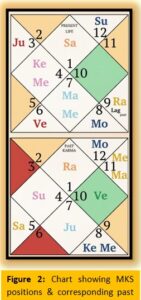 The tradition further teaches several auxiliary principles relating to Marana Karaka Sthana. Additional dicta pertaining to Maraṇa Kāraka Sthāna, whose detailed treatment lies beyond the scope of this article, include:
- An MKS planet automatically activates the Yogakāraka influences of the chart.
- Purva Punya Analysis through the Ninth House [2,5]
In Paramparā, Maraṇa Kāraka Sthāna is not viewed merely as a present-life affliction. It is also examined through the lens of Pūrva Puṇya and karmic inheritance. The ninth house, being the seat of Dharma, Guru, blessings and accumulated merit from previous lives, is taken as the reference point for understanding the deeper karmic causes behind an MKS placement.
The methodology is straightforward. Instead of judging the MKS position from the Lagna alone, the astrologer re-examines the same position from the ninth house. The resulting relationship reveals the nature of the karmic imbalance that may have contributed to the manifestation of the MKS in the present incarnation.
A recurring observation within the tradition is that several MKS positions occupy places of weakness when viewed from the ninth house, suggesting a deficiency or misuse of a particular aspect of Dharma in prior lives. Thus, the MKS placement not only indicates an area of struggle in the current life but also points toward a karmic lesson requiring correction and maturation.
Mercury MKS in the Fourth House: Mercury placed in the fourth house becomes eighth from the ninth house. The eighth house is associated with debts, obligations, liabilities, hidden transactions, inheritances and unresolved karmic entanglements. According to the teaching transmitted in the lectures, Mercury occupying this position suggests that the native may have failed to honour financial or moral obligations in a previous life. The phrase used in the notes is that such a person “did not pay back money,” although this should be understood symbolically as well as literally.
Because Mercury governs commerce, exchange, agreements, accounting and transactions, the karmic lesson may involve restoring integrity in matters of obligation, reciprocity and trust. The resulting MKS in the fourth house may therefore compel the native to confront issues relating to security, belonging, education or emotional peace until these unresolved karmic debts are gradually addressed.
Thus, from the Pūrva Puṇya perspective, Mercury MKS in the fourth house points toward unfinished obligations and unresolved debts carried forward from previous incarnations.
Mercury MKS in the Seventh House: Mercury placed in the seventh house becomes eleventh from the ninth house. The eleventh house governs gains, acquisitions, profits, fulfilment of desires and networks of association. According to the doctrine taught in the lectures, this placement suggests that the native may have pursued gains through questionable or unethical means in previous lives. The notes specifically mention possibilities such as cheating, deception, theft or other improper methods of acquiring wealth or advantage.
However, the tradition also cautions that the exact manifestation depends heavily upon sign placement, house ownership, yogas and planetary associations. Mercury is particularly sensitive because it tends to influence the houses it owns as much as, or sometimes more than, the house it occupies.
The deeper philosophical implication is that the native may have prioritized gain over discrimination. Since Mercury represents judgement, discernment and ethical intelligence, the karmic lesson in the present life becomes one of restoring purity in decision-making and learning to align material success with Dharma.
This interpretation harmonizes remarkably well with the later teaching that the seventh house acts as a maraka to Virgo. Just as desire can destroy discrimination in the present life, the Purva Punya indication suggests that the misuse of discrimination for personal gain may have contributed to the karmic circumstances producing Mercury’s Marana in the first place.
Remedy
When confronting the profound karmic decay of Maraṇa Kāraka Sthāna, our Paramparā teaches an absolute truth: the Kāraka is the hand of God. It is the ultimate lifeline, and any effective remedy must be intimately associated with this natural significator to pull the dying planet from the depths. To successfully appease an MKS graha and resurrect its obscured purpose, one must engage both the physical and spiritual dimensions of its existence.
For example: on a tangible level, if the afflicted planet happens to rule the second house of sustenance, the native is strictly advised to consume foods explicitly associated with that graha, thereby grounding its erratic energy within the physical vessel.
Yet, the ultimate restoration of the planet’s trajectory requires praying to Lord Śiva to strengthen the dharma of the dying graha. The spiritual architecture for determining this specific worship is precise: we locate the mūlatrikoṇa of the MKS planet and count to its ninth house of dharma.
For our topic of interest Budha, the mūlatrikoṇa is Kanyā, and the ninth house from it falls in Vṛṣabha. The presiding Śiva liṅgam for the domain of Vṛṣabha is Somanātha. Therefore, to breathe life back into a dying Mercury and restore its divine capacity to guide right action, the native must seek the grace of Śiva through the Somanātha Liṅgam, dedicating themselves to the continuous repetition of the sacred mantra:
om namaḥ śivāya somanāthāya.
Also apart from this, Lord Balarāma is regarded as a principal remedy for Mercury MKS. As the bearer of the plough, he symbolizes disciplined effort, purposeful action and the cultivation of right karma. His grace helps restore direction and revive the weakened dharma of Mercury.
CLINICAL ANALYSIS: CASE STUDIES IN MKS MANIFESTATION[6,7]
Case Study I: Russell Crowe Mercury MKS in 4th house
Russell Ira Crowe (born 7 April 1964) is an actor and film director. His work on screen has earned him various accolades, including an Academy Award, two Golden Globe Awards, and a British Academy Film Award. Crowe notoriously dropped out of high school at the age of 16. The structured environment of formal vidyā could not contain him, and his dying Mercury forced an early ejection from the classroom to pursue his ambitions in performance and music. Mercury is placed in the fiery domain of Aries alongside Jupiter. The doctrine states that a drowning MKS planet will desperately clutch at any conjoining graha. Jupiter rules the 3rd house (acting, performance, hands) and the 12th house (cinema, foreign lands). Crowe channels the suffocating mental pressure of his 4th house (loss of sukha or inner peace) directly into his 3rd and 12th house pursuits. His most acclaimed cinematic roles—such as John Nash or Maximus—are literal portrayals of highly intelligent men enduring extreme psychological or emotional devastation.
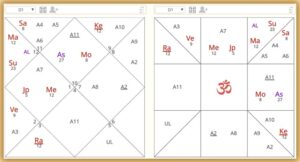
The dying Mercury survives by using his acting craft (Jupiter) as a life raft. Mercury is Prithvi tattva (earth) drowning in Jala (the 4th house), but the specific sign here is Aries, governed by Mars. To trace the symptomology of his internal tension, we must locate the dispositor. Mars sits in the 3rd house of Pisces, conjoined with the explosive 8th lord, the Sun. When the mental friction of the dying Mercury reaches a critical mass, it cannot be contained in the 4th house. It travels to Mars and erupts violently through the 3rd house (communication, the hands, and short-tempered courage). This astrological mechanism perfectly explains his history of public altercations, most notably the 2005 incident where he physically threw a telephone (a 3rd house communication device) in a sudden fit of rage (8th lord influence) injuring a hotel staff member.
The Siddhi Graha: The Rule of Three
Applying the Vāra Chakra doctrine to find the peculiar talent born from this affliction requires counting three steps from Mercury: Mercury → Jupiter → Venus. Venus becomes the Siddhi Graha, meaning Crowe’s ultimate compensatory talent lies within Venusian kārakatvas.
In his chart, Venus is exceptionally strong, sitting in its own sign of Taurus in the 5th house of creative intelligence. His inability to regulate his mental peace (Mercury MKS) is entirely bypassed by his peculiar, world-class talent for cinematic arts, aesthetic expression, and music. Long before acting, his primary outlet was writing and performing in rock bands, utilizing the Venusian harmonics (and 3rd house instruments) to process his internal state.
The core dictum dictates that the natural kāraka of the afflicted bhava must step in to save the native. For the 4th house, this is the Moon. For a Capricorn Lagna, the Moon rules the 7th house (the public) and is placed directly in the 1st house (the physical self and personality).
Despite a trail of PR disasters caused by a short-circuiting Mercury, Crowe’s career has never permanently flatlined. The Moon in the Lagna gives him immense, raw emotional gravity. The public (7th house) connects with him on a visceral, empathetic level (Moon), continually forgiving the transgressions of his intellect because of the undeniable emotional truth he projects on screen.
To soothe a dying Prithvi graha, the native instinctively gravitates toward literal earth and physical karma, invoking the archetype of Lord Balarama’s plough.
Biographical Evidence: Crowe’s ultimate sanctuary is not a luxurious, passive retreat but a 1,400-acre working agricultural property in Australia. By managing livestock, navigating the natural terrain, and engaging in the physical mechanics of a functioning farm, he provides his dying, restless Mercury with a tangible, earthy framework, effectively stabilizing his mind through agricultural karma.
Case Study II : Franklin Delano Roosevelt: Mercury MKS in 7th house
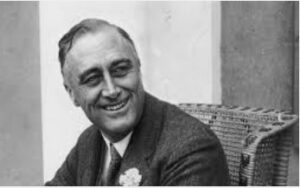
Franklin Delano Roosevelt (January 30, 1882 – April 12, 1945), also known as FDR, was the 32nd president of the United States, serving from 1933 until his death in 1945. He is the longest-serving US president and the only one to have served more than two terms. His first two terms were centered on combating the Great Depression, while his third and fourth focused on US involvement in World War II. A member of the Democratic Party, Roosevelt served in the New York State Senate from 1911 to 1913 and as the 44th governor of New York from 1929 to 1932.
The Death of Discrimination and Pūrva Puṇya.To understand the death of Budha in the seventh house, we must examine the structural architecture of the zodiac. The seventh house acts as the absolute maraka to the sixth house of Virgo, which governs purity, research, and discrimination. When Buddh is placed in the seventh house, his discriminatory power is clouded by desires. Furthermore, applying the Bhavat Bhavam principle, the 7th house is the 11th from the 9th house of Dharma and Pūrva Puṇya. A dying Mercury here points to a past-life ledger tainted by the misuse of resources or questionable gains. The soul incarnates with a heavy mandate to rectify this imbalance.
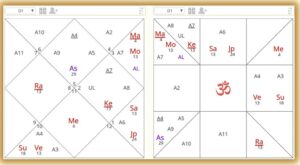
This specific affliction manifested in FDR’s life on two distinct fronts: the personal and the public. On an intimate level, the death of Buddh’s discrimination in the house of kama (relationships) literally clouded his judgment, resulting in multiple illicit affairs—most notably his long-standing relationship with Lucy Mercer. The 7th house MKS destroyed his ability to maintain the purity (Virgo) of his marital vows, profoundly fracturing his marriage. Yet, on a macroscopic level, his karmic mandate forced him to reconcile the historical ledger of his patrician wealth. Because his Mercury rules both the 2nd house (wealth) and 11th house (gains), the New Deal and his administration’s massive taxation on the wealthy effectively executed one of the largest redistributions of wealth in American history. He paid off the karmic debts of his lineage by ensuring that resources were strictly used to sustain the masses rather than for personal, unchecked accumulation.
The Crisis of Personal Action vs. Directing Others
The doctrinal reality of Mercury MKS in the seventh house is that it creates a profound crisis of action. The native possesses a brilliant capacity to know exactly what everyone else should do, but experiences paralyzing hesitation or absolute physical blockage regarding their own path.
Biographical Evidence: During his formative years at Groton School and Harvard College, Roosevelt was relatively undistinguished as an individual student or athlete. His personal academic pursuits—traditional domains of Budha—were lackluster, and he later dismissed that formal logic entirely, remarking, “I took economics courses in college for four years, and everything I was taught was wrong.” However, his capacity to orchestrate group karma flourished early. He became the editor-in-chief of The Harvard Crimson, a position that bypassed individual academic output and instead relied entirely on ambition, energy, and the ability to manage and direct the actions of others. This structural pattern reached its ultimate, literal climax at the age of 39, when a paralytic illness permanently destroyed his physical ability to walk. He was literally immobilized—the supreme physical manifestation of a paralyzed Buddh unable to initiate its own movement. Yet, because the dying Mercury in the seventh house retains its capacity to direct the karma of others, he sat in a wheelchair and orchestrated the New Deal. He directed the complex daily actions of an entire nation while enduring severe, permanent restrictions on his own physical autonomy.
The Kāraka of 7th house: Venus
The core dictum dictates that the natural kāraka of the afflicted bhava must step in to save the native. For the 7th house, this is Venus. The parampara further explicitly notes that for this placement, the spouse often becomes the critical catalyst pushing the native toward action. In FDR’s chart, Venus is the 10th lord of karma, placed in the 6th house of disease, enemies, and servitude, conjoined with the Lagna lord, the Sun. Venus is also getting the malefic 10th aspect of a debilitated Saturn from the 9th house. Crucially, Venus placed in the 6th house is also in a state of Maraṇa kāraka sthāna. This creates a profound double-affliction: the very planet tasked with rescuing the dying Mercury is itself in a state of death. This structural reality dictates that his salvation cannot come through traditional romantic comfort, but only through harsh, sacrificial duty.
Biographical Evidence: When polio struck, FDR’s mother urged him to retire as a quiet invalid. It was his wife, Eleanor (the 7th house karaka), who vehemently fought this, pushing him relentlessly back into the arena of public karma. Because Venus sits dying in the 6th house of disease and servitude, their marriage was fundamentally stripped of its traditional romantic luxury. Following the discovery of his infidelity, the intimate aspect of their marriage effectively died, transforming into a sterile yet incredibly formidable political alliance. Eleanor functioned as his physical surrogate—she travelled the country, descended into dark coal mines, inspected harsh factory working conditions, and fought fierce civil rights battles on the ground. She perfectly fulfilled the role of the Karaka, saving his dying Mercury not through marital bliss, but through relentless 6th house servitude to the nation.
The Siddhi Graha: The Rule of Three
Applying the Vāra Chakra doctrine to find the peculiar talent born from this affliction requires counting three steps from Mercury: Mercury → Jupiter → Venus. Venus becomes the Siddhi Graha, meaning the native develops a highly specialized, almost instinctual reliance on Venusian domains to survive the failure of pure logic.
FDR’s peculiar Siddhi manifested as extreme diplomatic grace and intuitive harmonization. Where cold logic or dictatorial commands would have failed during the panic of the Great Depression, FDR possessed an unparalleled Venusian ability to charm the public. Through his famous “Fireside Chats,” he used the soothing, harmonic tone of his voice to bypass logical fear and connect with the public emotionally. Later, he used this same Venusian Siddhi to hold together the highly fractured, deeply suspicious Allied coalition of Winston Churchill and Joseph Stalin, winning a global war through relationship-building rather than brute intellectual force.
The Balarama Theme
To soothe a dying Prithvi (earth) graha, the native must invoke the archetype of Lord Balarama’s hala (plough)—relentless, earthly labor.
FDR pulled America out of its economic depression not simply by printing money, but by handing men tools and putting them into the dirt. He executed the Balarama remedy on a massive national scale by creating the Civilian Conservation Corps (CCC). He sent millions of unemployed young men into the wilderness to plant over 3 billion trees, construct natural water reservoirs, and physically till the soil. He anchored the panicked mind of a dying nation in relentless, purposeful, earthly karma, mirroring the exact cosmic remedy required to resurrect a dying Buddh.
Conclusion
Ultimately, Marana Karaka Sthana forces the soul to confront pain. Any MKS planet is often one of the most compelling reasons for a soul to take rebirth, representing an unfinished karmic lesson that demands both serious study and compassionate understanding from the Jyotishi.
Mercury in Maraṇa Kāraka Sthāna is not merely a planetary weakness, but a profound karmic lesson concerning the proper use of discrimination, knowledge and action. Whether through the constraints imposed upon curiosity in the fourth house or the erosion of discrimination through desire in the seventh house, Mercury is compelled to confront the limitations of its own nature. The tradition teaches us that within every Marana lies the seed of Siddhi, and therefore no MKS placement should be interpreted fatalistically. Through appropriate remedies, righteous conduct, disciplined effort, divine grace and the refinement symbolized by Venus, the native gradually transforms confusion into wisdom and vulnerability into mastery. Thus, Mercury MKS ultimately represents not the destruction of intelligence, but its purification.
ॐ तत् सत्
Further studies:
While the theoretical foundations of Maraṇa Kāraka Sthāna provide the framework for interpretation, its deeper nuances are best appreciated through the study of lived experience. Students of Jyotisha are therefore encouraged to analyze the horoscopes of well-documented personalities and correlate the condition of Mercury with significant events, behavioural patterns and life outcomes. Some prominent examples of individuals possessing Mercury in Maraṇa Kāraka Sthāna include:
- Mukesh Ambani (Indian Businessman): Mercury MKS in 7th H
- R. Rahman (Indian Musician): Mercury MKS in 7th H
- Adolf Hitler (Dictator): Mercury 7th H
- Jawaharlal Nehru (Indian Politician): Mercury MKS in 4th H
- Zsa Zsa Gabor (American Actress): Mercury MKS in 4th H
- Aaron Copland (American Composer): Mercury MKS in 4th H
Bibliographic Reference
1. Vyasa, K. D. (n.d.). Shiva Maha Purana: Part 1 (First Half) (Gita Press, Trans.). Gita Press. (Original work published ca. 4th–10th century CE). Digital archive edition retrieved from archive.org. For the specific verse (Vidyesvara Samhita 14.15a), the in-text citation is (Shiva Purana, n.d., Vid. Saṃ. 14.15a). View the source at Internet Archive.
2. Rath, S. [Raman Suprajarama]. (2022, October 23). Marana Karaka Sthana | Pandit Sanjay Rath | Vedic Astrology Master Class 2022 [Video]. YouTube. https://www. youtube.com/watch?v=yys8U6Fw-zM&t=14s
3. Rath, S. (2021, October 15). Marana Karaka Sthana and the Seventh House [Private course video]. Parāśara Jyotish Course Year 5, Devaguru Brihaspati Center
4. Gor, K. [Vastu & Vedic Astrologer Kaartik Gor]. (2020, September 25). Karaka & Marana Karaka Sthana | Vedic Astrology [Video]. YouTube. https://www.youtube.com/watch?v=ToS7Smf9C3U&t=2145s
5. Fedorova, N. (2022). Marana karaka sthana, Kashi Jyotish conference 2022 [Video]. YouTube. https://www.youtube.com/watch?v=etF5Y6sx8qo
6. Russell Crowe. (n.d.). In Wikipedia. Retrieved June 5, 2026, from https://en.wikipedia .org/wiki/Russell_Crowe
7. Franklin D. Roosevelt. (n.d.). In Wikipedia. Retrieved June 7, 2026, from https://en.wikipedia.org/wiki/Franklin_D._Roosevelt



ॐ गुरवे नमः 🙏🏻 truly Enlightening and inspiring writing ✍️