Written by Krystal Soultry
From the teachings of my jyotish guide and Guru Pt. Sanjay Rath, for whom I have deep respect, all mistakes are my own.
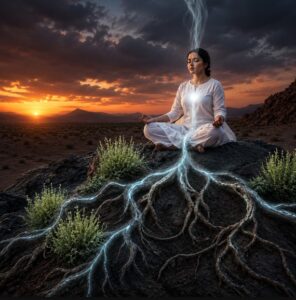 What remains when the Moon no longer gives back its light? When the luminous current that feeds the mind, the emotions, and the body’s tides withdraws entirely from the sky? Amāvasyā (New Moon) is that moment. The thirtieth tithi. The exact conjunction of Sun and Moon, when the Moon’s illuminated face turns away from Earth and the side we never see faces us instead. What exists on the dark side of the Moon, is the realm of the Pitṛs, the ancestors, and Amāvasyā is when that realm and this one come closest to one another.
The Moon covers roughly thirteen degrees of the zodiac each day while the Sun covers one, so the gap between them changes by twelve degrees daily, and a tithi is that twelve-degree step. Thirty such steps close the full circle of 360 degrees and return the Moon to the Sun’s side. At that meeting the illuminated face aims sunward, the dark face aims at Earth, and the vanished Moon receives its oldest name: Kālī, literally the dark, the black.
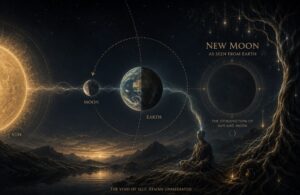 It is the meeting of the two luminaries at zero degrees of separation, the Moon’s movement inseparable from the Sun’s. Wherever this conjunction falls, in whichever chart it appears, that chart carries the quality of Amāvasyā.
When Sun and Moon unite, Asta (setting) and Udaya (rising) conjoin, and the Vāyu of Chandra meets the Agni of Sūrya. Wind and fire do not make peace with each other, and the day carries that conflict in its field. Amāvasyā is considered inauspicious for ordinary undertakings for exactly this reason.
The Moon functions as a mirror. It returns solar light toward Earth, and through that reflection the mind is given the conditions to perceive itself: the Arūdha, the image of the self, held up for the living to see. On Amāvasyā that mirror turns away. Submerged in the Sun’s light, its face aimed toward the soul and away from the world, the lunar mirror goes dark. The ordinary medium through which we perceive ourselves and our circumstances withdraws, and what remains, for those who can stay still inside it, is something closer to the ātmā itself, unmediated, with no reflection standing between. It belongs to the realm of the Devas and the Pitṛs, not to waking earthly consciousness. This is why Amāvasyā is described as carrying a weight that most people feel but cannot name.
When the Moon vanishes, its nurturing essence, Soma, the lunar nectar that feeds mind, body, and the bonds between the living and their line, descends into the earth’s vegetation, into roots and sap, underground, while the soft lunar current that ordinarily moves through memory, emotion, and the body’s fluids is no longer available to the living.
Following the direction of the withdrawal, the bright fortnight shows the Sun pouring light into the Moon while the Moon fills; the Sun pours light into the Moon and through the nakṣatras the Moon measures out Soma in that half, and the gods preside. Through the waning fortnight the current reverses, the Moon gives back what it received, and the powers presiding are the Pitṛs, who are the Maharṣis, the great seers sustaining all creation with the very nectar they return. So when Soma sinks into root and sap at Amāvasyā, nothing is lost. The nectar is travelling home along the line it came down, ancestor to ancestor, toward the source.
The darkness that settles over the tithi stays concealed in ordinary light it becomes perceptible once the light is gone. The weight of what has been inherited, the debts older than this lifetime, the presence of those who came before and have never been properly met, all of it surfaces when the lunar mirror turns away and the day goes still.
 The half-days surrounding the conjunction are governed by fixed Karaṇas (half-tithis) called Sthira Karaṇas, and their function is stabilization at the edge of a threshold where the ordinary markers of time dissolve. Śakuni, one of the four fixed Sthira Karaṇas, governs the last half of the fourteenth tithi, the final movement before the conjunction arrives.
The remedy is the pañcākṣarī, the five syllables of Śiva, and the choice tells you what kind of night this is: Śiva is invoked where something must burn. By the fourteenth tithi the Moon has decayed to a last thread of light, and the name the night carries is naraka caturdaśī, the caturdaśī of the netherworlds. What a lifetime has gathered and never answered for exerts its full downward pull here, drawing the soul toward those depths, and the five syllables are recited so that the fire of Śiva consumes that weight first.
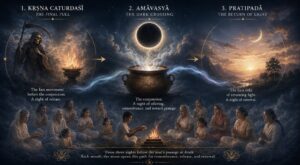
The sequence of these nights carries a weight beyond doṣa and remedy. Kṛṣṇa Caturdaśī is taught as the symbolic expression of death itself, maraṇa, and this is why namaḥ śivāya belongs specifically to that night. The Amāvasyā that follows is described as a night of boiling in the pot, a night for calling out to the mother, to Kālī, the only one who can carry the soul through it while Śiva remains in dhyāna. Pratipadā, the first tithi of the returning light, is birth again: a night of pratikāra, the atonement that follows the darkness before the newly risen Moon is seen. These three nights follow the same sequence as the soul’s passage at death: the fourteenth is dying, Amāvasyā is the dark crossing, Pratipadā is the return to light. The lunar calendar runs this sequence every month. Twelve times a year the soul is given the same three nights to meet consciously what death will one day require of it.
नमः शिवाय namaḥ śivāya
ॐ नमः शिवाय oṁ namaḥ śivāya (with praṇava, for the initiated)
When the fifteenth tithi arrives, the last thread of light goes out and Soma withdraws into the plants and trees. The same fire of Śiva invoked on the fourteenth night does not stop there. It is the fire that, for the soul who has prepared, burns a path through Chandra-loka entirely.
And what one crosses into is more than darkness — it is a realm.
Chandra-loka is where most souls go at the moment of death itself. It is the waiting room of saṃsāra. More precisely it belongs to Bhuvaloka, the intermediate stratum between the earthly world and the heavens, and it is here that the soul’s sorting begins. A soul carries exactly what it could not release in life: the emotional residue, the unfinished longing, the pull of everything left incomplete. They are the very substance the soul is made of at the moment of crossing, and they determine how long it waits and what draws it back. The binding force is Pitṛ-ṛṇa, ancestral debt, the obligation to those who came before that went unmet before the body was left. Until that debt is addressed the soul cannot move upward. It remains in Chandra-loka, waiting.
In Kali Yuga a further difficulty has arisen. Earthly attachment has grown dense enough that many souls cannot complete even the first crossing. They remain suspended between the world they left and the lunar realm they cannot quite enter. Tarpaṇa, the water offering that feeds the ancestors directly, and Śrāddha, the rites of ancestral propitiation, address both conditions: nourishing those who have reached Chandra-loka, and helping release those caught between.
Because Chandra-loka belongs to Bhuvaloka, it is the nearest threshold. The soul does not journey far to reach it. It is immediately above the physical world, accessible at the first crossing precisely because of where it sits in the structure.
Amāvasyā-anta, the exact moment the conjunction completes, is when the Pitṛs fall asleep. In the hours before that moment they are present, having descended to be near what they left. The darkness of Amāvasyā is the very condition of that closeness. At no other point in the lunar cycle do the living and the Pitṛs draw so near.
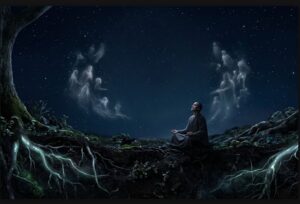 The ancestors form an order, and the order descends: from the most impersonal height down to the most intimate, from cosmic principle down to the face you still remember. At the summit stand the seven principal Deva-Pitṛs: Kavyāvāha, Anala, Soma, Yama, Aryamā, Agniṣvāttā, and Barhiṣat. These are no one’s grandparents, they are the founding powers of ancestry itself, the seven through whom the bond between the living and the dead first entered the world.
The types of Pitṛs are Deva Pitṛs, Soma Pitṛs, and Bārhiṣads, and these correspond directly to three of the seven primordial lords named above. The Deva Pitṛs are the divine ancestors — beings such as former Indras who, having completed their tenure, became ancestral powers worshipped even by subsequent Devas at their own Pitṛpakṣa. The Soma Pitṛs are the lunar ancestors, keepers of the Soma current that flows through the Moon into all living beings. And the Bārhiṣads are those connected to the sacred grass (barhis) of fire sacrifice, the Pitṛs who receive offerings through the ritual fire of the earth. Among the seven deva-pitrs, Soma is the third, the Moon itself as Pitṛ-lord, holding the nectar-channel through which all other ancestral powers are nourished. Closer still to the living are the Mānuṣya Pitṛs, the human ancestors of one’s own family, the most intimate of all the ancestral orders and the most directly reached by Tarpaṇa.
There is a nakṣatra-level confirmation of where the Pitṛs take residence in the cosmic structure: the male solar line, running from Aśvinī through the nakṣatras, ends precisely at Maghā. Maghā is where the male lineage terminates. Maghā’s presiding devatā is the Pitṛ, the ancestral powers. At Maghā, the Moon takes over from the solar line, and the ancestral field begins. This is why Maghā nakṣatra is the nakṣatra of Pitṛ karma, and why it falls in Leo — the sign of the Sun’s own sign, at the exact point where solar dominance gives way to the lunar ancestral order.
To worship these seven on Amāvasyā is to address the whole structure of ancestry at its root, and the teaching attaches two fruits to the act. The flaw of Amāvasyā birth is lifted. And the quieter inheritance of a bloodline, the covetous and grasping tendencies that pass unexamined from one generation into the next, is redeemed along with it.
The Mānuṣya Pitṛs are the human ancestors, the dead of one specific family, your family: the named, the half-remembered, and the ones whose names were already lost a generation before you were born. These are the nearest of all. These are the ones who descend during the waning fortnight and sit with the household through the dark of the Moon, and these are the ones most directly reached by Tarpaṇa. When you cup the water and let it fall, it falls first into their hands.
This is why the order matters at Amāvasyā. The seven lords are the principle; and the water you offer climbs back up the very line it once came down. You feed the nearest, and through the nearest the debt travels toward the root.
The Sun is the natural Pitṛ, the father principle, and Pitṛpakṣa is the most potent period of the year for Śrāddha rites, when the solar force stands most aligned with Chandra-loka and offerings reach those waiting there most directly.
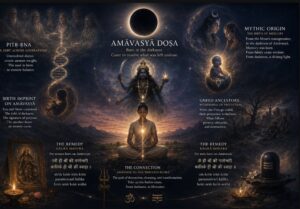
When a soul is born on Amāvasyā, the chart carries Amāvasyā Doṣa. The darkness pressing on the Moon at birth is the signature of why that soul came: to meet a Pitṛ debt that accumulated in the family across generations, something neglected or left unresolved by those who came before. The soul born on the New Moon carries that weight because it came, specifically, to address it.
Sun and Moon sitting together in a chart is, strictly, a tithi-doṣa, a flaw of the lunar day, and this on its own is not yet a mark of ancestral debt. Casual reading folds the two into each other, but the doṣa of Amāvasyā birth is a specific condition of the tithi, and by itself it does not prove that a family carries an unresolved Pitṛ-Ṛṇa.
A deeper layer of the Amāvasyā birth teaching: when a child is born on Amāvasyā, this is confirmation that the mother is under a curse at the time of that birth: she does not know why she is suffering, but the suffering is there. The child born on the new moon is not merely carrying their own weight; they are confirming and inheriting a condition already present in the maternal line. This is why the remedy works through both the Kālikā mantra (which addresses the child’s own tithi condition) and the ancestral rites (which address the line from which it came).
The mythological grounding of Mercury’s nature carries the same signature: Mercury was created in absolute darkness, in the tamas of Amāvasyā, from the false love of the Moon toward his mother. From that falsity and that darkness Mercury came — and yet he came out shining, because his original colour is a shining black, a darkness that carries its own luminosity.
The reason the fifteenth tithi belongs to the Pitṛs is told as a story, and the story is about a debt. Chandra desired Tārā, wife of Bṛhaspati, preceptor of the gods, and took her on the fourteenth night of the waning fortnight; the guru’s curse followed him for it. Then, on Amāvasyā itself, hidden among the plants where Soma conceals itself on that night, the defilement was completed, and from it Budha, Mercury, was born. A wrong against a guru and a wrong against a woman were written into the darkest night of the month, and that night is given to the Pitṛs as its deity.
When the Pitṛs go unfed, their protection withdraws, and what follows is: poverty, and destruction. It is that invisible protection, those unseen hands, that holds people upright when their own strength gives out. Most never know they are held by it until it is gone, and by then the source of what has unravelled is no longer obvious.
Girls born on Amāvasyā carry this in its most concentrated form. In this frame they are understood as incarnations of Mahāvidyā Kālī, the darkness given form, the designated transformer of everything in the family that has not yet been faced. This is a lens of purpose, a reading of why the soul chose that night, not a verdict passed on a child. Precise tools are given for this incarnation, and the capacity to work with the energy is treated as native to the birth itself.
For those born on Amāvasyā, a specific remedy is given in the form of a seventeen-syllable mantra addressed to Parameśvarī Kālikā, who is worshipped in Puri and whose other name is Rādhikā. A picture of Rādhā is kept, and the mantra is recited every evening before dinner to bring stability to the life. The mantra differs by gender.
For women born on Amāvasyā:
स्तीं हीं श्रीं क्रीं परमेश्वरी कालिके हीं श्रीं क्रीं स्वाहा ॥
strīṁ hrīṁ śrīṁ krīṁ parameśvarī kālike hrīṁ śrīṁ krīṁ svāhā
For men born on Amāvasyā:
ॐ हीं श्रीं क्रीं परमेश्वरी कालिके हीं श्रीं क्रीं स्वाहा ॥
oṁ hrīṁ śrīṁ krīṁ parameśvarī kālike hrīṁ śrīṁ krīṁ svāhā
There exists what is called the ‘Amavasya connection’: a direct path from Amāvasyā to Śiva through Rudra. The Pūrṇimā has its own connection to Śiva through Kṛṣṇa, but Amāvasyā reaches Śiva through Rudra, the form of Śiva that governs destruction, cleansing, and the dark half.
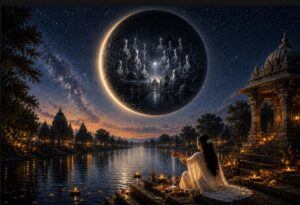 The primary ritual response to Amāvasyā is Tarpaṇa, the act of feeding the Pitṛs directly. The word means to satiate, to revive the mantra devatā through ritual offering, and the rite is the living reaching across the threshold of the tithi to place nourishment into the hands of those waiting in Chandra-loka. Śrāddha is the more complete rite, performed formally on Mahālaya Amāvasyā and throughout Pitṛpakṣa, extending what Tarpaṇa begins. Both belong to the waning fortnight, the period when the Pitṛs are awake and able to receive.
Pitṛ, in this offering, reaches wider than the father’s line. The tradition holds Mātṛ within the same word : Pitṛ includes Mātṛ, and Śrāddha performed for one’s ancestors reaches both lines together, the forefathers and the foremothers, even though the season carries only the name Pitṛ-Pakṣa.
Mangal carries a particular charge within this structure. Where Sun and Moon govern the wider Pitṛ order, Mangal governs Kula, the family specifically, the ancestors of one’s own household who have passed, and Svadhā is named as the Mother-form that answers to Mangal in this role. To neglect the family ancestors, in this teaching, is to invite Mangal’s particular severity, and the remedy given for Mangal placed in the fourth house especially is the yearly, sincere performance of Śrāddha at Pitṛ-Pakṣa, kept up rather than performed once and considered discharged.
The most direct cosmological statement of why the dark side belongs to the Pitṛs: when night comes, one’s back is turned to the Sun. In that position, facing away from the Sun, into the dark sky, one is facing the Pitṛs. Of all the Pitṛs, the highest are the Ṛṣis. The Śakti of this night-face is Kāli, whose very name means ‘dark.’ The sky’s black colour is Kāli herself. When one says Kāli, Kāli, Kāli, one is saying Svadhā, Svadhā, Svadhā: the sacred word of the Pitṛ offering. And what one receives from the dark side is not material nourishment (which comes from the Sun side through Svāhā / Rādhā) but knowledge: the moon side, the dark side, the Pitṛ side, is the Brahmana-guru side, the side from which the mind receives its capacity to know.
The crow, Kāka, is the natural messenger of the Pitṛs, the living interface between the ancestral realm and the physical world. To feed a crow on Amāvasyā is to transmit directly to those in Chandra-loka. Cows carry the same function. The donation of food on this day is held in a high act of charity because it addresses the deepest layer of obligation, the one most people carry without knowing it is there.
The full procedure of Tarpaṇa belongs to instruction. It should be learned properly, from a teacher or a qualified priest, since the details vary by lineage and by family practice. What requires no instruction is already named here: feeding the crow, feeding the cow, the donation of food. These are the open doors of the rite, available to anyone on any Amāvasyā.
Gathered plainly, the practice of caturdaśī and Amāvasyā runs as follows. On kṛṣṇa caturdaśī, recite the pañcākṣarī of Śiva. Through Amāvasyā itself, set ordinary undertakings aside and let the day be one of descent rather than activity. Offer Tarpaṇa if the practice has been learned. Feed the crow and the cow, and give food, if it has not. Those born on Amāvasyā add the Kālikā mantra in the evening, and those who wish to reach the whole ancestral order at once carry the Svadhā mantra. At Amāvasyā-anta, when the conjunction completes and the Pitṛs withdraw into sleep, the light returns.
ॐ ह्रीं श्रीं क्लीं स्वधा देव्यै स्वाहा
oṁ hrīṁ śrīṁ klīṁ svadhā devyai svāhā
Chandra-loka is a transit point, and for souls who have cleared their Pitṛ-ṛṇa, or who cultivated sufficient spiritual depth in life, a road exists that bypasses it entirely. This is the Śiva path. Where the Moon holds the soul in the emotional residue of saṃsāra, Śiva is the point at which that hold releases. For those with the right orientation at the moment of death, Śiva-dūtas intervene and the soul is redirected upward, toward Svarga Loka, Satyaloka, or liberation itself, instead of returning to Chandra-loka for another cycle.
From Svargaloka, where Indra resides, the soul may ascend further: to Mahāloka for those who did something great, to Janarloka for those who gave themselves in service to the world, to Taparloka for renunciates who left Saṃsāra, to Satyaloka for those who embodied absolute truth as Yudhiṣṭhira did. Beyond these, one may take the path of the night toward the 14 Rudralokas, and from there, having exhausted all desire, proceed to Kailāsh. The lokas above Chandra-loka are not destinations the mind imagines — they are destinations the mind earns, through what it chose while it still had a body.
The Pitṛs sleep through Śukla pakṣa, the waxing fortnight. The ancestral pull on any soul is at its weakest then. The waxing Moon does not nourish the ancestral field the way the darkness of Kṛṣṇa pakṣa does, and for those genuinely oriented toward Mokṣa rather than return, the waxing fortnight is the window in which Chandra-loka’s hold on the soul loosens. The Śiva path does not open uniformly at all times. Its conditions are embedded in the lunar calendar, and they turn on the same axis as Amāvasyā itself.
Each Tarpaṇa performed during Kṛṣṇa pakṣa reduces the Pitṛ-ṛṇa by a measure. Each offering made on Amāvasyā addresses the deepest point of that debt. The obscurity of this tithi is neither an obstacle to be managed nor a mood to be waited out. It is a specific condition of visibility, and what can be seen inside it, the weight of what was inherited, the presence of those who came before, the path that lies beyond the lunar realm, can be seen in no other way.
The Moon returns to the Sun once every thirty tithis. Each conjunction marks the close of the Pitṛ-governed dark fortnight and the opening of the Deva-governed bright one. Tarpaṇa belongs to the former; the upward path belongs to the latter. The rites and remedies described in this text are calibrated to that alternation, and their efficacy depends on the timing being observed.
May your path stay illuminated.
oṁ Namaḥ Śivāya