Written by Prema Raj , inspired by the teachings of Guruji Pandit Sanjay Rath
सूर्य — Ātmakāraka, Rāja, Pitṛkāraka
A Comprehensive Study of the Solar Graha
In Jyotish, the Sun (Surya) is the supreme Graha (planet)—the king (Rāja) of all planets. He is the Ātmakāraka, the natural significator of the soul (Ātmā), self, and consciousness. All life in the solar system derives its light and energy from the Sun, making him the first among Navagrahas.
“Surya is the soul of the Kālapurusha (Cosmic Being). Without him, no Graha has independent light or power.” — Bṛhat Parāśara Horā Śāstra (BPHS), Ch. 3
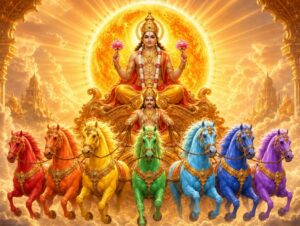 Ātmā (Soul, Self, Spirit) — the innermost spark of individual consciousness
- Pitṛkāraka — father, paternal lineage, ancestral heritage
- Rāja — royalty, government, authority, political power
- Prāṇa — life force, vitality, immunity, general health
- Tejah — radiance, brilliance, fame, prestige, honour
- Netra (right eye) — eyesight, illumination, perception
- Dharma — righteousness, law, duty, moral backbone
- Svātantryam — independence, self-reliance, individuality
- Sthāna — position, status, dignified rank in society
- Atma-vichara — self-inquiry, ego, pride
📚 Source: BPHS Ch. 3 (Grahaguṇādhyāya); Uttara Kālamṛta, Khanda 4
Classical texts describe Surya as having a square body (Chatura-Samsthāna), tawny/honey-colored hair and eyes, a bilious (Pitta) temperament, and very limited hair. He is of royal bearing, pure in conduct, and supremely powerful. His complexion is described as copper-red (Tāmra varna) or deep crimson.
- Element (Tattva): Fire (Agni) — transformation, illumination, courage
- Guna: Sattvic (primarily), with Rajasic qualities in action
- Gender: Male (Purusha)
- Caste: Kshatriya (Warrior-ruler class)
- Direction: East
- Season: Grishma (Summer / hot season)
- Day: Sunday (Ravivāra)
- Number: 1
- Gemstone: Ruby (Mānikya)
- Metal: Gold (Suvarna)
- Colour: Copper-red, saffron, orange
- Taste: Pungent (Kaṭu)
- Deity: Vishnu (as Hari), also associated with Shiva as Maheshvara
📚 Source: Sārāvalī, Ch. 5; BPHS, Ch. 3; Phala Dīpikā, Ch. 2
The Sun governs the following anatomical regions and health areas in Jyotish medical astrology (Ayur Jyotish):
- Heart (Hṛdaya) — the principal organ governed by Sun
- Right eye (in males); left eye (in females)
- Bones and skeletal structure
- Spine and back
- Stomach (upper digestive fire — Jāthara Agni)
- Blood and circulatory system
- Head and brain (consciousness aspect)
- Immune system — general Ojas/vitality
Afflicted Sun can indicate: heart disease, eye disorders, bone problems, ego-related psychological distress, fevers, and issues with the father.
📚 Source: Jātaka Pārijāta, Ch. 4; Bṛhat Jātaka, Ch. 15 (diseases)
The Sun’s relationships with other Grahas are foundational for understanding chart dynamics, Sambandha (connections), and Yoga formations.
| Graha | Relationship | Mutual? | Key Dynamic |
| Moon (Chandra) | Friend (Mitra) | Neutral ↔ Friend | Emotional mind & soul — mother & father |
| Mars (Mangala) | Friend (Mitra) | Friend ↔ Friend | Courage, energy; best natural ally |
| Jupiter (Guru) | Friend (Mitra) | Friend ↔ Friend | Wisdom, dharma; Guru-Shishya bond |
| Mercury (Budha) | Friend (Mitra) | Neutral ↔ Friend | Mercury is neutral to Sun |
| Venus (Shukra) | Enemy (Shatru) | Enemy ↔ Enemy | Opposite values; artistic vs. austere |
| Saturn (Shani) | Enemy (Shatru) | Enemy ↔ Enemy | Father-son conflict archetype; ego vs. karma |
| Rahu | Enemy | Enemy ↔ Enemy | Obsession shadows solar clarity; eclipse |
| Ketu | Enemy | Neutral | Detachment vs. solar ego; moksha tension |
📚 Source: BPHS, Ch. 3 (Naisargika Maitri); Sārāvalī, Ch. 6
Exaltation — Uccha (Mesha / Aries, 10°)
The Sun reaches maximum strength at exactly 10° of Mesha (Aries). This is called Paramocchabāla — peak exaltation power. Mesha is the first sign, governed by Mars, a natural ally. The fiery, pioneering, cardinal energy of Aries perfectly channels solar authority and vitality.
“In Mesha, the Sun shines like a king on his throne — commanding, radiant, and unopposed.” — Phala Dīpikā, Ch. 1
- Exaltation sign: Mesha (Aries)
- Exact exaltation degree: 10° Mesha (Paramocha point)
- Exaltation range where Sun is strong: 0°–20° Mesha
- Effects: Fame, governmental authority, leadership, physical vitality, strong father, clarity of purpose
- Exalted Sun natives: Often in positions of authority, governance, military leadership, medical fields
- Neecha Bhanga (cancellation): Even when debilitated (in Libra), certain Yoga combinations cancel the weakness and can give extraordinary results
📚 Source: BPHS, Ch. 3, v. 20-23; Uttara Kālamṛta, Khanda 4; Jātaka Pārijāta, Ch. 1
Debilitation — Neecha (Tula / Libra, 10°)
The Sun is most weakened at exactly 10° of Tula (Libra), the sign of Venus—Sun’s natural enemy. Libra represents balance, relationships, and compromise, all values that conflict with the Sun’s natural need for individual sovereignty and dharmic authority.
“The Sun in Tula is like a king stripped of his crown — his light dims, his authority wavers.” — Sārāvalī, Ch. 5
- Debilitation sign: Tula (Libra)
- Exact debilitation degree: 10° Tula (Paramaneecha point)
- Effects: Diminished ego strength, dependency on others, difficulty asserting authority, father issues, poor eyesight, compromised confidence
- Health risks: Weakened heart, eye problems, vitamin D deficiency
- Career: Struggles with recognition; may work under others or lack autonomy
Neecha Bhanga Rāja Yoga (Cancellation of Debility)
Classical Jyotish provides specific conditions that can cancel or reverse a debilitated Sun, transforming weakness into a powerful Rāja Yoga:
- The lord of Tula (Venus) is in a kendra (1, 4, 7, 10) from Lagna or Chandra
- The planet that gets exalted in Tula (Saturn exalts in Libra) is in a kendra
- The lord of the sign where planet is exalted (Sun exalts in Aries — Mars rules Aries) is in a kendra
When Neecha Bhanga occurs, the native often rises from humble or difficult beginnings to achieve extraordinary recognition — the very struggles of early life become the catalyst for greatness.
📚 Source: BPHS, Ch. 34 (Neecha Bhanga); Phala Dīpikā, Ch. 6; Jātaka Pārijāta, Ch. 8
Own Sign — Svarāshi (Simha / Leo)
Leo (Simha) is the Sun’s own sign (Svarāshi). The Sun is entirely at home in Leo — expressing its natural qualities of royalty, creativity, leadership, and dharmic pride without interference from other planetary energies.
- Svarāshi: Simha (Leo) — full range 0°–30°
- Effects: Regal bearing, natural authority, creative expression, dramatic personality, generosity, pride
- Strong dharmic compass; consistent character; loyal and protective
- Potential challenges: Arrogance, ego inflation, difficulty accepting criticism
📚 Source: BPHS, Ch. 3; Uttara Kālamṛta, Khanda 4
Mūlatrikoṇa Rāshi (Primary Strength Zone)
The Mūlatrikoṇa (root-triangle) sign of the Sun is also Simha (Leo), but specifically between 0°–20° of Leo. This is considered stronger than regular Svarāshi but weaker than Uccha (exaltation).
| Dignity | Sign / Degree | Strength | Score (6-pt) |
| Uccha (Exaltation) | Mesha, 10° (exact) | Maximum (Parambala) | 5 |
| Mūlatrikoṇa | Simha, 0°–20° | Very Strong | 4 |
| Svarāshi (Own Sign) | Simha, 20°–30° | Strong | 3 |
| Mitrarāshi (Friend’s Sign) | Dhanu, Meena, Karka, etc. | Good | 2 |
| Samarāshi (Neutral Sign) | Various | Moderate | 1 |
| Shatru Rāshi (Enemy’s Sign) | Tula, Kumbha, etc. | Weak | 0.5 |
| Neecha (Debilitation) | Tula, 10° (exact) | Minimum (Paramaneecha) | 0 |
📚 Source: BPHS, Ch. 3 (Graha dignities); Uttara Kālamṛta, Khanda 4; Sārāvalī, Ch. 5
The following table and descriptions detail the Sun’s expression through each of the 12 zodiac signs, drawing from classical Jyotish texts including BPHS, Sārāvalī, Phala Dīpikā, and Jātaka Pārijāta.
| Rāshi | Dignity | Degree | Classical Interpretation |
| Mesha (Aries) ♈ | Exalted (Uccha) | 10° | Pioneering, courageous, forceful leadership; very strong Sun giving fame, vitality, authority |
| Vrishabha (Taurus) ♉ | Neutral | — | Wealth-oriented, artistic; Sun less comfortable—ego vs. Venus softness; steady but slower expression |
| Mithuna (Gemini) ♊ | Neutral | — | Intellectual, communicative Sun; witty, adaptive leadership; Mercury’s sign dilutes solar fire slightly |
| Karka (Cancer) ♋ | Neutral | — | Nurturing leadership; Moon’s sign brings emotion to solar ego; patriotism, domestic focus, moody will |
| Simha (Leo) ♌ | Own Sign (Sva) | — | Strongest natural placement; royalty, confidence, creativity, dharmic pride; bright, magnanimous, theatrical |
| Kanya (Virgo) ♍ | Neutral | — | Service-oriented Sun; Mercury’s sign gives analytical, critical, perfectionist quality; good for administration |
| Tula (Libra) ♎ | Debilitated (Neecha) | 10° | Weakest placement; ego in Venus’ sign; compromised authority, dependency, difficulty asserting self |
| Vrishchika (Scorpio) ♏ | Neutral | — | Intense, investigative; Mars’ sign gives transformative, secretive solar power; strong but combative ego |
| Dhanu (Sagittarius) ♐ | Friendly | — | Philosophical, dharmic, optimistic; Jupiter’s sign elevates Sun—wisdom, spirituality, higher knowledge |
| Makara (Capricorn) ♑ | Neutral | — | Ambitious, disciplined; Saturn’s sign creates karmic tension; determined but delayed recognition |
| Kumbha (Aquarius) ♒ | Neutral/Enemy | — | Humanitarian, unconventional; Saturn’s other sign; Sun uncomfortable—ego vs. collective detachment |
| Meena (Pisces) ♓ | Friendly | — | Spiritual, compassionate; Jupiter’s sign; diffuse ego, sensitive, mystical—excellent for moksha-path |
📚 Source: Sārāvalī, Ch. 5 (Rasi-Phala); Phala Dīpikā, Ch. 4; BPHS, Ch. 20–32 (Bhavadhyaya); Jātaka Pārijāta, Ch. 4
The bhava (house) placement of the Sun indicates the life area most powerfully illuminated — where solar energy, ego, and authority manifest in the native’s lived experience.
| Bhava | Effects & Classical Interpretation |
| 1st (Lagna) | Strong, charismatic personality; noble bearing, health vitality, leadership, Atmakaraka energy dominant |
| 2nd (Dhana) | Wealth through authority; speech commanding but can be harsh; family pride; eyesight, face |
| 3rd (Sahaja) | Courageous, self-reliant; fame through siblings or media; performing arts, writing with authority |
| 4th (Sukha) | Father-figure at home; property from govt; heart health; mother-father tension; public recognition |
| 5th (Putra) | Brilliant intellect, creative genius; children blessed; political acumen; strong Poorvapunya |
| 6th (Ari) | Victory over enemies; service in govt; health resilience; digestive strength; legal wins |
| 7th (Kalatra) | Spouse in authority/govt; business prominence; Sun afflicts 7th (Maraka); partnership ego battles |
| 8th (Randhra) | Father’s short life or estrangement; occult powers; hidden fame; longevity concerns, chronic health |
| 9th (Dharma) | Blessed—Sun owns dharma; exemplary father; spiritual authority; law, religion, higher learning |
| 10th (Karma) | Digbala (directional strength); career pinnacle; govt service, politics, royalty; peak Sun power |
| 11th (Labha) | Fulfillment of desires; income from govt/father; elder siblings; networking with authority figures |
| 12th (Vyaya) | Foreign lands, isolation; spiritual liberation; eyes, right eye; father far or estranged; moksha path |
“Sun in the 10th house receives Digbala (directional strength) as the 10th is the direction of high noon — the Sun’s natural zenith. This placement is considered one of the most powerful for career, authority, and public fame.” — BPHS, Ch. 26; Phala Dīpikā, Ch. 11
📚 Source: Phala Dīpikā, Ch. 11 (Bhava Phala); BPHS, Ch. 24–35; Sārāvalī, Ch. 24; Jātaka Pārijāta, Ch. 6
What is Asta (Combustion)?
Asta means ‘setting’ — when a planet comes within a certain orb of the Sun, it is said to be ‘combust’ (Asta). The Sun’s immense radiance overwhelms the combust planet, significantly reducing its ability to give results. This is one of the most important sources of planetary weakness in classical Jyotish.
“A planet that is combust by the Sun gives results like a minister imprisoned by his own king — diminished power, unable to act freely.” — Phala Dīpikā, Ch. 3
Combustion Orbs for Each Graha
| Graha | Combustion Orb (Direct) | Combustion Orb (Retrograde) | Area of Life Affected |
| Moon (Chandra) | 12° | 12° | Mind, mother, emotions, public |
| Mars (Mangala) | 17° | 17° | Siblings, courage, property, energy |
| Mercury (Budha) | 14° | 12° | Speech, intellect, commerce, writing |
| Jupiter (Guru) | 11° | 11° | Children, wisdom, dharma, teacher |
| Venus (Shukra) | 10° | 8° | Spouse, luxury, arts, marriage |
| Saturn (Shani) | 15° | 15° | Longevity, karma, service, profession |
| Rahu/Ketu | Not applicable | — | Shadowy — conjunct Sun = eclipse energy |
📚 Source: BPHS, Ch. 3 (Asta / combustion); Sārāvalī, Ch. 7; Phala Dīpikā, Ch. 3
“When Mercury conjoins the Sun, Budha-Aditya Yoga forms — giving intelligence, eloquence, governmental favor, and skilled profession.” — Phala Dīpikā, Ch. 16; BPHS, Ch. 76
This is one of the rare cases where combustion itself is a celebrated Yoga. However, the yoga’s strength depends on Mercury not being too close (within 3°) and being in a friendly or own sign.
📚 Source: BPHS, Ch. 76 (Yogādhyāya); Phala Dīpikā, Ch. 16; Uttara Kālamṛta
- When is the Sun Strong? — Summary
- In Mesha (exalted), especially at 10°
- In Simha (own sign), especially 0°–20° (Mūlatrikoṇa)
- In the 10th house (Digbala)
- In Shukla Paksha (waxing moon period)
- During daytime — especially midday
- On Sundays and in Grishma ritu (summer)
- When aspected by Jupiter or Mars
- Vargottama position
- In Tula (debilitated), especially at 10°
- In Kumbha (Saturn’s sign, enemy)
- In the 12th or 6th house without compensating strength
- Combust planets clustering around it (overcrowding)
- In Krishna Paksha (waning moon, though Sun is unaffected by moon phase directly)
- Aspected by Saturn (6th, 7th, 10th aspect of Saturn to Sun = difficult)
- Rahu or Ketu conjunct Sun (eclipse energy — instability of identity)
- Sun in Rashi Sandhi (0°–1° or 29°–30° of a sign)
- Sun in Gandanta (junction of water and fire signs: Meena/Mesha, Karka/Simha, Vrishchika/Dhanu) — especially at 0°–3°
📚 Source: BPHS, Ch. 27, 34; Phala Dīpikā, Ch. 2–3; Sārāvalī, Ch. 7–8
The Sun participates in numerous classical Yogas (planetary combinations) that profoundly shape the native’s destiny. The most significant are:
Rāja Yogas with the Sun
- Sun in kendra or trikona from Lagna, in own or exalted sign = strong Rāja Yoga
- Sun conjunct or aspected by the 9th and 10th lord = Dharma-Karma Adhipati Yoga (highest Raja Yoga)
- Sun as Lagna lord in 10th, or 10th lord in Lagna = kingly career
- Suns exchange (Parivartan) with Moon, Mars, or Jupiter in good houses = extraordinary authority
Famous Solar Yogas
| Yoga Name | Formation | Result |
| Budha-Aditya Yoga | Sun + Mercury in same sign (not too close) | Brilliant intelligence, eloquence, administrative skill, govt. favor |
| Veshi Yoga | Planet (except Moon) in 2nd from Sun | Wealthy, happy, truthful, reputation; nature depends on planet |
| Voshi Yoga | Planet (except Moon) in 12th from Sun | Valorous, diligent; negative if malefic |
| Ubhayachari Yoga | Planets in both 2nd and 12th from Sun | Like a king — flanked by ministers; noble, powerful, charismatic |
| Nishkarma (no planet 2nd/12th) | Sun alone, no planets 2nd or 12th | Reduced chart strength; native has fewer natural advantages |
| Surya-Mangala Yoga | Sun + Mars conjunction | Courage, warrior qualities, engineering, surgery, athletics |
| Surya-Guru Yoga | Sun + Jupiter conjunction | Dharmic authority, wisdom, legal/political/spiritual prominence |
| Kemadruma-like (Sun) | Sun afflicted by Rahu-Ketu on axis | Identity crisis, father issues, health concerns, ego instability |
📚 Source: BPHS, Ch. 36–38 (Rāja Yogādhyāya), Ch. 72 (Veshi/Voshi); Phala Dīpikā, Ch. 17; Jātaka Pārijāta, Ch. 9
The Sun’s Nakshatra position refines solar expression and connects to the deity, symbol, and qualities of that lunar mansion. The Sun rules three specific Nakshatras:
| Sun’s Nakshatras | Rāshi | Degrees | Deity & Theme |
| Krittika | Mesha / Simha | 26°40’–10°00′ | Deity: Agni (Fire God) — purification, cutting, sharp decisive action; warrior quality; fire of transformation |
| Uttara Phalguni | Simha / Kanya | 26°40’–10°00′ | Deity: Aryaman (solar deity of contracts) — partnership, generosity, patronage, royalty, fruits of dharmic action |
| Uttara Ashada | Dhanu / Makara | 26°40’–10°00′ | Deity: Vishvadevas (universal gods) — invincibility, final victory, unyielding solar dharma; warrior’s triumph |
📚 Source: BPHS, Ch. 3 (Nakshatra Adhipati); Nakshatra Jyotish tradition; Taittiriya Brahmana for deity attribution
In Jyotish, the Sun’s position is assessed not only in the natal chart (Rashi/D-1) but also across key divisional charts (Amsha / Varga). The most important for Sun:
- D-9 (Navāmsha): Reveals the true inner quality of the Sun — the soul’s evolved state. Sun in own or exalted sign in D-9 greatly elevates the natal Sun, even if weak in D-1.
- D-10 (Dashāmsha): Career and public life chart. Sun’s position here determines professional authority, government recognition, and public career success.
- D-12 (Dvādasāmsha): Parents chart — specifically shows the father and paternal lineage. A strong Sun in D-12 = blessed father-native relationship.
- D-2 (Hora): Wealth chart. Sun rules the solar Hora — benefic Sun in solar Hora supports wealth.
- D-3 (Drekkana): Siblings and courage. Sun in Drekkana of allies strengthens.
- D-20 (Vimshāmsha): Spiritual chart — Sun’s strength here shows capacity for self-realization.
- D-60 (Shastyāmsha): Most sacred divisional — shows past-life karma. Only used by advanced practitioners.
📚 Source: BPHS, Ch. 6–7 (Varga Adhyaya); Jātaka Pārijāta, Ch. 2
Classical Jyotish provides specific remedial measures (Upāya) to strengthen a weak Sun or pacify an afflicted one. These work through the principle of Sarira-Mana-Atma (body-mind-spirit) resonance with solar energy.
Mantra Upāya
- Surya Beeja Mantra:
- Surya Gayatri: ‘Aum Bhaskaraya Vidmahe Marichaya Dhimahi Tanno Surya Prachodayat’
- Aditya Hridayam:
- Om Suryaya Namah — daily 108 repetitions at sunrise
Dāna (Charity) Upāya
- Donate wheat, jaggery, copper, red cloth, ruby, gold on Sundays
- Feed wheat bread to crows or black ants (Saturn’s creatures to balance Sun-Saturn karma)
- Support father, father-figures, or government servants
- Donate to temples, particularly Surya temples (like Konark, Modhera, Arasavilli)
Ratna (Gemstone) Upāya
- Ruby (Mānikya) — primary gemstone for Sun, worn on ring finger, gold setting, on Sunday morning
- Red Spinel or Red Garnet — substitute for Ruby when authentic ruby is unavailable
- Weight: Minimum 3 Ratti (carats); ideally 5–7 Ratti in gold or copper
Japa, Worship & Lifestyle
- Offer water (Arghya) to the rising Sun daily — reciting Surya mantras
- Surya Namaskar (12 postures salutation) every morning
- Visit Surya temples on Sundays and Saptami (7th lunar day)
- Respect the father; mend strained paternal relationships
- Avoid cruelty, ego-inflation, and arrogance — solar weaknesses
- Eat wheat-based foods, consume saffron milk, maintain solar discipline (waking at sunrise)
📚 Source: BPHS, Ch. 86 (Upayas); Phala Dīpikā, Ch. 27; traditional Jyotish Upāya protocols
Beyond the predictive dimension, the Sun holds the deepest metaphysical significance in Jyotish. He is Pratyaksha Brahman — the visible manifestation of the Supreme Brahman (Absolute Reality). The Vedas begin and end with reverence to the Sun.
“The Sun is the soul of all moving and unmoving beings. Whoever knows the Sun, knows the Self.” — Chandogya Upanishad, 3.19; Shatapatha Brahmana
- Ātmakāraka: Sun is the natural significator of the Ātmā (soul, true self). His strength reflects the soul’s clarity and dharmic alignment.
- Purusha Principle: Sun represents the pure Purusha (conscious witness) within Sāṁkhya philosophy — the unchanging awareness that illuminates all experience
- Guru-Tattva: As the illuminator, Sun symbolizes the role of the Guru who removes darkness (ignorance) with light (knowledge)
- Svadhyāya: The Sun’s placement in the chart shows the domain where self-study and self-realization are most naturally cultivated
- Moksha dimension: A strong, well-placed Sun—especially in connection with the 12th, 8th, or Ketu—can indicate a soul destined for liberation
“Surya is the lamp that illuminates the three worlds — the physical, the subtle, and the causal. To worship the Sun is to worship consciousness itself.” — Suryopanishad
📚 Source: Chandogya Upanishad; Suryopanishad; Shatapatha Brahmana; BPHS Introduction (Parashara’s cosmic framework
All interpretations in this document are drawn from or consistent with the following primary classical Jyotish texts:
| Text | Author / Period | Relevance to Sun |
| Bṛhat Parāśara Horā Śāstra (BPHS) | Maharshi Parāśara, pre-500 CE | Most authoritative — Ch. 3, 20–35, 46, 66, 76, 86 |
| Sārāvalī | Kalyāṇa Varma, ~800 CE | Ch. 5–8, 24, 38 — rashi/bhava phala, transits |
| Phala Dīpikā | Mantreshvara, ~1100 CE | Ch. 2–4, 11, 16–17, 21, 26–27 — all Sun topics |
| Jātaka Pārijāta | Vaidyanātha Dīkṣita, ~1400 CE | Ch. 1, 4, 6, 8, 9 — dignities, bhavas, yogas |
| Bṛhat Jātaka | Varāhamihira, 505–587 CE | Ch. 2, 5, 15 — nature, strength, diseases |
| Uttara Kālamṛta | Kālidāsa, ~1600 CE | Khanda 4, 6 — significations, dasha |
| Jātaka Tatva | Jaganātha Bhaṭṭa, ~1800 CE | Supplementary dignities and yogas |
| Chandogya Upanishad | Vedic scripture, ~700 BCE | Metaphysical identity of Sun as Brahman |
| Suryopanishad | Minor Upanishad, traditional | Sun worship, spiritual significance |
| Aditya Hridayam (Ramayana) | Valmiki, ~500 BCE | Solar mantra tradition; Agastya’s teaching to Rama |
☀Tat Savitur Vareṇyaṁ Bhargo Devasya Dhīmahi ☀
“May we meditate upon the radiant glory of that Sun who illumines the three worlds — may He inspire our intellect.”
— Gāyatrī Mantra, Ṛgveda 3.62.10