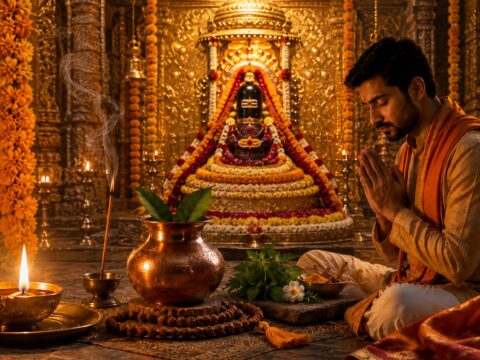
Pandit Sanjay Rath: How many concepts of the origin of the universe are there? Have you heard of the Big Bang theory? There is a Big Bang theory. Big Bang means a bomb exploded. Second theory is the theory of Śūnya. Our Vedic theory of creation rejects these. Vedic concept of creation explains that it is a gradual creation because of and through the līlā of Bhagavān. It is gradual. It has come from “nothing”. It expanded from an atom. This concept of expansion from an atom, is fully accepted by the most modern theories on the expansion of the universe. Today, science has got proof that the universe is expanding. There is something called entropy and the entropy of the universe is constantly expanding. Baby expands from a chromosome into a human being. The tree expanded from a little seed into a large and huge tree. Expansion is the natural method of growth. So, the entire universe also must have expanded from a seed. So, the entire universe’s growth is based upon the expanding seed. The seed that was put for creation, has expanded. Now, for this expansion to take place, there must be a ground and space for expansion. When you plant a seed, you plant it inside earth. So, the seed of the universe also has a kind of ground and a kind of space, for its growth to take place. That space is indefinable by the human concept. That space is called Nārāyaṇa. From where this space starts and where it ends, we don’t know. Human mind has a limitation and the biggest limitation of human mind is this space. The biggest problem of human mind is that it doesn’t know from where this space starts and where it ends. It is beyond human imagination. This is the biggest key of the mind that Bhagavān has locked and hidden. The second lock, is the lock of time. We were small children, and we grow bigger, bigger and bigger, and then we die one day. Similarly, more babies come, they grow big and then die one day. Plants become trees and grow huge in size and gradually their death also comes. So, time is linear because we live only for a linear period. Our mind cannot visualize in terms of three-dimensional time. This second key is also hidden by God. So, God has locked us in two ways, time-understanding and space-understanding. The concept of Jyotiṣa, was introduced by Ṛṣis, to help human beings, in unlocking these two locks. That’s why we need Jyotiṣa. Why do you need Jyotiṣa? If you want to buy a car, then go to a dealer and buy a car. Why do you need Jyotiṣa for buying a car? If you want to marry, find the person and marry. Why do you need Jyotiṣa for that? The real need for Jyotiṣa, is to unlock these two locks. We have stretched Jyotiṣa into other things because it is helpful. But the original need for Jyotiṣa is to unlock these two locks. If we can’t use Jyotiṣa for unlocking these two locks, why do we need it? So, the Vedic concept of the creation of universe is based upon expansion. And this concept of expansion and the symbol of expansion is Brahmā. That’s why it is called Brahmāṇḍa. Anda means egg. Brahmā + aṇḍa. Brahmā is the creator. The aṇḍa is the seed. Like tree grows from seed. The universe grows from a seed. This seed is symbolic of Śiva Liṅga. The aṇḍa of Brahmā needs some ground, some base to sit on, otherwise how will the universe come into being. The space on which the aṇḍa sits, is Śakti, and the aṇḍa itself is the liṅga. Together it forms, Śiva Liṅga. Rudra was born from Brahmā, this is said in Purāṇa.
There is drastic difference between Rudra and Śiva. Rudra is formed from the word “Rud” (with short “u” sound) which is a Sanskrit word meaning “to cry”. Whoever is born, will have to cry. A baby is born, it cries. The moment you are born, you cry. When will the crying end? When you die. That is why it is Rudra.
Scribe’s notes: “Rud” is a Sanskrit word meaning “to cry”. “Ra” is Agni (fire element) bīja sound. Agni-bīja sound gives strength and knowledge. Combined together, the two words form, Rudra. This word in itself is a mantra. If someone chants this one word, all the problems that make you cry, will vanish and you will become a favourite of Rudra Deva. An image of the Rudra Deva can be found on the Internet, it is a form of Śiva, rather a simplistic form, having two hands, with a triśūla (trident) in one hand.
Guruji Sanjay Rath continues: So, we have now got Brahmā. He is the one who created the universe. How did he create the universe? He created the universe by making an egg, which is called Brahmāṇḍa. And where did he put this egg? He put this in space. What is space? Space is Prakṛti, called Śakti. What did the aṇḍa do? It expanded and the first creation was Rudra, then all other creation took place. So, the first created thing was Rudra. Do you know the highest meaning of the Śiva Liṅga? The base is the Śakti, the space, is limitless and the human mind can never comprehend this. So, nobody can have full understanding of mother Śakti. The liṅga is the aṇḍa, is from where all creation took place. Today we are clear on the meaning of Śiva Liṅga and the creation of the universe. That’s how the universe is created, not from the Big Bang. Where will the Big Bang happen? You need some space and ground for that. So, when the universe started expanding, it started following time. Time cannot be understood by human mind. And there are different cycles of time. The sages have said that time is not linear, it is cyclic. We must understand cyclic time. But even if we are thinking about cycles of time, we are actually thinking in terms of linear time, as if there are linear cycles, or linear levels of time. But there are cycles of time, and these cycles of time and this cyclic nature of nature cannot be comprehended by human mind in its real, raw form. If you draw a line, it is linear. You can draw a circle, but it still is two-dimensional. We cannot comprehend multidimensional cyclic time. We are looking at the head of the spring, as if it’s a circle. But if we look from the side, there is a third dimensional expansion of that. Likewise, time is multidimensional and cyclic. Time is expanding in multiple dimensions. When we have to take the concept of time and concept of space, together, then we can understand creation. We will understand the dimension of God, which we call Vāsudeva. When we identify, where this creation started, and where it ends, and have full understanding of cyclic-time, and have separate and clear-cut understanding of all this, then we will understand the form of God, which we call Vāsudeva. It is called the perceptible part of God. A Deva-ṛṣi can understand this.
Scribe’s notes: Read the first chapter of Bṛhat Parāśara Horā Śāstra. The first chapter describes that the perceptible part of God is only one-fourth part of God. The rest of that is imperceptible and is three-fourths.
Guruji Sanjay Rath continues: The remaining three parts are imperceptible. This imperceptible part cannot be understood with a human-body. Nobody with this human body can comprehend the imperceptible part of God. The imperceptible part does not have a form, it cannot have one form, it is beyond form. These are three parts of Nārāyaṇa, which have Amṛta-tattva. Amṛta-tattva means that it can never be destroyed. That form is constant and permanent, forever. The rest of the creation is temporary, will vanish one day. Creation, sustenance and destruction is constantly taking place. Today we are studying in a class. But in some other parts of the country, someone might be dying. So, how do we decide good and bad muhūrta? I ask this question, often. Just by looking at planets in a chart, how can you say this muhūrta is good or is bad? Although at the same time, creation, sustenance, and destruction are simultaneously taking place. At this moment, there may be sadness and pain in someone’s home, while in another one, there may be good events happening and there may be happiness and joy. These two things are simultaneously taking place. But you look at planets and say, this is good muhūrta or a bad muhūrta. What kind of Jyotiṣa is this? What kind of muhūrta are you finding? Let us say 9:30am on 5th of November is very good for starting some new work. But at that same time, on that very day, somebody is dying and somebody is taking birth. What kind of muhūrta is this? The word “muhūrta”, what is it for? Muhūrta has to be applied for an individual. The same exact time can be a time of death for an individual but for another one, that can be the time of birth. Am I being understood? So, when we talk of sṛṣṭi (सृष्टि) and when we talk of sṛṣṭi kāraṇa (सृष्टिकरण) first have clarity of all the issues that we have talked about till now in this class. We are going to ask this question on every point when we do Jyotiṣa: Do we understand sṛṣṭi kāraṇa? One must identify and understand the event for which the muhūrta is being determined. Origin of the universe, is divided into four parts. The one perceptible part of Vāsudeva is one-fourth part and is like this: draw a square and divide that square into four squares. The sṛṣṭi (सृष्टि) is in one of the squares, so, the other three squares are invisible to that, because they are outside that one square. This one square has form and shape, but the other three squares are drawn for your understanding, but in reality, they are formless. If I ask you now, is God formless or does God have a form; what answer will you give me now? So, God has form, but God is also formless. This form is 25%, which is visible, the formless part, which is 75% is outside this and is not visible and cannot be comprehended by human mind, not in this body. So, we have discussed Vāsudeva. What is Vāsudeva? Vāsudeva is that which includes everything that is knowable and understandable. Vasu means jñāna, enlightenment. Deva means giver of light and knowledge. That’s it. Don’t stretch the meaning of this word beyond this. A Jyotiṣī should only extract that meaning out of a word, that is legitimately there and never stretch the meaning. It is said that Śiva is God. I am not denying it. But when you look at the meaning, Śiva means “auspicious,” bringing good and doing good. I often ask a question:
Oṃ Namaḥ Śivāya
ॐ नमः शिवाय
Oṃ Namo Bhagavate Vāsudevāya
ॐ नमो भगवते वासुदेवाय
Oṃ Namo Nārāyaṇāya
ॐ नमो नारायणाय
Oṃ Viṣṇave Namaḥ
ॐ विष्णवे नमः
Among these, which is the name of God and why? Come on, you are all intelligent; tell me. Which is the name of God in this? The moment you said “Oṃ,” you are talking about these three parts which are unmanifested: “a,” “u,” and “m,” equals AUM. This is 75%, the unmanifested. The rest of the part of the mantra is the 25% which is perceptible. This can be Śiva, or Nārāyaṇa, or Viṣṇu, or Vāsudeva. But if you do only “AUM,” then you are doing only the unmanifested God. That is Amṛta-tattva. The 25% perceptible part is not pure Amṛta. The unmanifested, or imperceptible, part could not be comprehended by the greatest of the sages. The Vedic concept is clear that this unmanifested part is beyond your comprehension. The purpose of Jyotiṣa is to search for this imperceptible part. We break up the perceptible into two parts: one portion is understood only by the sages, as defined by Parāśara. Parāśara Muni is brilliant; there is no doubt about that. The second part of the perceptible one is the Brahmāṇḍa. So, it is exactly 12.5%; it is the Brahmāṇḍa. Hence, a normal human being cannot utilize more than 12.5% of the brain. Mahārṣis and Devarṣis can utilize 25% at max. The rest of the 75% cannot be utilized. So, if you can utilize 100 percent of your brain, you will become God. So, people ask me questions: Rāma and Kṛṣṇa, how can God be born like a human being? But if you understand the definition which we have just discussed, it will become clear that God is he who can utilize the brain like this. So, we discussed the definition of Nārāyaṇa and how Nārāyaṇa is manifesting. In the three parts of the imperceptible, AUM, “a” is Brahmā, “u” is Viṣṇu, and “m” is Maheśvara in Amṛta-tattva. Oṃ is perceptible; “AUM” is imperceptible. The akṣara “a” is rajas and its bījākṣara is Hrīṃ. The akṣara “u” is sattva, and its bījākṣara is Śrīṃ. The akṣara “m” is tamas, and its bījākṣara is Klīṃ. With Klīṃ Bīja, you can overcome tamas. With Bīja Hrīṃ, you can overcome rajas. And with Bīja Śrīṃ, you can maintain sattva. The ṛṣis have taken birth in the perceptible part, but they want to go to the imperceptible part. But tamas is not present in the imperceptible part; it is only in the perceptible part, where we have taken birth. In the perceptible part, sattva, rajas, and tamas are being created and destroyed. But in the imperceptible part, which only has sattva and rajas, these two cannot be destroyed as it has Amṛta-tattva, nectar element. Like temples are sattva, but they get destroyed one day. This is the perceptible world, and it is temporary because it does not have Amṛta-tattva. So, the question comes: how can you migrate from the perceptible to the imperceptible part of God? The only way is to destroy tamas. Once you have destroyed tamas, you get ready to migrate to the imperceptible part. How to destroy tamas? The mantra or the Bīja, seed mantra, is Klīṃ. We do not know who Śiva is, and we cannot jump straight to Śiva yet. The first step is to destroy tamas with this mantra. Right now, we are only into some akṣaras.
Scribe’s notes: A collection of phonetic sounds clubbed together to sound like a mantra or a hymn is called bījākṣara. They are to be chanted with prayer beads, but only after receiving them from a Guru. These mantras are too great and are the highest of the highest mantras. These bījākṣaras are the seeds of Śakti or Prakṛti. They enable the native who chants these to start moving towards the imperceptible part of God.
Gurudev Sanjay Rath Ji Continues: We will come back to our creation. When God created this universe, he created the Brahmāṇḍa. And the aṇḍa broke, and it expanded into the space. That space is Śakti. Śiva is auspicious because he is expanding into Śakti. That’s why it is auspicious because it is a representation of God. The first creation of God is called Rudra. Why is he called Rudra? Because he cried, which means that everyone who is born will cry. This is beautifully explained in the Madhusūdana Stotra: Garbhavāsaṁ mahad duḥkhāt trāhi māṁ Madhusūdanaḥ. To be born in the womb is a great pain; please save me from that, Madhusūdana. So, that is the concept of Rudra, the moment of creation. There are 11 types of Rudra, and there are 11 ways in which you can be created and there are exactly 11 ways in which you can be destroyed. Among these 11 ways of destruction, there is only one way which is supposed to be very auspicious. That is Śiva. Among the 11 types of Rudra, that one who gives final emancipation to the soul is Śiva. There are many ways to die. There are different ways to take birth. That birth which leads to immediate freedom of the soul, and to go to whatever it came from, is called Śiva. That is the real meaning of the word Śiva. So, who is Śiva? Śiva is Maheśvara. Why? Because he is giving freedom to the soul. The word Maheśvara is made from a combination of two words: Mahā and Īśvara. Mahā means great. Īśvara is again made from a combination of two words, Īśa and Vara. Īśa means that which is dear to the soul. Vara means the giver. So, Maheśvara means the great Lord who gives and protects, who is dear to the soul. You will realize the importance of this concept when we do Śūla Daśā and when we study Maheśvara and Rudra. But remember that there are 11 kinds of Rudras. Of these 11 kinds, the one who gives freedom is called Maheśvara, and he is Śiva because the latter means “the auspicious one.” The one who does good to everyone and always does it is Śiva. So, now, we exist in Oṃ. From Oṃ, we have to go to AUM. How shall we migrate? The difference between these two is that there is no tamas in AUM. Brahmā is associated with rajas. Viṣṇu is associated with sattva. Śiva is associated with tamas. When you worship Śiva, and when you understand Śiva, you will come out of tamas. To understand the mantra Oṃ Namaḥ Śivāya, there is a book called Tirumantiram. That whole book is only about this one mantra. If you want to understand that mantra, read that book. God created everything out of nothing. Nothing is Śūnya. And infinity is also Śūnya. What is the difference between Śūnya and Mahāśūnya? Zero is Śūnya. Infinity is Mahāśūnya. When we talk of Śakti, it is infinity; it has no limit. Does the world start from this address? No. God knows how many solar systems are there. We do not know that. That point from where it is starting and where it is ending is called infinity. Infinity is Mahāśūnya. And what is Śūnya? “Nothing” is Śūnya.
So, from Śūnya, Mahāśūnya is created. The universe is created into that Mahāśūnya and is continuously being created in that Mahāśūnya. The day the universe touches the end point of Mahāśūnya, Pralaya will happen. If there is a balloon, and if it keeps expanding, the day it expands to its maximum, it will burst. That is Pralaya. It is a very simple and beautiful concept. And it is true and mathematically proven through science. So, when we talk of the universe, we are talking about Brahmāṇḍa. It is different from Śakti. Brahmāṇḍa is the physical matter. Śakti is the space in which the physical universe, or Brahmāṇḍa, is expanding. The womb of Mother Śakti is called Mahāśūnya. It is a very simple and clear concept. So, out of the total that comprises the perceptible plus the imperceptible part of God, we are in 1/8th. The 3/4th part of God that is imperceptible is beyond our study. This 3/4th portion that is imperceptible is studied through spirituality. To understand this, you must understand Ṛgveda. Take a Dīkṣā Guru and study Ṛgveda. Even then, the imperceptible portion cannot be understood in completion. Because Parāśara is clear on this, that nobody can understand this. So, if someone says he has complete knowledge about God, please stay away from such people. Our Jyotiṣa study is only restricted to the perceptible part of God.
Now, we break the 25% part, i.e., the perceptible part, into different parts. First, we break it into two equal parts, each comprising 12.5%. The one part that is only knowable to sages is 12.5%. To understand this, there should be absence of tamas. If one has tamas, he is not a sage. The rest of the perceptible part, i.e., the second half of the perceptible, is then divided into seven parts, which are actually the seven lokas, or the seven worlds. The lowest one is Pṛthvī-loka, called Bhū-loka. Bhuvar-loka is above Bhū-loka, so it is second from the bottom. Bhuvar-loka is the solar system. Svarga-loka is above Bhuvar-loka; it is third from the bottom, comprising all the stars in the sky. Bhuvar-loka is also called Graha-maṇḍala. The Grahas, or planets, move in this level. But these days, humans are also walking in this level, spacewalking. That’s why it is said that humans can cross sages and Devas. Humans have the strength to cross sages and Devas. So, they have insecurity from humans. They shiver in anxiety when they see humans, because of the latter’s ability. Because God has given such a brain to humans that humans can cross sages and Devas. The number of stars, including the constellation system, is the Svarga-loka. It is also called Nakṣatra-maṇḍala.