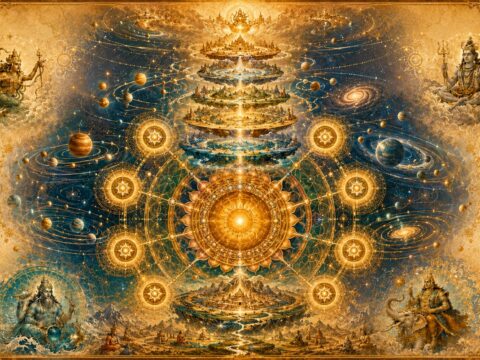
Guruji Sanjay Rath: The Grahas do not like you. Someday humans can even set up a colony on another planet and extract minerals from there. So, planets are in Bhuvar Loka. It is called Rāśi Maṇḍala. Pṛthvī Loka is also called Mṛtyu Loka. Mṛtyu means death. The guarantees that are sold in the market, like insurance, have no guarantee. The only guarantee is death. Hence, this Pṛthvī Loka is called Mṛtyu Loka. That is why it is called Yama Loka. You will die. The word Yama also means punishment. That is why Mṛtyu Loka is the correct name. Then we come to number four, that is fourth from the bottom, which is Mahar Loka. Mahar Loka has two parts, spiritual and material planes. The spiritual plane is the upper portion. You cannot see this with your two eyes; it can only be seen through the third eye. Jana Loka is above Mahar Loka. It is fifth from the bottom. Tapaḥ Loka is above Jana Loka. The highest among these seven lokas is Satya Loka. Whoever reaches Satya Loka will never come down again. That soul, who reaches Satya Loka, waits for the destruction of the creation, so that it can go to levels beyond Satya Loka. So, the purpose of studying Jyotiṣa is to reach this Satya Loka. That’s why it is called Jyotiṣa, made from combining two words, jyoti and īśa, meaning light and God respectively. The light of God is not meant to help you buy a house or a car. The light of God is to help you, to lead you to Him. Otherwise, astrology may be the word for a commercial thing. But the moment you use the word Jyotiṣa, it means the light of God, and helps you to lead to Him. If there is no spirituality in Jyotiṣa, then it is not Jyotiṣa; rather, it is astrology. That part is Vedic astrology. Vedic astrology and the spiritual part is called Jyotiṣa. If we understand the effect of Grahas in our life, then it is called astrology. Some people also add Nakṣatra Maṇḍala to this, and call it astrology, but actually it is Vedic astrology. But those people who wish to use this knowledge to reach Satya Loka should call it Jyotiṣa. Let us be very clear what we are studying. When we say that the syllabus contains Vedāṅga Jyotiṣa, it must include this whole thing.
When the entire creation took place, it could not occur without Śakti. If you don’t have land, you cannot build the house. Brahmā creates the aṇḍa and puts it in the space called Śakti; otherwise, it cannot be held. How can a baby be born if not from the mother? The Śakti which gives birth to the whole creation, her first name is Jagatprasūtikā. If I want to worship that Śakti who gave birth to this whole creation, she is to be worshipped with the following mantra: Jagatprasūtyai Namaḥ. This is the first name and mantra of the Mother. She is the first Śakti. All the other forms of Śakti come after this form. She kept the whole creation in her womb, and by doing this, she has done the greatest task. When the creation went into the womb of the Mother and expanded, under what guṇa and form did she accept this? Was it Sarasvatī Mā, was it Lakṣmī Mā, or was it Kālī Mā, or was it one single form? When we were studying the whole process of creation, there were three guṇas, viz., sattva, rajas and tamas. So, the form of the Mother in whose womb this creation expanded must have all three guṇas. Can you tell me the three forms of this Mother according to sattva, rajas and tamas? The form with rajas guṇa is called Sarasvatī Mā. The form having tamas guṇa is called Kālī Mā. And she must have sattva guṇa, so we call her Lakṣmī Mā. But when they are creating you, they are doing a Mahākārya, a kārya of Mahāviṣṇu. For example, when a woman becomes a mother, she actually takes a conscious decision to become a mother. Somewhere deep inside her consciousness, that decision is a very big decision. She is doing the act of God. That’s why she is no longer an ordinary lady; she becomes a Mahādevī. What is the difference between a woman and a Mahādevī? That decision, to become a mother, made her a Mahādevī. So, Sarasvatī Mā becomes Mahā Sarasvatī Mā. Lakṣmī Mā becomes Mahā Lakṣmī Mā. And Kālī Mā becomes Mahā Kālī Mā. When these three Śaktis come together, they can create, sustain and destroy the creation. Mahā Sarasvatī Mā is “Aiṃ.” Mahā Lakṣmī Mā is “Hrīṃ.” Mahā Kālī Mā is “Klīṃ.” And when we combine these three and add the word “Jagatprasūtyai,” the mantra is: Aiṃ Hrīṃ Klīṃ Jagatprasūtyai Namaḥ. When it comes to the destruction of a part of creation, the mantra is: Aiṃ Hrīṃ Klīṃ Cāmuṇḍāyai Vicce. So, to go forward in creation and to go back, the path is the same: Aiṃ Hrīṃ Klīṃ. It depends on what you want, and you choose the appropriate mantra. So, then we realize that it is from sound that this whole creation is taking place. Sound is the seed from which this creation has come. So, Mother Śakti creates from these sound-seeds. So, the entire creation is because of mantra. Which is the house of mantra? The 5th house. Which is the house of children? The 5th house. The reason is the same, that creation and mantra are put in the 5th house. This bhāva is called Bhaviṣya Bhāva. So, the 5th house, when we do Jyotiṣa, is the house of mantra; it is also the house of children and creation. These are the three Śaktis, which you have to understand fully.
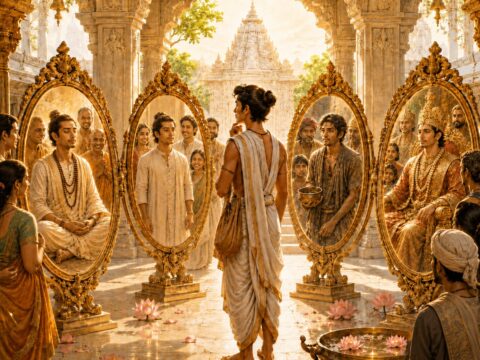
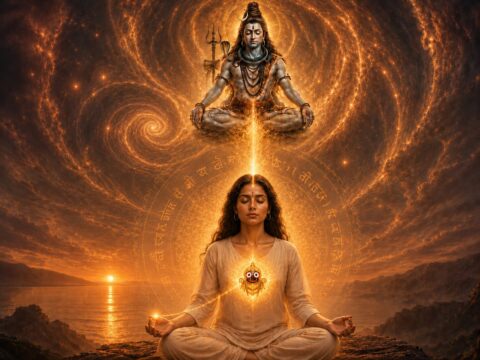
Now, let’s discuss Ahaṃkāra. What is Ahaṃkāra? Ego? Māyā? If you want to study Jyotiṣa, you have to widen your worldview; a narrow view is not conducive to making you a good Jyotiṣī. A student explains what Ahaṃkāra is, and Guruji Sanjay Rath says: although you have made a good point, it is not the exact meaning of the word Ahaṃkāra. Tell me the meaning of the word Ahaṃkāra. First, be clear on the meaning and difference between the words ahaṃ and Ahaṃkāra. Among these two, which one is detrimental for the self? Ahaṃkāra is ego; ahaṃ is not ego. There is a Mahāvākya, Ahaṃ Brahmāsmi. Ātman is ahaṃ and is Brahmasvarūpa, has jñāna, and thus, Ātman is Brahmasvarūpa, the infinite God. Ahaṃ is not bad. But when ahaṃ gets a shape, it gets bad. Ahaṃkāra = ahaṃ + ākāra (shape). It means when ahaṃ gets a shape, it gets trapped in Māyā. The Sanskrit word ākāra means shape. For example: when I think that I am Sanjay, but actually I am not Sanjay, I am Ātman, I am a soul. Neither was I Sanjay ever, nor will I be Sanjay in future births. The soul cannot have this name “Sanjay.” I think I am Sanjay because of Ahaṃkāra. I am a soul, and the soul is Brahman, and has no name. The root of Ahaṃkāra is the name. For example, if it is said that “Dhirubhai Ambani is a wealthy man,” then Dhirubhai is rich, but that is not for his Ātman. When the body dies, the wealth does not go with the soul. The soul goes to its abode alone. Wealth and property are linked with the name of the person. Name is Ahaṃkāra. That’s why the infinite God has no name, is beyond all nomenclature, because if name is there, then Ahaṃkāra will set in, and Ahaṃkāra cannot be there in the infinite God. Oṃ and AUM are mantras and are symbolic. They take you to that infinite God. When you make an idol of Brahman, Ahaṃkāra comes even into that too. That’s why visarjana is done for the idol. The day you start worshipping Śiva in His formless state, then you will be at that level about which we are talking right now. That is the number seven level. At that level of Satya Loka, there cannot be any ākāra and Ahaṃkāra. There is no difference between your God and my God. At that level of formlessness and shapelessness, there will be no difference between Rāma and Allāh. When that level is reached, all humans will look the same; that is the essence of spirituality. But it is very difficult to reach that level. We will find no difference between Śiva and Śakti. Tamas will be totally vanished from inside. When all this occurs, you will be ready for number seven. Oṃ Tat Sat, this mantra will be continuously ringing inside you. Every Ātman comes under Ahaṃkāra when it takes a body and a form. The root of Māyā is Ahaṃkāra. For example, a car has a shape, so someone possesses it and says, this is my car and that is your car. This sense of physical possession is Māyā. The truth is that the soul is different from the body; the body is asatya, whereas Ātman is satya. This extrapolation of Ātman onto the physical possessions is asatya. But it is difficult to reach this level, where you become totally free from Māyā. When you get out of this Māyājāla, you will be ready for mukti. When you let go of your name, you will be free from Māyā. That’s why, when you get Dīkṣā for saṃnyāsa, the native has to leave the name behind, let go of the name. After saṃnyāsa, the native doesn’t have a name. The native remains Ānandasvarūpa of, let’s say, Śiva. Then you call the name Śivānanda. There is no name, it is just a reference; only fools believe that saṃnyāsīs have a name. Our Paramparā Guru, Achyutānanda, used to give ānanda to Achyuta; that’s why he was referred to as Achyutānanda. Such people don’t have any name, but only have a reference. Name is due to rajas. Pure sattva will not have a name. The sense of physical possessions comes from rajas. For example, my village, your village, my car, your car; all of these physical senses of possession and ownership come from rajas. The highest of the Yogīs in the Himālaya don’t have a name. The world gives them a name, like Nīm Karolī Bābā. That is not his name; people have given this name to him. The day you give up your name, the journey towards that spiritual level of Satya Loka and beyond starts.
What are the two basic differentiations of Ātman? Jīvātma and Jaḍātma. Jīvātmas are living beings. And Jaḍātmas are non-living beings. Do Jaḍātmas have Ahaṃkāra? Jaḍātmas have Ātman and they have ākāra, shape, so they have Ahaṃkāra. The formula always works whenever you want to understand Ahaṃkāra: Ātman plus ākāra is equal to Ahaṃkāra. Where there is Ahaṃkāra, destruction will surely take place. The island of Sumātrā was totally destroyed in the tsunami. Now, the island had a name and had a shape. So, everything that has a name and a shape will one day undergo destruction. Jaḍātma always has a shape, so Ahaṃkāra is also present. Don’t you feel differently towards a Mercedes as compared to a Maruti car? Surely you do and I do, and everybody does. The reason is simple: Ahaṃkāra. And the Ahaṃkāra is in you because of a shape. And it is also because of the desire to possess something. Ahaṃ is in you and ākāra is in that island. So, there is Ahaṃkāra. In the Bhagavad Gītā, it is clearly stated that both Jīvātma and Jaḍātma have Ahaṃkāra. There, the narrator, Kṛṣṇa, has said: “I make two forms of Ātman, i.e., Jīvātma and Jaḍātma.” The former enjoys the latter. This is Saṃsāra. Jīvātman has manas, whereas the latter doesn’t have manas; that’s why it cannot do anything on its own. Guru Sanjay Rath ji tells a student not to deviate the class away from the topic.
Guru Sanjay Rath ji continues on the topic of Ahaṃkāra:
Where there is no Ahaṃkāra, it will never be destroyed. This is the guarantee from Kṛṣṇa. Why can Ātman never be destroyed? Because it has ahaṃ only, and has no ākāra, no shape or form. That’s why Ātman can never be destroyed, because ahaṃ is not bad.
Guru Sanjay Rath ji starting new sub-topic: Jīvātma.
The broad difference between Jīvātma and Jaḍātma is that the Jīvātma can reproduce another Jīvātma, which is a God-like act. Because only Bhagavān has this power. That’s why Jīvātma is a svarūpa of Bhagavān. But Jaḍātma cannot reproduce another Jaḍātma. Have you ever heard whether baby Himālaya was born? Because Jaḍātma cannot reproduce another Jaḍātma. This is the main difference between Jīvātma and Jaḍātma. So, each Jīvātma has Pūtrakāraka, but Jaḍātma doesn’t have a Pūtrakāraka. The only difference between Jīvātma and Jaḍātma in broad terms is Pūtrakāraka. This truth is substantiated by Parāśara and Jaimini. This is a very important concept. When we study Kāraka, all this will be used. If you don’t clear your concepts here, you will have problems over there. Can one brick make another brick? No. The complete definition of an Ātman is identified with 24 guṇas. When a Jīvātma reproduces another Jīvātma, 24 guṇas of that Ātman are the same in both. But when a brick is made out of sand, 24 guṇas are not the same. Similarly, the ocean and a river both have water, but both have different guṇas. Similarly, Pacific Ocean water is different from Indian Ocean water. You have to study the 24 guṇas. These 24 guṇas are described in Sāṅkhya Śāstra. That’s why brick cannot be said to be a child of sand, because the guṇas undergo change. So, as a part of the homework, study the 24 guṇas from Sāṅkhya Śāstra. The 13th chapter of the Bhagavad Gītā has all this. Read that.
Next question: What is Paramātma?