 It is perhaps the most agonizing question in spiritual life: Why do good people suffer? We observe the virtuous—the kind, the generous, the truth-speaking—struck by illness, betrayal, poverty, and loss, while the selfish and corrupt flourish in wealth and power. This apparent injustice has driven seekers to question the very foundations of karma, dharma, and divine order.
1. Sanchita Karma: The Accumulated Warehouse
Sanchita karma represents the total accumulated karma from all past lives—an immense warehouse of actions, reactions, and unfinished business. As the BAPS organization explains, “Sanchit karma is an accumulation of karmas containing the sum total of all a person’s karmas from one or many past lives. The fruits of these karmas are being experienced or have yet to be experienced.”
2. Prarabdha Karma: The Fruit That Ripens Now
Prarabdha karma is that portion of sanchita karma which has been “activated” or earmarked for fruition in the present life. This is the critical concept for understanding present suffering.
3. Kriyamana Karma: Actions Being Created Now
The Soul’s Curriculum
The soul does not incarnate for pleasure; it incarnates for evolution. As Sethi notes: “The soul does not have the same view of unpleasant earthly experiences that our conscious mind might have. You might be amazed to think that your soul decided to give you each of the experiences you have had in your life. The good and the more challenging. There are lessons to be learned by all of them if you look at it from the bigger picture.”

-
Lagna in Sagittarius with the Sun (Atmakaraka) in the ascendant
-
Eighth lord Moon in the tenth house afflicted by Saturn
-
Method of Pairs indicating short life altered to middle life through Yoga Vipareetam
The Fire That Purifies Gold
The Role of Saturn: The Great Karmic Teacher
The Nodes (Rahu-Ketu): Karmic Axis of Destiny
The Eighth House: The House of Transformation
1. Adhyatmika Tapa: Suffering from One’s Own Body and Mind
2. Adhibhautika Tapa: Suffering from Other Beings and the Environment
3. Adhidaivika Tapa: Suffering from Divine or Cosmic Forces
Karma Is Not a Bank Account
The Ego’s Judgment vs. the Soul’s Knowing
-
Intention (chetana): The Buddhist and Jain traditions emphasize that intention determines karmic weight more than external action. A “good” act performed with subtle pride or expectation creates different karma than the same act performed with pure selflessness.
-
Unconscious patterns: Many “good” people carry unconscious resentment, fear, or self-sabotage that creates suffering independent of their conscious virtue.
-
Collective karma: The individual acts within families, communities, and nations whose collective karma also shapes experience. Collective and relational karma operates beyond individual virtue.
The Fourth House: Emotional Purification
The Eighth House: Ego Death and Rebirth
The Twelfth House: Surrender and Transcendence
Vipareeta Yoga: When Suffering Becomes Fortune
The Power of Remedial Measures (Upayas)
-
Mitigate the intensity of prarabdha karma
-
Accelerate the exhaustion of negative karma
-
Transform the quality of suffering into spiritual growth
The Soul’s Curriculum Design
-
The birth moment (determining the planetary configuration)
-
The family and environment (determining the karmic field)
-
The major life events (through prarabdha activation)
-
Burn through accumulated negative karma rapidly
-
Develop specific spiritual qualities (compassion, patience, detachment)
-
Create conditions for service to others
-
Accelerate the path to liberation
The Example of Sri Ram
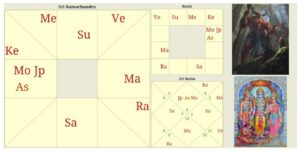
In Chart 2 (Sri Ramachandra), the Gajakesari yoga and Dharmakarmadhipati yoga in the ascendant and seventh house indicate “suffering and hardship before the beginning of the Rajyoga.” Sri Ram was exiled for fourteen years, his wife abducted, and he had to fight a war to recover her. Yet these sufferings were the necessary conditions for establishing dharma on earth. The soul that chooses such a chart does not seek comfort; it seeks purpose.
-
Immediate justice: Good deeds should yield immediate good results
-
Material comfort as the goal: The purpose of life is pleasure and avoidance of pain