Om Gurave Namah
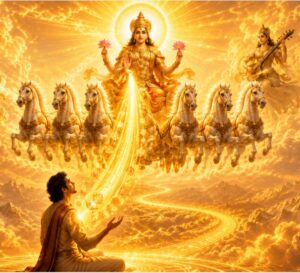 You cannot underestimate the role of Sūrya in Jyotiṣa. Sūrya is one of the most important Grahas. Better to say, he is an extremely important luminary.
Sūrya is Sarvātmā ca Divākaraḥ. Divākaraḥ means “maker of the day.” As an Agni planet giving light, he is a spark of the soul. He represents the soul of the Kāla Puruṣa. Being the luminous part of Agni Tattva, he is responsible for knowledge; hence, he is important for spirituality. He connects you to all other souls in this world.
He gives energy to every single being in this world to wake up. He gives awareness as the Kāraka for the Lagna. He gives vitality. You can see because of the light of Sūrya. He is the ruler of the seven days. These Lords we call Vāreśas, the ones who give us energy and life force.
rāmāvatāraḥ sūryasya candrasya yadunāyakaḥ |
nṛsiṃho bhūmiputrasya buddhaḥ somasutasya ca ||
“Rāma is the avatāra of Sūrya; the leader of the Yadus, Kṛṣṇa, is of Candra; Nṛsiṃha is of Maṅgala; Buddha is of Budha.”
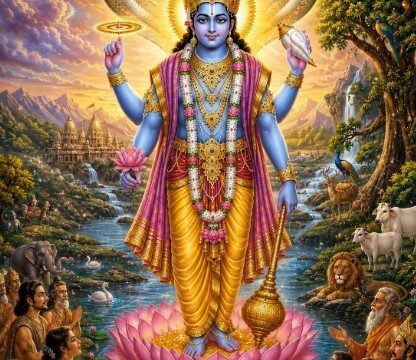
Śrī Rāma Avatāra manifested through Sūrya, and He represents a perfect human being; therefore, we can say that Sūrya is extremely important for human beings.
Sūrya, as Savitṛ and the son of Aditi, is the prasava-kāraṇa Devatā—the deity who initiates and creates. As a creator, he connects us to the six ṛtus of our life. It is the Karaka for Lagna and for Lagna Gayatri is importnant. Sun is Agni (gnir āpaḥ kumāraś ca viṣṇur indraḥ śacī tathā |
kaḥ sūryādi-khagānāṃ ca devatāḥ parikīrtitāḥ ||). Hence Sun sign is the Gayatri of Agni Devata.
Maharṣi Parāśara says: “sūryacandramasau rājānau” — “Sūrya and Candra are kings.” This is very important to understand. Sūrya is the giver of Rāja Yogas, and Candra is the sustainer.
If we divide life into three parts—childhood (bālya), middle life (prauḍha), and old age (vṛddha)—then, as Sūrya rules the natural fifth Bhāva, he becomes extremely important for our middle life, career, and wealth. The period from 24 to 60 is the most active phase of life for all human beings, when we create career, wealth, family, and all our saṃsāric life under the light of the Sun. Sons are also considered wealth in Vedic culture; therefore, putras are also wealth.
Sūrya Lagna is one of the most important Lagnas. Sūrya is always a structure; he is the skeleton of the whole solar system. As Maharṣi Parāśara assigns asthi—bones—to Sūrya, this Graha receives the features of bone structure and the skeleton.
So, what important things do we relate to Sūrya?
- Future, because he rules the natural fifth Bhāva.
- Resources, including vitality and health.
- Wealth and finance.
- Spirituality
The Lord of the Sun sign is the giver of wealth and good fortune. Savitṛ is the giver of everything, including knowledge. Also, from the nature of this Graha, we can understand how the person interacts with the world. It works on both sides: what you receive and what you should give to all the other souls.
Certainly, we want this Graha to be well placed in a Kendra or Koṇa. Duḥsthāna positions are difficult, if it is placed in upachaya it is both ways – can be good if well-placed.
If Sūrya is conjoined malefics — those malefic energies we gave to the world in the previous lives, so we get it back. For example is there is a conjunction of Su and Sa your experience of the world will be like that Sa – full of suffering and pain.
If Sūrya is with the benefic Graha — it means those benefics will give all their positive and good things to Sūrya. Like conjunction of Su and Ju form Gopāla Yoga like in Prabhupāda’s chart. Anyway you will get this planet in plural in life and destiny. Here you feel happy with you and you experience may be good (except the period when you may feel spiritual purification if graha is combust).
If it is badly placed from Lagna, the person may reject and not follow those karmas. Weak Graha can be strengthened by offering it to Śiva.
The most important thing we should understand here that Sun is teh creator. To create Rajas is needed and behind Rajas there is always a desire. So for each of the Savitṛs we must understand a desire.
| Āditya | Desire | About the Āditya |
|---|---|---|
| Dhātā | To create a new world, a new order, or a utopia. | Dhātā is connected with creation, establishment, and rebuilding. This Āditya gives the impulse to recreate the world according to a higher vision. |
| Aryaman | To improve and protect the well-being of family, spouse, and lineage. | Aryaman is connected with family bonds, nobility, marriage, agreements, and social honour. This Āditya supports the creation of families, institutions, and stable social structures. |
| Mitra | To make the world more friendly, cooperative, and peaceful. | Mitra is the Āditya of friendship, contracts, harmony, and mutual support. He gives the desire to build bridges, protect the weak, and create agreements. |
| Aruna/Varuṇa | To understand bondage, karma, suffering, and the hidden causes of pain. | Varuṇa is connected with cosmic law, karma, healing, and release from bondage. This Āditya gives the desire to solve deep problems and remove suffering. |
| Indra | To establish proper rule, leadership, order, and modernization. | Indra is the king among the Devas. He is connected with sovereignty, power, reform, and the battle against disorder or corruption. |
| Vivasvān | To ensure food, resources, abundance, and protection from poverty. | Vivasvān is connected with nourishment, labour, service, and survival. This Āditya gives the urge to work hard and provide practical abundance for society. |
| Pūṣan | To question the existing agenda and remake what is not correct. | Pūṣan is connected with guidance, correction, nourishment, and the path. This Āditya challenges the status quo and pushes society toward a new direction. |
| Parjanya | To transform everything, unlock secrets, and understand hidden forces. | Parjanya is connected with rain, fertility, crisis, and transformation. This Āditya brings the power to change the world, sometimes through intense or difficult processes. |
| Aṃśa | To establish fairness, equality, freedom, and rightful reward. | Aṃśa is connected with portion, share, justice, and divine distribution. This Āditya gives a strong concern for fairness and rightful participation in society. |
| Bhaga | To achieve industry, progress, fortune, and great material results. | Bhaga is connected with fortune, enjoyment, prosperity, and the rightful share of wealth. This Āditya gives the power to work intensely and manifest visible achievement. |
| Tvaṣṭā | To innovate, reshape systems, and create new structures through skill. | Tvaṣṭā is the divine artisan and maker. This Āditya is connected with invention, design, technical intelligence, and the power to reshape society through new ideas. |
| Viṣṇu | To unify, renounce, spiritualize, and bring everything under one higher truth. | Viṣṇu is connected with preservation, expansion, unity, and universal order. |
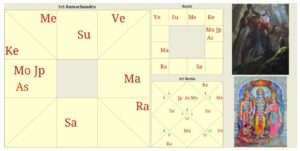
Surya is in Aries. So this is Dhata Aditya. So what is his desire? To create a new world, a new order. Why? Because he wants to stop cannibalism (all rakshasa- Ra niccha). There was a lot of cannibalism in India during that time.
Anitya (dispositor) is Mangal. Mangal is exalted in Ruchaka Mahapurusha yoga. This will indicate katriya karma, war karma as the Sun sign Lord is in the 7th bhava (war or love bhava).
How will we understand if he does have ability to do it? Look at the position of Surya. Surya itself is the 10th bhava.his is the house where the Sun achieves Digbala (maximum directional strength). It is one of the best placements for career authority, public recognition, and governmental influence. So for sure, there will be success. Will he achieve it on his own? No, Sun is exalted, king is exalted, he never does anything himseld. Raja has servant and this servant is Hanuman ji – Mangal exalted in 7th bhava. So Hanuman will go and fight the war and find SIta, then he will come back to the Lord and tell where has she been taken. That is how we examine Surya Lagna.
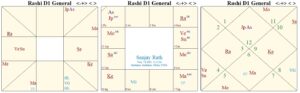
Sūrya is in Karkaṭa. So the Āditya is Varuṇa/Aruṇa. He represents the end of life and the fruits of Karma. Varuṇa is connected with cosmic law, Karma, healing, and release from bondage. Karkaṭa Rāśi is the natural Sukha Bhāva. This Āditya gives the desire to solve deep problems and remove suffering. Now, the desire is to understand bondage, Karma, suffering, and the hidden causes of pain. Varuṇa has a pāśa, or noose, which he uses to put the souls into the cage of the body.
Āditya’s dispositor is Candra in the twelfth Bhāva — Vyaya Bhāva — and he is in Śatabhiṣā, whose Devatā is Varuṇa. So the person’s consiousness is always dwelling on spiritual subjects. Mo is also connected to Me forming Sharada yoga. Sūrya is conjoined astāñgata Śukra in the fifth Bhāva. When Su conjoins Ve and it gets astangata, desires and enjoyments are under control and dharma and principles become very high. You will teach Jyotiṣa in a foreign language: the sixth Lord and eighth Lord are in the fifth Bhāva. And what is Jyotiṣa about? The understanding of Karma, time, life, birth, rebirth, and Mukti.
Does he have abilities for that? Sūrya is in the fifth Bhāva — Jaimini says: “pañcama Sūrya Gītā jña”.
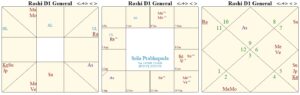
In his chart we find Su conjoined Ju in Gopala yoga and with Ke – parampara yoga.
Surya is in Simha rashi – Indra Aditya. Desire is establish proper rule, leadership, order, and modernization. Anitya Mangal is in 6th bhava – service with the Moon.
This Su in 9th bhava is capable of intense penance, supernatural achievements; forming groups or institutions.
Next example Sri Sri Ravi Shankar
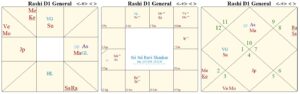
Sri Sri Ravi Shankar’s lifelong mission is to create a stress-free, violence-free society. He emphasizes that individual peace and the recognition of humanity as a “one world family” are the ultimate prerequisites for achieving lasting global peace.
Where is Mangal? Mangal is in Lagna exalted in parivartana with Lagna Lord Shani. Mangal is under the drishti of Ju, so Mangal is controlled by this Ju. Hence violence free society.
Surya is in the 4th bhava -great healer or problem solver, can create spiritual organizations.
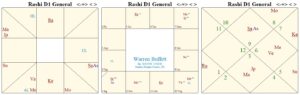
Lets have a look at some billionairs charts. In Warren Buffett’s chart Su is Simha rashi. Indra Aditya. What is the desire of Indra? To establish proper rule, leadership, order, and modernization. Su is in the 9th bhava under the drishti of Rahu (eclipse) afflicting Ju. Warren Buffett became rich by compounding high-yield investment returns over eight decades, starting with childhood side hustles and evolving into a master strategy of buying undervalued companies and reinvesting their profits. What is his war about? It’s in Mithuna 7h – business. War for money? Vaishya Karma. Ma is 5th L – shares. 5th L and LL in Kendra is a Rajayoga. So he became Indra of investements.
Warren Buffett’s modernized 90/10 investment rule for retail investors.
Su is in the 9th bhava: he will be capable of intense penance, supernatural achievements; forming groups or institutions.
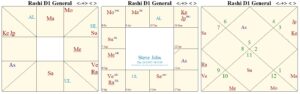
In the chart of Steve Jobs, Sūrya is Lagna Lord in Kumbha. Tvaṣṭā Āditya. What is the desire? To innovate, reshape systems, and create new structures through skill. And Sūrya being in Vāyu rāśi is Rājayoga.
Sūrya is in the 7th bhāva — the person has the power to completely change the existing order of things.
So now you can see that without Sūrya Lagna we cannot really say about a person’s destiny, resources, finance and good fortune. Focus on Su rāśi and the Āditya and you will know what the person will give to this world.
Written by Dana Khanina, inspired by the teachings of Guruji Panit Sanjay Rath .
OM TAT SAT
Om Shanti, Shanti, Shanti