 Our topic for today is the Ṛṣi of Varuṇa. If you look at the natural zodiac, you will see that it is divided into two parts. We call them the day and night signs, or the daytime half and the nighttime half. Vāra Śāstra is based upon these two halves: the daytime half, which is visible, and the nighttime half, which is invisible.
Now, there are two ways of determining this. One is based upon Sūrya, and the other is based upon Candra. Thus, there is a Candra method and a Sūrya method.
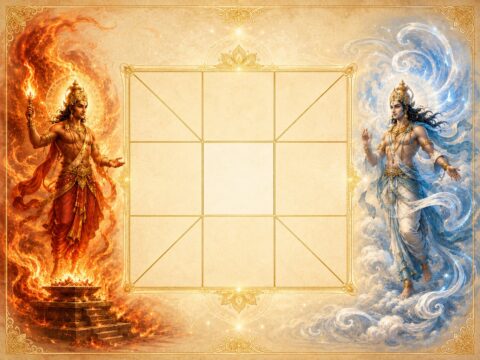
The Naisargika method is based upon Sūrya. Beginning from Lagna, the houses from the first to the seventh constitute the invisible half. Do you see? The other half, from the seventh house back toward Lagna, is the visible half.
The axis extending from Lagna to the seventh house forms a very powerful Śiva Liṅga. Do you understand the idea? It is a column of light. Within our body, this same principle is Kuṇḍalinī. Therefore, the view from within the body and the view from outside the body are different.
The half extending from the seventh house toward Lagna is the visible half. The visible half is like the daytime.
During the daytime, Sūrya moves from Lagna through the tenth house and then toward the seventh house. It appears to move in this reverse direction—like a retrograde Sūrya. That is the daytime effect.
During the night, Sūrya travels beneath the ground in the opposite direction. This is why all the Nakṣatras can be seen here.
All the Nakṣatras operate strongly from Lagna to the seventh house. It is very interesting. From Lagna to the seventh house, the Nakṣatras are very active and powerful. However, in the other half—from the seventh house through the eighth, ninth, tenth, eleventh, and twelfth houses toward Lagna—the Nakṣatras are not as powerful. In this half, the rāśis are more powerful.
That is why we say that one is the daytime half, or the Viṣṇu half. This entire half is ruled by Viṣṇu. The other is the nighttime half, which we call the Rudra half. Rudra means “the howler.”
This column of light that you see here represents human knowledge. Knowledge lies along the first–seventh-house axis—the column of light. Directly above it is Guru, situated over the head, and the form associated with Guru is Airāvata. Okay?
As far as the natural zodiac is concerned, this is your horoscope. What you are looking at is your horoscope. Did you understand your horoscope?
Now we shall come to what we call the column of light in relation to the natural zodiac. In the natural zodiac, Leo is associated with Sūrya, and Cancer is associated with Candra. Sūrya always moves directly. Therefore, the half extending from Leo to Capricorn is called the daytime half. The other half, extending from Aquarius to Cancer, is the Candra half.
Thus, the Candra half extends from Aquarius to Cancer, while the Sūrya half extends from Leo to Capricorn. This is the situation in Bhuvar loka. Why is this Bhuvar loka? Because Bhuvar loka begins from Leo. Do you understand the idea? We are rotating the zodiac and placing Leo in the first house.
If I were to draw a North Indian zodiac, I would place Leo in the first house. This is Bhuvar loka. In Bhuvar loka, you have to place Leo in the first house and then study the chart.
In Bhū loka, we place Aries in the first house. Here, however, Leo is placed in the first house. Therefore, signs five, six, seven, eight, nine, and ten constitute the Sūrya half. It is reversed. You can see that it has become reversed. Signs eleven, twelve, one, two, three, and four constitute the Candra half.
Thus, the arrangement of Bhū loka and Bhuvar loka is reversed. We can see this when we examine Mūlādhāra and Svādhiṣṭhāna.
Read further
This is Mūlādhāra. From Mūlādhāra, you can see that the blue current moves in this direction and then reverses until it reaches Maṇipūra. Correct?
Now let me use another color, and then you can see how the Nāḍīs are changing. This is Mūlādhāra. If I place Sūrya here and Candra on the other side, I can say that Sūrya and Candra are being reversed. Do you see that?
Bhuvar loka is experienced from Svādhiṣṭhāna, whereas Bhū loka is experienced from Mūlādhāra. The experience of day and night—the experience of Sūrya and Candra—in Mūlādhāra is reversed in Bhuvar loka, at the level of Svādhiṣṭhāna. Thus, what is considered favorable in Bhū loka becomes reversed in Bhuvar loka.
Remember that, when we view the houses beginning from Aries, we place Candra on the left-hand side and Sūrya on the right-hand side. But the moment we view the houses beginning from Leo—the houses of Bhuvar-loka—we reverse the arrangement. We place Sūrya on the left and Candra on the right. How interesting!
Now we are going to examine Bhuvar-loka. This is where we shall study how the Devatās descend into Bhuvar-loka.
The Devatās are not situated in Bhuvar-loka. The Devatās are at the Maṇipūra level, in Svarga-loka. In Svarga-loka, we have the Devatās. Even higher than them, in Mahar-loka, we have the Ṛṣis.
It is very interesting to understand this hierarchy. In Bhū-loka, we have human beings—the Manuṣyas. In Bhuvar-loka, we have the Grahas. In Svarga-loka, we have the Devatās. In Mahar-loka, we have the Ṛṣis.
At the level of Bhū-loka, there is only the square: East, West, North, and South. There is only the square here in Bhū-loka.
At the level of Bhuvar-loka, however, we suddenly have more divisions. We have the Ṛtus, the six seasons. Here, at the level of Bhū-loka, we have a caukā, a square, so I place four divisions here. At the Graha level, in Bhuvar-loka, there are six divisions corresponding to the seasons.
In Svarga-loka, we have the twelve rāśis. But in Mahar-loka, we have the Nakṣatras. Therefore, Nakṣatra Jyotiṣa is concerned with the Ṛṣis. Nakṣatra Jyotiṣa is about the Ṛṣis. It is not really about the Devatās.
The Devatās present in Mahar-loka are not the same as the Devas of Svarga-loka. The Devas of Svarga-loka are ruled by Brahmā. The Ṛṣis of Mahar-loka are ruled by Viṣṇu. Viṣṇu rules Mahar-loka, the Ṛṣis, and the Nakṣatras.
Therefore, the whole of Viṣṇu Jyotiṣa is concerned with Mahar-loka. It is concerned with the Ṛṣis and with the Nakṣatras. Now, there is something very interesting. We know in Jyotiṣa that the overlord of the Nakṣatras is Candra, while the overlord of the Ṛṣis is Sūrya. According to these principles of Hinduism and Vedic Dharma, Candra is situated one loka above Sūrya, because this is the Candra Maṇḍala. Candra rules the Nakṣatras.
Let us associate this level with the mind. The mind functions from here, whereas Sūrya—your energy and your level of vitality—is situated at the navel. Your energy is in the navel, while your mind is in the chest.
Your breathing has a very important role in relation to the mind. If you breathe slowly, the mind becomes calm. If you breathe very quickly, the mind becomes agitated. Thus, breathing is connected with the mind, while the food you eat is connected with Sūrya. Therefore, Sūrya is very concerned with your Guṇas.
Sūrya and Śukra rule the plant kingdom. The plant kingdom is ruled by Sūrya and Śukra. Please study the classification of Dhātu, Mūla, and Jīva.
Mūla refers to the plant kingdom: plants, trees, fruits, and the entire realm of vegetation. This plant kingdom is ruled by Sūrya and Śukra. Sūrya rules the plants during the daytime, while Śukra rules them during the nighttime. Do you see?
Therefore, you must understand that Sūrya is deeply concerned with what you eat during the daytime. What you eat at night is an offering to Śukra. What you eat during the day is an offering to Sūrya, and it supports your Lagna.
What you eat during the daytime is beneficial for your Lagna. What you eat at night is connected with your seventh house.
You must understand this principle.Remember the column of light and the energy of Bhū-loka. The column of light in Bhū-loka lies along the Lagna–seventh-house axis. That is why Jaimini continuously tells us to focus on Lagna or the seventh house. Focus on Lagna or the seventh house. He does this repeatedly. Parāśara also emphasizes Lagna and the seventh house. Okay? I want you to make these connections in your mind. These connections are very-very important. They have to be made in the mind.
When we speak about Viṣṇu, we are speaking about the Viṣṇu Avatāra, whose most important Graha is Candra. Candra is the mind. The power of the Avatāra is to control your mind completely and totally.
When you say, “I am a great worshipper of Lord Śiva,” it is because, in your Anāhata Cakra, Viṣṇu desires that you worship Lord Śiva. If you say, “I am a great worshipper of Jesus Christ,” it is because, in your Anāhata Cakra, Viṣṇu desires that you worship Jesus Christ.
Therefore, you must remember that whoever you worship, and for whatever purpose you worship, that worship takes place through your mind. Your mind is the worshipper. Your mind is the most important horse, and this mind is actually controlled completely by the Avatāra because he controls your breathing: So’ham- Haṃsa; So’ham- Haṃsa.
From the Anāhata Cakra, he controls Vāyu and your breathing. He controls your Prāṇas through the breath, and he controls your longevity through the breath. We must realize that our longevity depends upon Viṣṇu, and we know that Viṣṇu is associated with cleanliness and purity. Therefore, if you are clean and pure, you are supposed to have a very long life.
The longevity of the body is 108 years, the longevity of the mind is 120 years, and the soul is situated still higher, at Viśuddhi. In Viśuddhi, the soul functions through the third of these important chakras. Which are the three important chakras?
Maṇipūra chakra controls your body, Anāhata controls your mind, and Viśuddhi controls your soul.
Thus, your body, mind, and soul are contained within the torso, below the neck. They are all held within this middle portion of the body. The longevity that Viśuddhi can give to the soul is 144 years.
Therefore, when calculating longevity, you should not simply apply different longevity systems without first sitting back and asking very calmly: What am I calculating? Am I calculating the longevity of the body, the longevity of the mind, or the longevity of the soul?
What is the longevity of the soul? It is the period for which the soul can remain on planet Earth. It corresponds to two degrees of the Ayanāṃśa. One degree is seventy-two years, and seventy-two multiplied by two is 144 years. This is one Nārāyaṇa Daśā and one Sudarśana Cakra Daśā. That is the period for which the soul can remain.
This is a broad view of your chakras and of how these chakras control your body, mind, and soul. It is also a broad view of how we must study the horoscope: Bhū-loka from Meṣa Rāśi, Bhuvar-loka from Siṃha Lagna, and Svarga-loka from Dhanu Lagna. To study Svarga-loka, you must make Sagittarius the Lagna and examine the natural horoscope from there. What is heaven? Okay. With that, I shall take a short break. You should make your notes.
What you are learning today may seem mind-boggling. Well, these are Jaimini classes. You can no longer continue asking, “Guruji, how is Ketu the Mokṣa Kāraka?” Absolutely not. We are now at the level at which we must come into contact with the Ṛṣis. Therefore, we must study the subject at that level. Now you are going upward—finally.
We are experiencing this world from Bhū-loka. Correct? So, for the time being, forget the other levels. What is our sky? It is our tenth house. When we pray to God, we look upward. We do not look downward.
If you look downward while praying to God, all kinds of snakes, ghosts, and Dānavas may come and say, “Hello, how are you?” Do not look downward while performing Pūjā. Do not make that mistake. You perform Praṇāma and then look straight ahead or upward. That is why it is very important that, while meditating or performing Pūjā, your head remains upright.
Many of you fall asleep during meditation, and then your head drops forward. I have seen many great meditators sitting with their heads bent downward. All these Dānavas, Rākṣasas, and Rāvaṇa may then come to say “Hello” to you.
So what should you do? Lie down on your back. Samādhi—what is Samādhi? You are facing vertically upward. Even if you wish, you cannot face downward unless you sleep on your stomach. Sleep on your back so that your face remains upward. Facing exactly upward means that you are in Bhū-loka. You are lying flat here in Bhū-loka, your eyes are directed upward, and you will immediately see Bhairava. You will see Bhairava, and that becomes your guidance mechanism.
Now, what is daytime for us? It is in the sky. In terms of the sky, we look from Leo; we look at Siṃha rāśi. The day is ruled by Sūrya, by Indra Āditya. Where is Indra Āditya? Indra Āditya is in Leo. Remember that. The nighttime is ruled by Candra.
During the daytime, Sūrya is the most important Graha in the sky. We cannot see the other Grahas because Sūrya is so powerful, so full of ego. “What Nakṣatra are you talking about? Where are the Nakṣatras? Come on, nonsense!” Sūrya, full of his ahaṃ—his “ahaṃ brahmāsmi”—dominates the daytime.
Do you want money? Then go and work. Work is given by Sūrya, and wealth is also given by Sūrya. Therefore, he is very powerful: Indra Āditya. He rules the Ṛṣis, he rules the Devas, and he rules the daytime because the day is connected with Sūrya and Sūrya is connected with the Devas, from the level of Brahmā—“ahaṃ brahmāsmi.”
Now come to the night. The night is ruled by Candra, and we have seen that Candra is the king of the Nakṣatras and connects us with Viṣṇu. Every Viṣṇu Avatāra will have a very strong lunar influence upon the Lagna. If that influence is not present, then how are you connected with Mahar-loka? How are you connected with the Nakṣatras? Therefore, Candra is extremely important here. Candra connects us with the Ṛṣis. The Ṛṣis are visible only at night.
Look at the Saptarṣi. Can you see the Saptarṣi during the daytime? No. You cannot see the Saptarṣi during the day. They are visible only at night. How interesting. Therefore, as far as we are concerned, the Ṛṣis are related to the night, while the Devas are related to the day.
If the Ṛṣis are night-related, they are Candra-related. But Candra also signifies blood. Therefore, our blood is connected with the Ṛṣis, not with the Devatās. We are not the children of the Devatās; we are the children of the Ṛṣis.
Let us now study the Vāyu Purāṇa. The two most important Devatās for us are Indra Deva and Varuṇa Deva. “Va” belongs to Varuṇa, and “La” belongs to Indra: “La” and “Va.” These are the two important sounds.
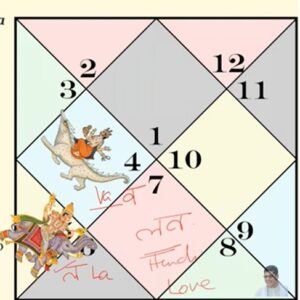 Together they form “lava.” Here, *lava* is a Sanskrit or Hindi word, not the English word “love.” In your fingers there are phalanges. What is *lava*? Try to understand. In the finger, *lava* is the gap or the junction between the phalanges.
Each finger represents a rāśi. Therefore, what is *lava*? It is the boundary of the rāśis. In the same way, the sounds “la” and “va” mark the boundaries of the rāśis.
The first major boundary is between Leo and Cancer. This is the Gaṇḍānta of Varuṇa and Indra. There is another sunset point that is not visible. Capricorn belongs to Indra, whereas Aquarius belongs to Varuṇa. Therefore, Leo and Capricorn—signs five and ten—mark the beginning and ending points of Indra. Aquarius through Cancer—signs eleven through four—mark the beginning and ending points of Varuṇa.
Now, what does the Vāyu Purāṇa say? It is due to the curse of Maheśvara that the noble souls—the Saptarṣi, Dakṣa, and the powerful sages such as Bhṛgu and others—manifested themselves in this Manvantara.
They had no desire to come at this time. This is Kali Yuga. They said, “What work do we have here? These useless fellows are going to appear. Why do we have to come?” Maheśvara became angry and said, “No, you cannot absolve yourselves of your duties. You must go there and produce the creatures. If you do not produce the creatures, how will the world be populated? How will they redeem their karmas? How will time be used?” Time must be used; otherwise, it will be wasted.
Maheśvara is the name by which Viṣṇu worships Śiva. How interesting. Therefore, this was essentially a prayer of Viṣṇu. Who caused this whole situation—this mischief of you and me coming to Bhū-loka to learn the Jaimini Sūtras? Viṣṇu caused this mischief.
He worshipped Maheśvara. Rāma worships Rāmeśvara; Kṛṣṇa worships Someśvara. In this way, they worship Īśvara to redeem themselves from karma.
Here we are speaking about Budha and Viṣṇu. He worships, creation begins, and Śiva becomes angry. Why should the Saptarṣi merely come and attend class? Merely attending class is not sufficient. You are a Ṛṣi; you must also work.
The souls who will incarnate in Bhū-loka are, fundamentally, ignorant. They know nothing about the akṣaras. They know nothing about the powerful matrix that governs the laws of karma. They are interested only in physical visibility. For them, proof of life is whatever is physically visible.
But what physical proof do you have that you possess a mind? Can you prove physically that you have a mind? What laws of physics can you use to prove the existence of the mind? The laws of physics cannot prove that you have a mind.
Therefore, such minds look only for physical truths. Your task as Ṛṣis is to awaken their minds. The mind must be awakened from merely looking at and dwelling upon physical things. It must learn to contemplate the mind itself and understand the laws of karma. You can learn the laws of physics, but who will teach you the laws of karma?
Therefore, the Ṛṣis must come and incarnate. How will they come? For you to be born, you must have a father; he must have a father; and he must also have a father, and so on. We go all the way back to the starting point, where we find the seven sages.
Śloka 410 tells us that the seven sages were born again as the seven Mānasaputras of Brahmā. Again, notice the expression *Mānasaputra*—the mind-born sons of Brahmā.
This creates a very interesting situation. Brahmā is in charge of the body, and he has the Devas to perform the work for him. But Brahmā also has a mind. Therefore, they can descend from the mind of Brahmā.
Why? Because the Ṛṣis are above. They are in Anāhata, and they must first descend to Svarga. Svarga lies below Anāhata. How will they descend? They come into the head of Brahmā. What is functioning in the head? The mind functions in the head of Brahmā.
The mind works through the head, but the mind is not located solely in the head. The mind is in the chest and functions through the head. The mind has two seats. See how Candra has two horns. The upper seat of the mind is in the head, and the lower seat is in the chest. The upper seat is Sahasrāra, and the lower seat is Anāhata.
Thus, the mind functions like the two horns of the crescent Moon. The upper part of the crescent is connected with Sahasrāra, and the lower part is connected with Anāhata. This is what connects the head and the heart. The head and the heart are connected by Candra. I hope I am being very clear. I know that I am teaching many advanced concepts in one short lesson, so you will need to listen carefully and make proper notes.
Now, these seven sages were born. The sages were in Anāhata, at the level of Mahar-loka, and they had to descend. Why did they descend? Because of the curse of Maheśvara.
Budha seems to have cursed them. How is Budha connected with Mahar-loka? Please answer this in the discussion list. How is Budha connected with Mahar-loka? Maheśvara appears to have become angry with them, and that is why they descended into the head of Brahmā. This is why they are called Mānasaputras. Mānasaputras are born from the head. They are not born from the loins and do not arise from the Agni Maṇḍala.
If I draw Brahmā here, with his body and legs, this upper region is the Soma Maṇḍala, the middle region is the Sūrya Maṇḍala, and the lower region is the Agni Maṇḍala. Even for Brahmā, the three Maṇḍalas are the same. The Ṛṣis came from the Soma Maṇḍala. They did not come from the Agni Maṇḍala. How did you come? From where did you come? You came from the Agni Maṇḍala of your parents.
Which Graha controls Agni? Maṅgala. Which Graha obtains Digbala in relation to Agni? Śukra. Therefore, Maṅgala and Śukra caused your creation. You were created through Maṅgala and Śukra. It is very interesting: Śukra came from the father, and Maṅgala came from the mother. In Western astrology, people say that men are from Mars and women are from Venus. But in Jyotiṣa, the father gives Śukra and the mother gives Maṅgala. See the difference between astrology and Jyotiṣa.
If a child is very brave, it is because of the mother. If a child is cowardly, it is also because of the mother. If a child possesses great love and affection, it is because of the father. If a child carries hatred and similar emotions, these too arise from the father. Am I being clearly understood?
Śukra comes from the father, and Maṅgala comes from the mother.
Venus comes from the male, and Mars comes from the female. I am very sorry, but I have just destroyed one of the famous modern expressions: “Men are from Mars and women are from Venus.” Brahma Horā, Gola Horā—remember? PJC. I have destroyed that idea. How? By drawing Śukra from the father and Maṅgala from the mother. Therefore, we cannot say that Maṅgala is exclusively male or that Śukra is exclusively female. When Maṅgala influences a woman, she is drawn toward a man. When Śukra influences a man, he is drawn toward a woman. Thus, these two attract one another. We have learned another very important lesson.
The Tattva controller and the Graha obtaining Digbala have very important roles in manifesting the Tattva. Agni Tattva manifests through Maṅgala and Śukra, and in this way the Agni Maṇḍala is formed. You are created from the Agni Maṇḍala, whereas the Saptarṣi are created from the Soma Maṇḍala. They do not like all this Agni Maṇḍala activity. Therefore, this work is assigned to Agni Deva. A Homa is performed. There is an Agnihotrin, the priests recite prayers, and the husband and wife circumambulate the sacred fire as part of the marriage rite.
The Ṛṣis are born from the head. They were adopted as sons by Svayambhū, the self-born god Brahmā himself. Therefore, Svayambhū—that is, Brahmā—adopted them as his sons because they emerged from his head. They are therefore regarded as adopted children. The Saptarṣi are Mānasaputras. Mānasaputras are adopted sons; they are not bodily born children. Who, then, were the first adopted children in the world? The Saptarṣi were the first adopted children in the world. Okay.
The creative activity was then initiated once again, as before and in the proper order, by those noble souls. They are truly noble. They had committed no fault, and yet Maheśvara cursed them. How must they have felt? Maheśvara is their teacher. He teaches them all the time. “This Guru likes us so much. We obey him, we are always on time for class, and still he scolds us. What kind of Guru is he?” You see? They did not give groundnuts to Maheśvara. Then they began manifesting the other beings in a series: snakes, birds, cows, dogs—everyone was created. Their death and rebirth occur because the Saptarṣi received the curse of Bhava, which is another name of Śiva. Notice the names that are used: Bhava and Maheśvara.
I would like you to comment on these names in the group, because these two names are very specifically mentioned in the Vāyu Purāṇa. The Saptarṣis receive the curse of Bhava, and that is why they have to be reborn. Their rebirth occurs because of the curse of Bhava. Which Graha represents this form of Śiva? Which Graha symbolizes the Bhava form of Śiva? That Graha should therefore symbolize rebirth.
Is it Śukra? Is it Śukra? If so, Śukra, whose Mūlatrikoṇa is in Tulā, the natural seventh house, should symbolize rebirth. Am I being clear? Therefore, you must understand that, in the Purāṇas, even when a particular name of Śiva is mentioned, you cannot take that name lightly. Some very important knowledge is being transmitted through the use of that specific name in the śloka. Okay?
The Saptarṣis manifested again, and they resumed the process of creation. In order to accomplish this manifestation, Brahmā performed the great Varuṇa Yajña. Why did he perform the great Varuṇa Yajña? When someone is under the curse of Maheśvara—Śiva—only Varuṇa has the power to release that person from a curse arising from Maheśvara. Even if you are under the curse of one of the Ṛṣis, only Varuṇa can release you from it.
From Janar-loka, they travelled toward Svarga-loka. Some of them travelled from Janar-loka to Svarga-loka, passing through Mahar-loka. Brahmā then assumed the form of Varuṇa. Now, who assumed this form? Brahmā assumed the form of Varuṇa for the creation of all the Ṛṣis, because Brahmā himself could not originally create the Ṛṣis. Who, then, created the Ṛṣis in the beginning? The Ṛṣis descended from Janar-loka as the Mānasa Putras of Brahmā. They came down from Janar-loka as Mānasa Putras. This means that they had already been created. They already existed. Who created them originally? Varuṇa created them. It was Varuṇa. Therefore, Varuṇa is no ordinary Devatā. He is not merely one among many ordinary Devatās. He is an extremely powerful Devatā who possesses absolute control over bondage.
Varuṇa has the power of bondage. He can place anyone under bondage, while the one who can release a being from bondage is Śiva. Thus, bondage and freedom from bondage form a divine interplay between Śiva and Varuṇa. When Śiva imposes a curse—that is, a form of bondage—upon the Ṛṣis, Varuṇa can release them from it. When Varuṇa places his curse and his pāśas upon all souls, including you and me, we come under the Aṣṭabandhana of Varuṇa. The one who can release us from these bonds is Śiva. He is the one who frees the soul and the mind from bondage.
He is the soul of all the aṅgas of the Yajña. All the aṅgas—the limbs or constituent parts—of the Yajña are associated with him, together with Vaṣaṭ-kāra. What was the first mantra? The first mantra was Vaṣaṭ-kāra. Vaṣaṭ is associated with the Ṛṣis. To awaken a Ṛṣi, we must use:
Vaṣaṭ, Vaṣaṭ, Vaṣaṭ.
Now consider Brahma tejas. Brahmatejas refers to the spiritual brilliance of the Brāhmaṇas. Kṣatriya tejas is found among the Kṣatriyas. Brahma tejas belongs to the Brāhmaṇas, while Kṣatriya tejas belongs to the Kṣatriyas.
Brahma tejas can also be understood in relation to the eyes—the three eyes of Brahmā. Tejas contains Sattva and Rajas Guṇas, while Tamas is associated with Ākāśa.
Where is Ākāśa situated in your body? Ākāśa is here, in the region of the throat. Sattva is associated with the neck, while Sattva and Rajas Guṇas are present in Brahma tejas.Thus, Sattva is present here, in the third eye. Sattva and Rajas are present here, while Tamas is situated below the neck, in the region of Ākāśa. Where did Tamas descend? It descended to the neck. When Tamas descends to the neck, poison also descends with it. Therefore, the grace of Nīlakaṇṭha becomes essential.
The most important Devatā here is Nīlakaṇṭha Mahādeva. He takes away and contains the poison. That is how you are able to survive. When the virile seed was poured into Agni, Kavi—Śukra—emerged from the blazing fire, and Hiraṇyagarbha Brahmā named him Bhṛgu. Thus, Śukra was placed into Agni. What is the direction of Agni Deva? It is the South- East direction.
Therefore, when Śukra is associated with the southeast direction, or when Śukra is in the fourth house, he assumes the form of Bhṛgu.
From this, we learn a very important lesson:
Grahas in Digbala are also associated with the Ṛṣis.
How interesting! Grahas in Digbala may also be connected with particular Ṛṣis. Therefore, there must be one form of Digbala associated with the mind and another form of Digbala associated with the body. The Digbala associated with the mind and the Digbala associated with the body are distinct.
Digbala associated with the mind involves a Ṛṣi, whereas Digbala associated with the body involves a Deva.
For example, when Sūrya has Digbala at the level of the body, we call him Indra. When Sūrya has Digbala at the level of the mind, we call him Kaśyapa.
When Śukra has Digbala at the level of the body, we call him Agni Deva. When Śukra has Digbala at the level of the mind, we call him Bhṛgu.
Mahādeva saw Bhṛgu and declared: “I desire a son, and I have received initiation. I desire a son, and I have received initiation.”
What does it mean to be initiated? Where does initiation occur? Mantra initiation is indicated by the fifth house. Without mantra initiation, you cannot have a son in the proper spiritual sense. If you have a son without mantra, that son comes without the blessing—the Ṛṣi-kṛpā.
Mahādeva therefore said, “May he be my son. May Bhṛgu be my son.” Thus, Mahādeva adopted Bhṛgu as his son. Bhṛgu was the firstborn among the Ṛṣis. The first Ṛṣi to be born was Bhṛgu. Śukra was the first Ṛṣi to be born. Okay. I think that is enough for today.