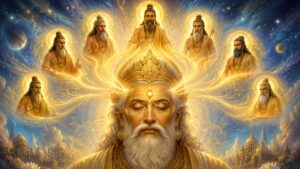
 We are continuing our discussion of the advent of the Ṛṣis. Ṛṣis are extremely pure souls. The highest expression of Guru—what is it? The highest expression of Guru is the purity of Viṣṇu, arising from Mīna, and the knowledge of Śiva, arising from Dhanu. That is said to be the highest expression of Guru. The word “Ṛṣi” represents the highest expression of Guru. He can grant you purity. He can grant you knowledge. He grants you purity because of his access to Viṣṇu. He grants you knowledge because of his access to Rudra.
The Ṛṣis are in the four higher lokas. They reside only in the four higher lokas. They do not come down to the Tamas. They do not even like to come down much to the throat chakra. They will reside in your Ājñā chakra or they will normally reside on your Sahasrāra chakra.
They do not like to come down to Tamas because you know that Tamas starts in the throat chakra. Below that everything is Tamas. The five Tattvas, Ākāśa. Ākāśa is in your throat. Ākāśa is dominating in your throat.
You know there is Vāyu in your heart, in your chest. Maṇipūra is in your stomach region. So that is Agni out there. Then you have Jala in your Svādhiṣṭhāna and you have Pṛthvī in your Mūlādhāra. So these five are the Tamas Tattvas.
What am I talking about? I am talking about your astral body. You have an astral body, a body of energy. That astral body, the lower part below the neck is Tamas energy. This is your Rajas energy and the Ṛṣis do not like this either.
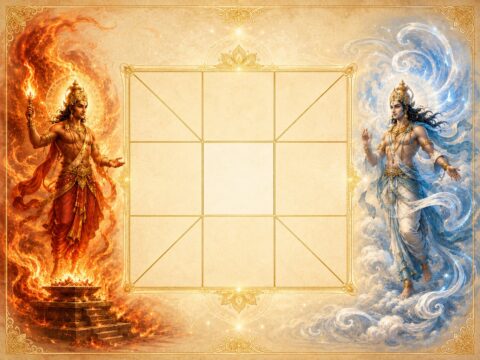
They like to be in this Sattva. So we were talking about the creation. When the virile seed was poured into Agni, Kavi, Śukra emerged from the flaring fire and Hiraṇyagarbha Brahmā called him Bhṛgu. So we must understand that this Bhṛgu is in some way associated with Śukra. Therefore, conception is in the seventh house, Ādhāna. And this Ādhāna is associated with Bhṛgu. Then delivery is in the first house and we call that Janma or Udaya and that is also associated with Bhṛgu. So, Bhṛgu in some way is a Śukra energy, Śukra energy that is manifesting through the seventh house in the form of a bīja that is conceiving you. Your conception is happening. Your Ādhāna is happening.
So, if you observe throughout the Jaimini Sūtras, throughout the Upadeśa of Jaimini, he talks about seventh house, first house. What is this seventh house, first-house principle? The seventh house, first-house principle is nothing but Bhṛgu. It is Bhṛgu and this seventh house, first-house principle is a Bhṛgu who is the son of Mahādeva. Look at the name used over here.
So, Candra is being talked about, a lunar form of Śiva called Mahādeva and Bhṛgu is a Śukra form of Lagna. So some kind of a Lagna and seventh house connection is being made because of Bhṛgu and the one who adopts him and says, “You are my son,” is a form of Śiva called Mahādeva. So, three forms of Śiva have been mentioned so far. Maheśvara who gave the curse, Bhava who implemented the curse. Giving a curse is one thing; implementing it is another.
Bhava is the form of Śiva that implemented the curse and finally when the curse was implemented and the Ṛṣis had to come down, they had to come down to produce the children. That is when Śiva took Bhṛgu as his son saying that all children will be born through the movement between the first house and the seventh house. During the daytime, people who are born in the daytime, Bhṛgu sits normally in the first house. For a daytime birth, Bhṛgu is placed in the first house. For a nighttime birth, Bhṛgu is placed in the seventh house.
That is the first differentiation. So, if you are born at night, where is Bhṛgu placed? He is in the seventh house. I was born at night, where is Bhṛgu in my horoscope? He is in the seventh house.
That is why if you see in one PJC that I taught recently, I was telling them, look the seventh house is important. I used the word important. I did not say Bhṛgu because then they will be completely confused. They have not reached your level at which I can speak about the Ṛṣis. So, I am very careful what words I use. It is Bhṛgu who makes that house so important. Bhṛgu is in the seventh house.
So, seventh house is very important in my horoscope because I was born at night. And the planet over there, Maṅgala, connects me to Jyotish as the knowledge. If I was born during the day then my Lagna would be more important and the Guru would have the focus of all attention.
Where, then, is the focus? For example, let us take the chart of Lord Kṛṣṇa. Kṛṣṇa is Candra Avatāra. The Avatāra is known from Janma—that is, from the Lagna. The Lagna tells us who and what you are.
Which Grahas are taking Digbala from Lagna? Which Grahas are in particular houses from Lagna based upon which they are having special powers to influence the Lagna? For example, in the chart of Śrī Rāmacandra, we find that Śrī Rāma was born when the Sūrya is in the tenth house and he is a Sūrya Avatāra. Why would Sūrya in the tenth house make him a Sūrya Avatāra? Should we not be looking at the Lagna?
So we have learned about Jāta Graha. We have learnt how the Jāta Graha is the ray from which the Avatāras are descending. We have learnt that and from there we calculate as to which planet is bringing the Avatāra down. Whoever will bring you down will be the one responsible for your manifestation. Okay.
Read further
Now my next point over here. In the chart of Sri Kṛṣṇa, Candra is exalted in Lagna but that is not the most important planet. Where is Bhṛgu? In the chart of Sri Kṛṣṇa who was born in the nighttime, do not look at Lagna as the most important. Look at the seventh house.
The seventh house is Scorpio, ninth lord Śani is there. Therefore, for Lord Kṛṣṇa “yadā yadā hi dharmasya glānir bhavati bhārata” (BG 4,7). Dharma becomes the most important for an Avatār It is absolutely the most important. So therefore for Kṛṣṇa Avatāra, ninth lord Śani is in the seventh house.
What about Rāma Avatāra? Rāma Avatāra was born in the daytime. In Guru, the ninth lord is in Lagna. So, we can clearly see Bhṛgu is holding on to the ninth lord for the particular Avatāras to descend. And when the ninth lord is descending, becomes central to your decision-making, that means you will never break dharma.
You are the upholder of righteousness. You will always be a deeply righteous person. It is very interesting to know that whoever pointed a finger at Śrī Rāma, especially regarding his righteousness, was absolutely destroyed. Why? That is the nature of dharma.
Dharma has the power to invoke Dharmarāja or Yama. So anybody who will point a finger at Śrī Rāma and say something about dharma, “What you are doing is not right,”, you do not understand Śrī Rāma. So, how can you say what he is doing is right or wrong? You should instead say “Bāli, O mighty Bāli,”, you should say Rāma please explain to me this thing. What you do not understand, ask for an explanation. Do not point a finger at dharma. Because every time you point a finger at Rāma, his dharma will rise in response. Every time you point a finger at Lord Kṛṣṇa, it is Śani who is protecting his dharma who will rise. And interestingly, Guru is in Digbala. So not only will Yama rise as Dharmarāja, the protector of dharma.
Raja means the protector. The protector of dharma is Yama. The Graha with Digbala, Guru, Śaṅkara, Lord Śiva will rise. He will rise in great anger. In the form of Hanumān he rose and he did the Rudra Tāṇḍava.
And the world saw Rudra Tāṇḍava taking place in Laṅkā. Hanumān was dancing over there. Who was inwardly singing it? Rāvaṇa was singing that. In his soul, Rāvaṇa was singing the Rudra Tāṇḍava and he saw Rudra in the form of Hanumān dancing the Tāṇḍava in his Laṅkā.
Everybody was very agitated and running from here and there. Rāvaṇa was not agitated. He stood there quietly and told everybody, do not miss this teaching. Hanumān is a great Guru. Hanumān is a great teacher. He has come to teach something to me. None of the Devatās could teach me anything. They are fools. None of these great Yakṣas and so many Devas and powers I have destroyed because they could not teach me anything. They are unable to teach me. This Hanumān, he is my real teacher. My teacher has come down to teach me. I am learning his lesson. Do not repair the buildings of Laṅkā. Let it be like this to welcome the Rudra again.
You see, Rāvaṇa knew. He understood what I have been praying for. The day has come. There shall be complete pralaya and Rudra will destroy Laṅkā. All those who are dear to me will get mokṣa provided you do not become afraid in the last minute. If you become afraid in the last minute, mokṣa will be denied for you. So this is something important we learn. Look: when the ninth lord is having digbala, the Dig Devatā will certainly come to protect dharma. Particularly when Bhṛgu is involved. Why?
Because Bhṛgu has the power. He is the son of Mahādeva. Again, he is an adopted son—a Mānasa Putra. Mānasa putra, adopted son. I want you to understand this Lagna – seventh house.
Similarly, planets in digbala will definitely have the power. I am speaking of Digbala from Lagna because it is body. From Lagna when the planet has digbala, it is working through the intelligence. It is working through the body. Intelligence is a function of the body that you occupy. This human body that you occupy has the intelligence power of the Ṛṣis. The highest potential is present within you. Ṛṣis also created dogs. Ṛṣis also created snakes. Ṛṣis also created crocodiles.
They do not have the intelligence power that you have as manuṣya. You are the blessed ones. You are truly a blessed birth. Do not think that your birth is a waste of time. You have been given a human birth.
The Ṛṣis have spent a lot of energy, a lot of their resources they have used to give you this body of a human being. This body of the human being that you will occupy is available only for a limited period. Do not let the Ṛṣi feel bad that his whole hard work in creating your body for your use, for your Ātmā to use, it is like a dress. When somebody buys a new dress for you, do not you say thank you? Then why do we fail to say thank you to the Ṛṣi who has created this dress for us? The Ṛṣi who was in charge of creating the dress and the Ṛṣi who was in charge of putting on the dress. One makes the cloth; another tailors and dresses you. To make the clothes, to put the clothes on you are different. The person who manufactured the cloth is different from the person who is tailoring the shirt for you. Did you understand?
There are two people involved over here. The person who is tailoring the shirt for you, for me and for everybody is Maharṣi Bhṛgu and the son of Mahādeva. So, two names are very-very important. Mahādeva and Bhṛgu. These two names you must always remember.
Mahādeva is the Candra form of Śiva. This Candra form of Śiva like the mother, the mother, you came in the womb of a mother when you were being created. How does a woman become a mother? The mother became a mother because of Mahādeva. At the time when a lady is carrying a baby, the Devatā who is with that lady is Mahādeva. Fortunate is that lady, fortunate is that lady to have such a close association with Mahādeva. Men cannot naturally have such a close association or they cannot carry a baby naturally. Artificial methods may do certain things but that is not natural. Artificial methods may produce an Asuric result, but they cannot reproduce the natural process of Manuṣya birth. Therefore remember this.
The hand of the Ṛṣis is very-very important in your creation. Therefore Bhṛgu must be the first born for he is responsible for this transition from the Ādhāna, seventh house to the Lagna, first house. The Ṛṣi who is there with you creating each part of your body based upon your karmas, creating your horoscope. The Ṛṣi who knows your horoscope completely and the greatest Ṛṣi for knowing horoscope is Bhṛgu and that is why there is a book called the Bhṛgu Saṃhitā—the compendium of Bhṛgu. Think about this for a few minutes please.
Maharṣi Bhṛgu is therefore extremely important. You cannot have a Lagna without Maharṣi Bhṛgu. You cannot have a Lagna. The Lagna is the grace of Bhṛgu, Bhārgava. We people from the villages near Purī, from the Śāsana villages of Puri which are on the right side of the road. The road has villages on the right side and villages on the left side. The villages on the right side lie near a particular river called the Bhārgavī. The river Bhārgavī flows close to our village and we place our Śiva Liṅgas close to that river called the Bhārgavī. Bhārgavī gets the name from Bhṛgu to remind us every day do not forget Bhṛgu. You cannot be a good Brahmin without Bhṛgu.
A good Brahmin will always remember the name of Bhṛgu and how do we remember his name? What is his mantra? The first akṣara of his name is taken. Bhṛgu’s first akṣara is if you write down Bhṛgu in Sanskrit, Bha is the first akṣara. From this Bha we realize that living in Bhū-loka, Bhū-loka, from *bha* we derive the name Bhū-loka.
From *bha* we also derive Bhuvar-loka. So Bhū-loka and Bhuvar-loka are getting their name from the name of Bhṛgu. Remember this. Śukrācārya teaches that look Father Bhṛgu, Bhṛgu is his father. Father Bhṛgu is the giver of Bhū-loka to all souls. Souls are able to enter Bhū-loka because the door has been breached by Maharṣi Bhṛgu. In the seventh house of their horoscopes based upon their karmas he will choose the seventh house and from the seventh house he will plant the seed. Bhṛgu plants the seed and he will carry the seed through the full term of gestation to the Lagna, Udaya Lagna. This planting of the seed belongs to the Bhuvar level. So the seed is planted in Bhuva.
Now Bhuvar-loka, as we have understood it, is in fifth house, sixth house, seventh house and eighth house. Of these houses seventh house is the planting of the seed and that is the Ādhāna. Bhū-loka is in first house, second house, third house, fourth house. First house is taken as the delivery. So that is Janma.
So the mantra for Bhṛgu is Oṃ Bhūr Bhuvaḥ Svaḥ. Svaḥ is from Sat. Svaḥ. Svaḥ is Self. Later I will teach you more about Sva. Okay. Om is Śiva. Śiva as Mahādeva. Bhūr that means first house. Bhuva, seventh house.
So the Ādhāna. Ādhāna is over here. Bhūr is Janma or Udaya. Svaḥ—the Self. Me is a part of Śiva, Paramātmā. The Ātmā, the soul, My soul has come to Bhū-loka through the Bhuvar-loka and that is me. I am not at one place. I exist in two places. At Bhu in Lagna and Bhuva in the seventh house. I am simultaneously existing in two places. I am a duality. I am a split personality having two principal parts. Two principal parts called the soul and the mind. Oṃ Bhūr Bhuvaḥ Svaḥ. In this the soul, the soul is Śiva. Śiva is the Om. It is the soul, Ātmān. Bhūr is the body, the earth. Bhuva is the mind. So mind, body and soul are in Om Bhūr Bhuva and Svaḥ is me. Sva is the Self. Sva is me. Sva and Sva. How many times have we discussed *sva*? So the mantra Oṃ Bhūr Bhuvaḥ Svaḥ is for understanding the Self.
It is for Self-realization—for knowing who we are. Why we are here. Why did we land up in this? What karmas brought me here? So where is my horoscope? Where is my horoscope in my horoscope? My horoscope is actually in the seventh house. My karmic horoscope is rooted in the seventh house. When we draw a chart, zero degrees of Tulā is gaṇḍānta and this is called the Bhṛgu gaṇḍānta. This is the Bhṛgu gaṇḍānta. This is where your soul was implanted inside the womb where half is in the little, when you say zero degrees, a small portion is here in the sixth house and a small portion is in the seventh house and you were implanted over here and you were delivered over here. Zero degrees it is another gaṇḍānta. So there are two gaṇḍāntas. One gaṇḍānta is called Ādhāna and the other gaṇḍānta is called Janma. This is shown in the Naisargika chart.
So where is the Jataka? Your horoscope, your karmic horoscope is actually in the seventh house. So therefore the seventh house, its symbol is horoscope. If a planet is in the seventh house, it will give you very good knowledge of Jyotish. You will be master of Jyotish because of the strength of the planet in the seventh house. That planet has to be very, very strong for you to be proficient in Jyotiṣa, for you to be able to draw horoscopes accurately, to accurately determine the planetary positions, to accurately know what the Grahas are indicating. The seventh house is very, very important for Jyotish and who is giving this knowledge of Jyotish in the seventh house? The seventh house knowledge of Jyotish is given by Bhṛgu. Oṃ Bhūr Bhuvaḥ Svaḥ. You may now adopt this mantra.
I chose this time of the midday to give this mantra to you on a Monday so that this mantra may be yours. You may take this mantra forward. This is the proper initiation of the Brahmā-vyāhṛti. This mantra Oṃ Bhūr Bhuvaḥ Svaḥ. This Bhūr Bhuvaḥ is Brāhmaṇa-vyāhṛti.
It is because of Bhṛgu that we are becoming Brāhmaṇa. Without Bhṛgu you cannot be a Brahmān. You got initiated into one of the highest, in fact the highest mantras. Oṃ Bhūr Bhuvaḥ Svaḥ. You can use this Brāhmaṇa-vyāhṛti with any mantra. Oṃ Bhūr Bhuvaḥ Svaḥ. Oṃ Bhūr Bhuvaḥ Svaḥ. Like that. This mantra Oṃ Bhūr Bhuvaḥ Svaḥ is normally used with planets in Lagna and the Bhuva. Bhuvar-loka.
The seventh house is the controlling for Bhuva. We are deriving Bhuva. As far as our experience in Bhū-loka is concerned, you can only experience Bhuva. You are seeing day which is from Lagna to sixth house and night which is from seventh house to twelfth house. Day Lagna to sixth house, night seventh house to twelfth house.
This is what you do every day. Every day you are seeing this only. In Bhū-loka you cannot experience more than this. To have a threefold division of Bhūr, Bhuva and even Svarga-loka, for that you have to go to Bhuvar-loka and observe from there. Your observation point has to be the Sūrya. So what is Bhu? What is Bhu? Bhū is geocentric. What is Bhuva? Bhuvaḥ is heliocentric. What is Sva? Svaḥ is Viṣṇu-centric. Where Viṣṇu is the center of the, where Viṣṇu is the center of the Sūrya. The chart is being drawn with Viṣṇu as the center. Now anyway these are different levels of Jyotish where we are, we have not yet reached that stage where we can talk about those charts.
We are not there but we are getting there. We are getting there, we are not there. Someday we will reach that point. We have to just stick to the path. Okay.
We now understand the importance of Lagna and seventh house because these two are the most important houses because they are the Sandhyā. They are Sandhyā. Sandhyā comes from the word sandhi. sandhi means the junctions of day and night. Day starts from Lagna, ends in the sixth house. Night starts from seventh house, ends in the twelfth house.
Technically the junction of day and night is in Lagna and the seventh house. It is called the twilight and who is strong in the twilight? Rāhu and Ketu are strong in the twilight. That is the reason why Rāhu and Ketu are called Grahas that control karma. Rāhu wakes you up every day because he has caused your birth, rebirth.
Every day we are born again. And Rāhu is responsible for being born again. Every day we sleep again and Ketu is responsible for our sleeping again. Because of Māyā, everything is ulta-pulta.*Ulṭā-pulṭā* means reversed. Everything is reversed.
Even the Sun has become retrograde because of Māyā and because of this power of Māyā, even the Sūrya is retrograde. We are seeing a retrograde Sūrya. Therefore what we are experiencing in life is Ketu is waking us up and Rāhu is going to put us to sleep. Ketu will wake us up, Rāhu will put us to sleep. That is ulta-pulta. Ketu is waking us up every day and Rāhu is putting us to sleep. This is the ordinary, inverted pattern of sleeping and waking. We are waking up because of Ketu. What is Ketu? The Agni is about to start.
Ketu is the ignition of the Agni. Ketu is the ignition of the Agni. The Agni is about to start. The Sūrya is about to rise. Wake up small creatures. Wake up, Ketu is saying. So we are waking up because the Sūrya is going to rise. We have become small creatures like the birds, like the animals. We have become small creatures. How sad.
The Ṛṣis are looking and thinking we created these people as manuṣya so that they can become like us. They can awaken the capacities bestowed by the Ṛṣis. Consider the teaching of Guru Nānak Dev. Guru Nānak Dev teaches wake up at four o’clock. All Gurus teach: wake up at 4. In fact they say for a perfect spiritual life wake up at three o’clock in the morning. Wake up at three o’clock but Rāhu is very strong at that time. Correct? Wake up because of Rāhu. Sleep because of Ketu.
If you wake up because of Rāhu and sleep because of Ketu, you will get Moksha. If you wake up because of Ketu and sleep because of Rāhu, you will be reborn. That is what they are trying to say. Both transition points belong to Bhṛgu. Waking up and sleeping are both Bhṛgu. Bhṛgu observes your waking up and Bhṛgu observes your sleeping. This is the job given to him by Mahādeva. He is the son of Mahādeva. The Vāyu Purāṇa clearly mentions this. So how do we do this? How do we wake up? Put an alarm. Pray to Mahādeva. Tell him please wake me up. Wake me up at 4. Do not make it later than that. Wake me up way before Sūrya rises. Wake me up way before Sūrya rises so that I may finish my bath before Sūrya rises. So that when the Sūrya is rising, I may be ready to welcome him with the mantras of the Ṛgveda. The verses of the Ṛgveda will fail if I have not taken my bath before Sūrya rises.
The verses of the Ṛgveda will fail. They will fail again and again and again and I will ultimately die because of Rāhu to be reborn again. In a future birth the Ṛṣis may not be so kind to give me a human body. So please let me make use of this birth properly. Pray to Mahādeva.
Did you understand that? After Bhṛgu has been produced, there is only one Ṛṣi at this stage. At this stage there is only one Ṛṣi and your Lagna and your seventh house, the ascendant and descendant have been established. There are no Grahas. There are no Grahas. From where, then, will the Grahas arise? Only the Lagna and the Saptama. Based upon karma, based upon karma they have been fixed. The second pouring fell. Second pouring, the second pouring.
Second pouring is the second pouring, fell on burning coals and then emerged Aṅgiras. Aṅgiras came from the burning charcoal. You know burning coal. In ancient times, people would cook food on burning coals. People in India would cook food over burning coals so that they get the blessings of Guru.
Aṅgiras emerged with limbs firmly formed by the burning coal. So what is the one quality of Aṅgiras? His hands contain Agni. He is holding Agni in his hands. There is Agni in his hands. There is so much energy in his hands. He is such a competent one. First came Bhṛgu—remember this. From Bhṛgu was the first or Lagna was the first. Let me just put it.
Lagna, Bhṛgu. Then came Aṅgiras. Agni Deva Agni Deva adopted him as a son and his descendants are called Āgneya. So the original Agni was Aṅgiras. From Aṅgiras emerged Bṛhaspati and many others.
Brahmā now poured Ojas into the Agni six times, corresponding to the Ṣaḍṛtus. Six times Brahmā poured with no flickering flame. The flame is not spitting. Previously the flame was spitting. *Thu-thu-thu*, *phaṭ-phaṭ*— The flame flickered and scattered sparks when Bhṛgu was born. Thus, Lagna is a single point.
Lagna is a point. It comes from flickering flame. That is why it is called tejas-chandas. The oblation was then poured six more times. The first to emerge from the rays was Marīci- Sūrya, Kratu- Maṅgala.
From the offering was the second one. So these two, the Lagna, Bhṛgu and Guru- Aṅgiras, I forgot to mention Guru earlier, are different. Lagna, Bhṛgu, and Guru- Aṅgiras,are different. They are different kinds of Ṛṣis. They are higher, very higher level Ṛṣis.
Then six times the pouring came. Remember the first pouring, the second pouring was on burning coal. This Ojas is now poured again six more times. There was no scattering flame, and therefore no Lagna principle. Nor did the Ojas spill onto the coal.
The Ojas did not fall inside the coal. So no Guru, no Medha and the other Grahas, therefore Sūrya, Maṅgala, they do not have the medhā of Bṛhaspati, of Aṅgiras. Bhṛgu and Aṅgiras are on a completely different level. Lagna and Guru are on a completely different level. Lagna is from the spitting fire in the center.
When the fire is starting, what is spitting fire? What is spitting fire? It is called spark. So Lagna is like a spark. Do you get the idea? The spark is flying. It flies. The spark is flying. That is why it is called flickering flame. It is a spark. Whereas this has gone into the coal. The ghee has fallen on the coal. As you’ve seen sometimes the black coal is there and there is a flame on top of it. So this is the coal that is burning. So the excess ghee. So this is coming from the overflowing ghee. So Guru is all about excess. There was so much ghee that it fell on the coal. It fell out of the pot into the coal. Get the idea?
So the sparking which caused the flame to come. The sparking caused the flame. That is Bhṛgu. The ghee that fell on the coal. So first the spark. Then the coal catches fire. The coal is catching fire. That is Guru. Now the pot is going to boil. So all the others came out of the pot.
All the others have come out of the pot. Sūrya, Maṅgala. So the first is Sūrya. The second is Maṅgala, Kratu.The third emerges saying: “Aham Tritiya”. “I am the third.”
The first one just came. Marīci emerged suddenly. It popped up.Then came Kratu, associated with Maṅgala. So Sūrya and Maṅgala were the first two and these two are one group.
Then came the third one. Aham Tritiya. He was the first one to speak. The first one to speak. See that. Aham Tritiya. The first one to speak and was called Atri. This is Candra, not Budha. This is Candra. So the first one to speak was the Candra and what did he say? Aham Tritiya. “I am the third Ṛṣi to emerge.”
The fourth had sharp pointy hair and was called Pulastya. Budha. His hair stood on end like the quills of a porcupine. His head was like that with all hair standing like that. Budha. Pulastya. So the third and fourth form another group. The first and second form one group.
What is the first and second? The Sūrya and Maṅgala Ṛṣis. The second group consists of the Candra and Budha Ṛṣis. So Atri and Pulastya. The first one to speak was Atri. Aham Tritiya. From Aham Tritiya. Atri. Thus arose the spoken name Atri.
The fifth came with long hair. Called Pulaha. associated with Śukra, and had long hair. And the sixth is called Vasiṣṭha. But according to the expounders of the Vedas those who know the truth. So Śani was the sixth who knows the truth. And he can immediately discern. Hey, this is the light. This is not the truth. So this Vasiṣṭha is very concerned. Hey, this fellow is lying. Hey, this fellow is telling the truth. This is right. That is wrong. This whole job was given to Śani. So this is the third group. Group A, Group B and Group C. So, what is the order of the coming of the Ṛṣis?
First was Lagna. Then came Guru. Then came Sūrya, Maṅgala, Candra, Budha, Śukra, and Śani.
Because Pulaha had long hair. Women traditionally like to have long hair to keep the Śukra strong. Women traditionally like to have long hair to keep the Śukra strong. A woman who never cuts her hair will never lose her husband. A woman who never cuts her hair will not lose her husband. Will never lose the Vāha. Seventh house is called Vāha. A woman who will never cut her hair will never lose the Vāha. A Śiṣya who never cuts his hair will never lose the Guru. That is the blessing of Pulaha. That would certainly put the barbers out of work. Pulaha was born from Vasu. Pulaha is born from Vasu.
That is fire. Vasu here signifies light, not fire. Agni is fire and heat. Agni is heat and Vasu is light. From the light came Vasu. Śukra therefore shall rule the eyes that will behold beautiful things in this world. To perceive beautiful things, the ability to see beauty in everything is coming from Śukra, from the blessings of Pulaha. Pitṛs were created by these great sages. Pitṛs, remember. The seven lineages of sages are well known in the world.
Marīci, Bhārgava, Aṅgiras, Paulastya, Paulaha, Vāsiṣṭa and Ātreya. These groups of Pitṛs are well known in the world. Lord Yama is the king of the Pitṛs. How interesting. So they also have a king who is Yama. Yama is the king of the Pitṛs. I think there is a lot to digest in this. A lot to think about and we will talk more about this.