All knowledge belongs to the Guru; any errors or omissions in interpretation are entirely mine.
Understanding Viveka through the Mahābhārata and Purāṇic Narratives
ॐ गुरवे नमः — Om Gurave Namaḥ
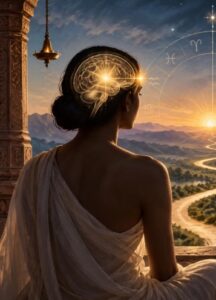 When we open a horoscope, one of the first things we are taught to examine is the Lagna. In many introductory texts, the Lagna is described primarily as the physical body, appearance, personality and the general expression of the individual. While these associations may help a beginner approach the first house, there is a deeper principle through which the Lagna can be understood: Viveka, the discriminating intelligence that determines the direction in which the Jīva moves.
This distinction is subtle but transformative. If Chandra represents the body and the vehicle through which experience takes place, Lagna represents the direction in which that vehicle is taken. The body is given to us, but what we do with that body is shaped by our intelligence, choices, values and discrimination. Two people may possess similar physical capacities, similar resources and even similar circumstances, yet their lives can move in completely different directions. The question is therefore not merely what we have been given, but what we choose to do with what has been given.
The Bhagavad Gītā offers perhaps the most powerful image through which this principle can be contemplated: the chariot of Arjuna on the battlefield of Kurukṣetra. Arjuna is an extraordinary warrior. He possesses training, courage, weapons, lineage and experience. Yet, at the very moment when he must act, his mind becomes overwhelmed. His bow slips from his hand, and he turns to Kṛṣṇa for guidance. His problem is not a lack of physical strength. It is not even a lack of knowledge. His crisis is a crisis of direction. He does not know which course of action is dharmic.
The chariot provides a beautiful metaphor. The body is the vehicle; the horses provide movement; the reins determine direction; and Kṛṣṇa holds those reins. Arjuna’s transformation begins not when he receives a stronger body or a more powerful weapon, but when his confused intelligence is restored through the teaching of Kṛṣṇa. At the conclusion of the teaching, Arjuna declares, “Kariṣye vacanaṁ tava” — “I shall do as You say.” The warrior has regained clarity. The chariot was always there, the horses were always there, the weapons were always there, but the direction had been lost. In this sense, the story of Arjuna becomes a profound illustration of Lagna as Viveka.
The Mahābhārata gives us another remarkable example in the episode of the Yakṣa Prashna. During their exile, the Pandavas become exhausted and thirsty. One by one, Nakula, Sahadeva, Arjuna and Bhīma approach a lake. An unseen voice warns them not to drink the water before answering its questions. Their thirst overcomes their discrimination, and they ignore the warning. Each subsequently falls unconscious.
When Yudhiṣṭhira arrives, he sees his brothers lying beside the lake. He too is thirsty and distressed, but he does something the others did not: he stops and listens. He accepts the condition of the mysterious being and agrees to answer its questions. The Yakṣa then tests him with a series of profound questions concerning life, death, dharma and wisdom. Yudhiṣṭhira does not respond from impulse. He responds through discrimination.
One of the most striking moments comes when the Yakṣa offers to restore one of his brothers. Yudhiṣṭhira could have chosen Bhīma, whose strength would be invaluable, or Arjuna, whose skill would be essential to the future war. Instead, he chooses Nakula. His reasoning is based on fairness between his two mothers: Kuntī already has a surviving son in Yudhiṣṭhira, while Madri has lost both of hers. His choice is therefore not based upon immediate advantage but upon dharma. The Yakṣa is pleased, and the brothers are restored.
The importance of this story for understanding Lagna lies in the circumstances under which Yudhiṣṭhira’s discrimination is tested. He is not sitting comfortably in a classroom discussing dharma. He is thirsty, grieving, uncertain and surrounded by the apparent loss of his brothers. Yet his intelligence does not become a servant of immediate desire. This is the real test of Viveka. It is easy to speak about right action when circumstances are favourable; the true test is what happens to our discrimination when fear, attachment, grief or desire demand immediate action.
The Purāṇic story of Samudra Manthana gives us another profound image of the inner workings of consciousness. The devas and asuras join together to churn the cosmic ocean in search of Amṛta. Mount Mandara becomes the churning rod, Vāsuki becomes the rope, and Viṣṇu assumes the form of Kūrma to support the mountain. The cosmic ocean is churned, and from it emerge many extraordinary treasures. Yet the first great substance to emerge is not nectar but poison, Hālāhala. Śiva takes the poison into himself and becomes Nīlakaṇṭha.
The psychological symbolism is powerful. Whenever an ocean is deeply churned, what lies beneath the surface rises. The same is true of human consciousness. When life churns us, when spiritual practice churns us, or when circumstances force us to confront ourselves, what has been hidden begins to emerge: fear, anger, attachment, ambition, jealousy, desire and insecurity. We may imagine that spiritual or psychological transformation should immediately produce nectar, but the traditional story reminds us that the poison may emerge first.
This also provides a useful way of contemplating the Navagrahas. The planets may be understood not simply as isolated benefic or malefic entities but as forces participating in the great churning of experience. The question is not merely whether a particular force is “good” or “bad.” The more important question is what happens when that force operates through the individual, and what the person’s Viveka does with what emerges.
The story of Prahlāda provides a striking contrast. Prahlāda is born to Hiraṇyakaśipu, a powerful ruler who rejects Viṣṇu and seeks supremacy. Prahlāda is sent to be educated and is expected to absorb the values of his father’s world. Yet his inner orientation remains fixed upon Hari. His father attempts repeatedly to turn him away and eventually subjects him to terrible trials. Poison, weapons, fire, elephants and other dangers are brought against him, yet Prahlāda’s inner conviction remains unchanged.
When Hiraṇyakaśipu finally asks where Prahlāda’s Viṣṇu is, Prahlāda answers that He is everywhere. Hiraṇyakaśipu strikes a pillar, and Narasiṁha emerges. The deeper significance of the story is not simply the destruction of a demon king. It is the demonstration of an intelligence whose fundamental direction cannot be dictated by external circumstances. Prahlāda’s environment tells him one thing, fear tells him another, power tells him another, yet his inner orientation remains fixed.
This brings us naturally to Rāvaṇa, who provides the opposite lesson. Rāvaṇa is often reduced to the role of the villain of the Rāmāyaṇa, but the traditional narrative presents a far more complex personality. He is learned, powerful, accomplished, a great devotee of Śiva and a ruler of extraordinary ability. Yet his intelligence does not save him from destruction. He receives warnings from Mārīca, Vibhīṣaṇa and others, but his desire overcomes discrimination.
This is where the distinction between intelligence and Viveka becomes essential. Intelligence can analyse a situation, collect information and construct arguments. Viveka determines what should ultimately be chosen. A person can therefore be extraordinarily intelligent and still reach a disastrous conclusion if intelligence becomes subordinate to desire. Rāvaṇa’s tragedy is not simply that he does not know; it is that his intelligence becomes aligned with what he wants.
Vibhīṣaṇa provides the contrasting example. He belongs to the same family, lives in the same kingdom and faces the same crisis, yet he chooses differently. When Rāvaṇa refuses to return Sītā, Vibhīṣaṇa speaks against him. Eventually he leaves Laṅkā and seeks refuge with Rāma. The story reminds us that although family, environment and circumstances exert enormous influence, they do not completely determine the direction of the Jīva. At certain moments, Viveka demands that one choose dharma even when doing so means walking away from what is familiar.
The Mahābhārata repeatedly explores the gap between knowledge and action. Duryodhana is a particularly powerful example. His tragedy is not simply ignorance. He repeatedly encounters people who tell him what is right. He knows that certain actions are contrary to dharma, yet his attachments and ambitions prevent him from withdrawing from them. A traditional expression associated with his predicament captures this tension: he knows dharma but does not move toward it, and knows adharma but cannot withdraw from it.
This is a crucial distinction for the student of Jyotiṣa. Knowing is not the same as understanding, and understanding is not the same as choosing. There can be a profound gap between what the intellect recognises and what the individual ultimately does. Viveka concerns this movement from knowledge toward right action.
Another beautiful illustration occurs before the Kurukṣetra war, when both Duryodhana and Arjuna approach Kṛṣṇa. They are offered a choice between Kṛṣṇa Himself, unarmed and unwilling to fight, and His vast army. Duryodhana chooses the army, while Arjuna chooses Kṛṣṇa. One chooses resources; the other chooses guidance. One chooses power; the other chooses the person who can direct his chariot.
The symbolism is significant for Jyotiṣa. Wealth, influence, education, connections and material resources increase our capacity to act, but they do not necessarily tell us what ought to be done. Resources without direction can simply allow a person to travel faster in the wrong direction. Arjuna’s choice of Kṛṣṇa represents something deeper: the recognition that the person holding the reins is more important than the magnitude of the resources available to the chariot.
Dhṛtarāṣṭra gives us another example of how attachment can overpower knowledge. Throughout the Mahābhārata, he receives warnings from Vidura, Bhīṣma and others. Kṛṣṇa himself attempts to prevent the catastrophe. Yet his attachment to his son repeatedly interferes with his ability to act upon what he knows. Sometimes the problem is therefore not lack of information. The problem is that attachment captures intelligence. The intellect begins to construct arguments in defence of what the heart has already decided.
Karṇa presents an even more complex case. He possesses courage, generosity, loyalty and extraordinary martial ability. Yet his loyalty to Duryodhana binds him to a cause that ultimately contributes to the destruction of the Kuru dynasty. Even when Kṛṣṇa reveals his true birth and gives him an opportunity to reconsider his allegiance, Karṇa remains where he has chosen to stand.
Karṇa’s story reminds us that even virtues can become binding when they are not guided by discrimination. Loyalty is a virtue, but loyalty to an adharmic cause can become destructive. Courage is a virtue, but courage without discrimination can become recklessness. Knowledge is a virtue, but knowledge without ethical direction can become manipulation. The astrologer must therefore look beyond isolated qualities and examine the direction in which those qualities are being expressed.
This brings us to Jupiter, Bṛhaspati, the Guru of the devas. If Lagna concerns the direction of intelligence, Jupiter becomes deeply significant because values provide the framework within which intelligence makes choices. The question is not merely how intelligent a person is, but what that intelligence considers sacred. What will the individual refuse to compromise? What principle governs the person when desire and duty come into conflict?
Jupiter therefore deserves to be contemplated not only as a significator of education, children, wealth and fortune, but also as the principle of guidance, wisdom and values. When we examine Jupiter and its associations, we can ask what kinds of principles are likely to guide the individual’s discrimination.
The planets influencing the Lagna similarly colour the way intelligence approaches experience. Mars may orient the intelligence toward action, competition and confrontation. Venus may emphasise desire, beauty, relationship and enjoyment. Saturn may express through discipline, endurance, responsibility and the experience of limitation. Mercury may emphasise analysis, calculation, communication and intellectual curiosity. Jupiter may orient intelligence toward principles, wisdom and dharma. Rāhu may intensify hunger, ambition, uncertainty and fascination with what lies beyond the familiar, while Ketu may draw the intelligence toward detachment, transcendence and that which lies beyond worldly identification.
The question, therefore, is not simply whether a planet is benefic or malefic. We must ask what colour the planet gives to the intelligence and where that intelligence is likely to take the Jīva.
This becomes especially important when considering why two people can experience the same event and respond in completely different ways. One person receives criticism and thinks, “I have failed.” Another thinks, “This is an opportunity to improve.” A third thinks, “They are threatened by me.” A fourth thinks, “Perhaps I need to reconsider my approach.” The external event is the same, but the internal interpretation differs. The interpretation produces the response, and repeated responses produce a life.
This is why the horoscope should not be approached merely as a catalogue of external events. Jyotiṣa can also help us understand the instrument through which those events are interpreted. The question becomes not simply, “What will happen?” but “What happens within this person when it does?”
Such an approach changes the role of Jyotiṣa. The native is no longer merely a passive spectator waiting for planetary events to occur. The horoscope becomes a map of tendencies, forces and patterns with which the individual participates consciously. It shows the terrain, but the journey still involves choice.
This brings us to the beautiful figure of Mīrā Bāī. Her life represents another possibility: the complete orientation of intelligence toward the Divine. The famous expression, “Aisī lagī lagan, Mīrā ho gayī magan,” captures this idea beautifully. The word lagan carries the sense of attachment, joining and becoming deeply fixed upon something. In this sense, the word Lagna itself invites a contemplative question: To what is our intelligence attached?
Is it attached to wealth, recognition, fear, pleasure, status, resentment or worldly achievement? Is it attached to knowledge, service or dharma? Or has it become oriented toward Bhagavān?
Mīrā’s life represents an intelligence whose direction becomes one-pointed. Her outer circumstances do not determine the final destination because her inner orientation has already been established.
Perhaps this is the deeper significance of studying Lagna. The body is the vehicle. The mind experiences the world. The planets colour our experience and responses. Jupiter provides a framework of values and guidance. But Lagna asks the fundamental question: Which way is the Jīva going?
The Mahābhārata and Purāṇas tell this story repeatedly through different characters. Arjuna shows us the need for guidance. Yudhiṣṭhira demonstrates discrimination under pressure. Prahlāda represents unwavering inner direction. Rāvaṇa demonstrates intelligence without proper discrimination. Vibhīṣaṇa demonstrates the courage to choose dharma over belonging. Duryodhana shows the tragedy of knowing without acting. Dhṛtarāṣṭra reveals how attachment can overpower judgment. Karṇa shows how even virtues can become binding when directed toward the wrong cause. Mīrā represents the possibility of an intelligence completely oriented toward the Divine.
These stories are therefore not merely ancient narratives. They are mirrors through which we can examine our own consciousness.
At different moments in life, we may become Arjuna, confused about which way to go; Duryodhana, knowing but unable to act; Dhṛtarāṣṭra, captured by attachment; Karṇa, bound by loyalty; Rāvaṇa, using intelligence to justify desire; or Yudhiṣṭhira, attempting to hold firmly to dharma under pressure.
The study of Lagna ultimately brings us back to one question: What is directing our intelligence?
Perhaps the deepest purpose of Jyotiṣa is therefore not simply to tell us what will happen to us. It is to help us recognise the road upon which we are already walking, understand the forces influencing our choices, and cultivate the Viveka necessary to choose the path of Dharma.
The horoscope may show the terrain. The planets may describe the forces acting upon us. Karma may present the circumstances. But the question of direction remains profound.
Which way are we going?
That is the question of Lagna.
And perhaps the ultimate purpose of Jyotiṣa is not merely to know the road ahead, but to develop enough Viveka to recognise whether the road we are travelling is taking us toward Dharma—and ultimately, toward the Divine.
ॐ गुरवे नमः
Om Gurave Namaḥ.
ॐ शांति शांति शांति

Bhagwan apka hemesha bhala mere jgd
ॐ जय जगदीश हरे
Please help me cultivate the viveka to choose and walk the path of dharma. Is it too late for me??? Can my intelligence be completely oriented towards the divine, like mira bai?
It is never too late. 🌸 The very desire to walk the path of Dharma is itself a movement of Viveka.
You do not need to become Mīrā overnight. Just keep turning your intelligence towards the Divine—one choice, one action, one day at a time.
When confused, pause and ask: “What is Dharma asking of me here?”
With sincere practice, surrender, and Guru’s grace, Viveka becomes clearer.
ॐ गुरवे नमः।