ॐ गुरवे नमः
This article is inspired by Bṛhat Nakshatra by Pandit Sanjay Rath. All knowledge belongs to the Guru; any errors or omissions in interpretation are entirely mine.
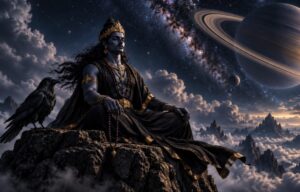 In the contemporary landscape of Vedic astrology, Saturn (Śani) is frequently reduced to a mere “arbitrary malefic,” a harbinger of misfortune and delays. However, a deep scholarly analysis through the lens of Sanjay Rath’s Brhat Nakṣatra—rooted in the Jagannath Puri tradition—reveals a far more sophisticated role. Śani is not a chaotic force of cruelty; he is the strategic administrator of Tapas (austerity) and the cosmic judge of discipline.
His influence is inextricably linked to the concepts of longevity (āyus) and renunciation. While the common perception of Saturn focuses on his “cruelty,” the tradition identifies this as the essential discipline required for spiritual evolution. By imposing limits and enforcing penance, Śani strips away the ego’s attachments, guiding the soul toward the ultimate truth. This cosmic role finds its technical and mythological roots in his complex origins within the solar household.
Puranic lore serves as a technical blueprint for understanding planetary behavior and psychological archetypes. The birth of Śani is a profound metaphor for the divergence between the material self and the shadow self. Born from Sūrya (the Sun) and Chāyā (Shadow), Śani represents the rejection of the blinding light of the ego in favor of the internal, reflective darkness. This domestic conflict—where the Sun initially rejected his son—defines Śani’s astrological role as the defender of the marginalized and the protector of those cast into the shadows.
The technical implication of Śani’s “lameness”—resulting from a Puranic curse—symbolizes his slow, deliberate movement and his relentless persistence. His fierce penance of Mahākāla Śiva was an act of extreme Tapas that eventually granted him the authority of punishment and the power to administer cosmic justice. This “torture” is not sadistic; it is a transformative fire.
Esoteric Symbols and Geometric Blueprints
According to the Brhat Nakṣatra framework, Śani’s nature is encoded in specific symbols:
- The Geometric Symbol: Śani is represented by a seven-pointed star comprising a triangle and a square. Technically, this signifies a “trouble-maker” or a “child with the couple,” often manifesting as distortions in the domestic environment where the ego refuses to yield.
- The Crow (Yamadūtaka): Functioning as a messenger of death, it signifies the proximity of the end and the necessity of final accounts.
- The Coconut Tree: Its structural resilience and elemental significance represent the hard exterior required to protect the “sweetness” of the spiritual realization within.
- Dark Garments: Symbolic of the absorption of all light and ego, reflecting a state of complete focus.
- The “Invisible” Tongue of Agni: Specifically identified as Satī or Atirūpā, this represents the fire that consumes the ego through the heat of suffering and meditation.
This Puranic heat manifests physically through the lordship of the elemental breath.
In the Nakṣatra framework, the Pañca Tattva (Five Elements) are critical for diagnostic interpretation. Śani is the primary lord of the Vāyu Tattva (Air element), connecting him to Sage Vasiṣṭha, the creator father who represents the breath of life. Śani governs the Prāṇa-vaha srotas (the invisible astral channels and the physical windpipe). Because he regulates the movement of air, he is the ultimate significator of longevity.
The technical logic behind Śani’s debilitation in the Nakṣatra of Bharaṇī illustrates the cessation of this movement. Bharaṇī is ruled by Yama (the God of Death), whose primary function is Prāṇa-nirodha—the arrest of breath. While Śani seeks movement to sustain life, Yama stops it. In this domain, for non-living things, the movement of breath is perceived only as a “pulse” of the universe, a subtle vibration that Śani sustains until the final arrest.
Furthermore, a critical technicality exists at the Nakṣatra Ganda between Prthvi (Earth) and Vāyu (Air), specifically between Stars 12 and 13. This junction represents “fluid loss and dryness,” the physical hallmark of Saturnine suffering where the dryness of the Tattva leads to emaciation and decay. This elemental movement ultimately dictates the soul’s placement within the higher spiritual planes.
The Sapta Loka Maṇḍala (Seven Worlds) provides a map of existence from the material to the spiritual. Śani signifies Tapar Loka, the sixth world and the third spiritual plane.
- Characteristics: Tapar Loka is defined by intense penance, meditation, and “spiritual heat.”
- Function: Unlike the lower lokas (Bhu, Bhuva, and Svarga) which deal with earthly existence and the solar system, Tapar Loka is a realm of pure spiritual endeavor.
When Saturn “afflicts” a chart, it is technically an invitation for the native to ascend from the material concerns of the lower worlds to this higher plane of meditation. The suffering experienced is the friction required to detach the soul from the lower planes and fix its gaze upon the eternal.
The concept of Graha Janma (Planetary Birth) reveals that a planet’s own birth Nakṣatra reveals its inherent vulnerabilities. For Śani, the technical data is as follows:
- Birth Star: Revatī (the water-fire Gaṇḍānta junction).
- Birth Tithi: Aṣṭamī (the 8th lunar day).
In Revatī, Śani undergoes extreme trials. However, this is also where the Tapasvi Yoga—the relationship between Śani, Śukra (Venus), and Ketu—reaches its height of renunciation, particularly when undergoing combustion in the stars of Budha (Mercury).
The Prescribed Remedy
To align with Śani’s Vāyu nature and bridge the soul’s transition from Bhuva Loka to the spiritual Tapar Loka, the tradition prescribes:
Perform 19 rounds of the Śani rosary strictly before sunrise. This timing synchronizes the breath with the rising Prāṇa of the day, harnessing the discipline of the morning hours to stabilize the internal Vāyu. These traits directly dictate the stability of the mind.
The Mānasa Nakṣatra represents the “Mind’s Throne.” While the placement of Sūrya here can lead to psychological collapse, suppressed anger, or schizophrenia, Śani’s presence creates a different polarity. He dictates the landscape of the mind between two extremes:
- The Mind of Steel: An unbreakable will and disciplined focus.
- Dark Depression: A state of heavy inertia and psychological collapse.
Case Study: Śrīla Prabhupāda
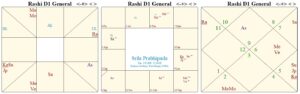
The chart of Śrīla Prabhupāda offers a profound example of an exalted Saturn in Tulā (Libra). Saturn rules his Mānasa Nakṣatra from the Lagna. While many would succumb to the “Dark Depression” of Saturn in the mind, his “Mind of Steel” arose. Strong exalted Śani shows a very determined mind. As a wandering monk, he preferred the station of Śani—renunciation and wandering life—over material comforts. This granted him the superhuman resolve to establish a global spiritual movement at the age of 70, bypassing all physical limitations of age.
The Śūla Cakra (the Trident of Śiva) is a diagnostic tool used to time death and identify chronic ailments. In this mapping, Śani represents the “Staff of the Trident,” corresponding to nodes 5, 6, and 7 from the Sun.
This placement signifies lingering, chronic suffering that does not kill immediately but exhausts the Vāyu Tattva over years. Physically, this often manifests as “fluid loss and dryness,” a literal dehydration of the vital Tattvas. This represents the “Staff” that one must lean on—the heavy burden of time and physical decay.
In conclusion, Saturn is the ultimate teacher of the Vedas. His perceived “cruelty” is merely the friction necessary to produce the light of renunciation. By governing the breath through the Prāṇa-vaha srotas, the resolve of the mind, and the ascension to Tapar Loka, Śani ensures that the soul eventually finds its way back to the stillness of the eternal.
ॐ शांति शांति शांति


Om gurave namah! In the surya article, it is mentioned that the planet in 9th from Surya, indicates who protects us, our destiny , our resources. That planet helps us achieve our goals in the world, helps us support the dharma of the world. Gives us power and protection. However if a retrograde shani is placed there in multrikona sign and the person does 19mala japa of a shani mantra on a certain mala, and if they suffer from dark depression- heavy inertia, psychological collapse(like mentioned above) and rebelliousness, negativity instead of harnessing an unbreakable will and disciplined focus, is it recommended to continue the japa?