ॐ गुरवे नमः
All knowledge belongs to the Guru; any errors or shortcomings in interpretation are entirely my own. These reflections are inspired by Pt. Sanjay Rath’s Guru Dṛṣṭi session, streamed live on 31 October 2026 as part of the Vedic Astrology Master Class 2026 Edition.

In Vedic astrology, Guru Dṛṣṭi (Jupiter’s aspect) is regarded as one of the most significant protective influences in a birth chart. As explained by Pt. Sanjay Rath, Jupiter serves as the guardian of the solar system, and its dṛṣṭi represents the divine benediction of Lord Shiva.
Jupiter’s aspects carry particular significance when considered in relation to specific houses:
- The 5th and 9th Houses: These trinal houses hold special importance in understanding Jupiter’s influence. The 5th house represents Bhakti (devotion) and the cultivation of knowledge, while the 9th represents Dharma (righteousness and established truth).
- The 7th House: According to the interpretation discussed in Pt. Rath’s teachings, Jupiter’s 7th-house aspect a dwipada or two-pada aspect, assigning it half the strength of its full aspect.
Motilal Nehru:
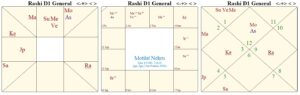
Examining the fifth house from Jupiter offers insight into the individual’s intellectual orientation and inner motivation. In Motilal Nehru’s chart, Mars rules this house, while Ketu’s placement is interpreted as indicating a strong material and intellectual focus, consistent with his career as a lawyer and constitutional thinker. Ketu’s debilitation adds another dimension to this interpretation.
Rabindranath Tagore:
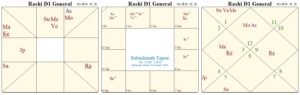
Tagore’s chart is compared with Motilal Nehru’s, with particular attention to Mars and Ketu in Gemini. Their conjunction is interpreted through the lens of Piśācha Yoga, but its expression is understood differently in Tagore’s case: as an exceptional capacity for artistic, linguistic and spiritual expression. The symbolism of Mars and Ketu is associated with transformation, drawing a parallel with the story of Lord Ganesha receiving an elephant’s head. When connected harmoniously with Jupiter, this combination is interpreted as carrying deeper knowledge and transformative potential. Tagore’s achievements across poetry, songs, painting, essays and the establishment of Santiniketan illustrate the extraordinary range of his creative expression.
Swami Vivekananda: Jupiter and the Path of Bhakti
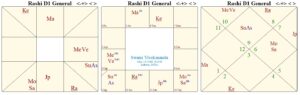
In Swami Vivekananda’s chart, Jupiter is placed in Libra (Tula Rashi). The fifth house from Jupiter falls in Aquarius (Kumbha Rashi), which is unoccupied. Its lord, Saturn (Shani), is associated in this interpretation with Kali Mata.
This connection offers an astrological perspective on the profound relationship between Vivekananda, Kali Mata and his spiritual mission.
The key principle: To understand a person’s deeper devotion and inner spiritual drive, examine the fifth house from Jupiter. This approach seeks to illuminate the individual’s underlying bhakti and spiritual orientation beyond conventional indicators.
Pt. Rath recommends the recitation of Bṛhaspati mantras derived from the Rig Veda as a means of deepening one’s connection with the Guru principle. Even when pronunciation is imperfect, sincere intention and the willingness to seek the Guru remain central. In Kali Yuga, the emphasis is on devotion, humility and the sincere pursuit of spiritual guidance.
ॐ शांति शांति शांति