Written by Deena Pranav Shah, Dr. Kunwar Shailen Dev Singh Guleria, Petra Pintaric
Guru: Pt. Sanjay Rath
Hari Om,
With the blessings of my Gurus and Paramparā, I would like to offer a few reflections on the concept of Karma. I will then examine this concept through the lens of Jyotiṣa, with particular focus on Budha Graha as Amātyakāraka.
 It is said that we are born because we have certain karma to fulfill. Thus, every moment of life is bound by karma. Through each choice, what we do, what we avoid, and how we act or interact—we continually shape our reality. In essence, life becomes the story of our actions, our relationships, and our engagement with time itself.
The teachings of the Bhagavad Gītā explain Karma very beautifully. In the chapter on Karma Yoga, Śrī Kṛṣṇa teaches us that no living being can remain, even for a single moment, without action. Karma, therefore, is woven into the very fabric of embodied existence.
कार्यते ह्यवशः कर्म सर्वः प्रकृतिजैर्गुणैः ॥ ५ ॥
kāryate hy avaśaḥ karma sarvaḥ prakṛti-jair guṇaiḥ
A very similar verse appears in the Śrīmad Bhāgavatam:
कार्यते ह्यवशः कर्म गुणैः स्वाभाविकैर्बलात् ॥ ५३ ॥
jātu tiṣṭhaty akarma-kṛt
kāryate hy avaśaḥ karma
guṇaiḥ svābhāvikair balāt
So, Karma is an integral part of our existence.
In Jyotiṣa, the tenth bhāva is the Karma Bhāva, and the natural kāraka for the tenth bhāva is Budha. The word “Kāraka” signifies divine intervention, or the hand of God. In the Chara Kāraka scheme, Amātyakāraka represents our actions at the soul level. Our Paramparā teaches that Amātyakāraka is a Viśeṣa Chara Bhāva Kāraka for the tenth house, the Karma Bhāva. Therefore, when Budha becomes Amātyakāraka, it is especially important to study how this placement influences the chart.
This article examines these major factors and considers how they influence what a person chooses to do, as well as the manner in which that karma unfolds in life.
To begin, let us introduce the key elements represented in the chart:
- Budha Graha and its natural significations
- Budha as Amātyakārakāraka.
- Budha as a Kāraka for Swarga Kendra (10 bhāva)
Once these elements are understood, we can explore how they interact in a person’s chart and how they shape the individual’s karma.
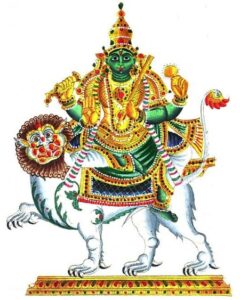 Ṛṣi Parāśara teaches that Buddha’s primary kavakava is vāṇī pradāyakaḥ—the giver of speech. Kārakatva refers to the essential significating principle of a graha, understood as divine intervention. A world without language or communication is difficult to imagine; even thought itself depends upon language and speech. Ṛṣi further teaches the following significations of Budha:
- He is rājakumāra, the prince among the Navagrahas.
- His varṇa is Vaiśya, the business class.
- His devatā is Viṣṇu, the sustainer of the entire universe.
- He is rājasika, which gives flexibility and a sense of humour.
- He represents Pṛthvī tattva.
- In the Pañcāṅga, he represents karaṇa.
- The lord of the karaṇa indicates the native’s career or principal karma.
- He possesses digbala in Lagna, the first house.
Therefore, Budha represents qualities such as youthful curiosity, readiness to learn, adaptability, and a sense of humor. His devatā, Viṣṇu, indicates intellectual flexibility and the connection with all. For the blessings of memory, intellect, communication, and learning, we bow to Budha.
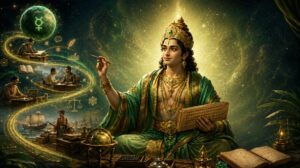 Ṛṣi Parāśara explains the Chara Kāraka scheme in BPHS, Adhyāya 32. This scheme reveals significations at the soul level by considering the degrees of the grahas, irrespective of their rāśi placement.
The sequence, from the graha with the highest degree to the one with the lowest degree, is as follows:
Atmakāraka → Amātyakāraka → Bhatrkāraka→ Matrkāraka → Pitrkāraka → Putrakāraka → Gnatikāraka → Darakāraka
The primary focus of this paper is Amātyakāraka.
- Ātmakāraka is the planet with the highest degrees in the chart.
- Ātmakāraka is the King at the soul-level domain, and has prime say in a person’s life.
- Amātyakāraka is the planet in the Jātaka with the second-highest degree, second only to the Ātmakāraka.
- Amātyakāraka is the closest advisor or counsellor to the King (AK).
- Amātyakāraka signifies one’s karma: profession, guidance, and counselling. It is considered to be important in determining a person’s professional path.
- Amātyakāraka is also a viśeṣabhāvakāraka for the 10th bhāva. Thus, it bears a profound relationship to the tenth bhāva and its karmic responsibilities.
- Ṛṣi Parāśara teaches us the importance of the tenth bhāva by referring to it as the highest kendrasthāna—Svargabhāva. It is also known as Siṃhāsanasthāna.
- This bhāva, also known as Karmabhāva, indicates our work—what we are here to do.
- The naisargika kāraka (natural significator) for Karmabhāva is Budha. (BPHS, śloka 34)
With this introduction, it becomes clear that Budha—who represents speech, communication, learning, and memory—is closely connected to our life’s work. As the natural kāraka for the Karma Bhāva and the representative of Karana in the Pañcāṅga, Budha strongly influences the unfolding of karma. His connection to the Upacaya bhāvas further highlights his role in shaping karmic growth over time. When Budha also becomes Amātyakāraka in a chart, this influence acquires soul-level depth, offering profound insight into a person’s undertakings and the manner in which one works to fulfill life’s goals.
For this reason, it becomes essential to study Budha and Amātyakāraka closely when examining one’s life work and karma. Because Budha is easily influenced, his placement, conjunctions, and aspects must also be carefully analyzed. To illustrate this, we will examine the jātaka of Śrī Ramana Maharshi. Although Budha can reflect a rajasic and material orientation when influenced in certain ways, this paper explores his higher expression through the example of a Karma Yogi.
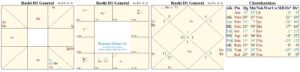
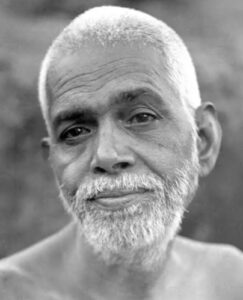
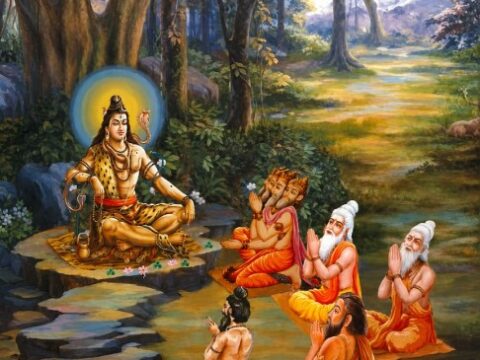
Bhagavān Ramana Maharshi, born Venkataraman Iyer on 30 December 1879 in Tiruchuzhi, is regarded as one of the greatest saints of modern times. Many see him as a manifestation of Dakṣiṇāmūrti Śiva on the physical plane. He stands as one of the finest examples of a Karma Yogi to have walked this earth.
Let us examine his Amātyakāraka Budha.
In the jataka of Sri Ramana Maharshi, Lagna is Tula,
Budha, as the lord of the 9th bhāva (dharma, bhāgya, and tīrtha) and the 12th bhāva of meditation, isolation, spirituality, and liberation, is placed in the Pāka Lagna—the seat of working intelligence—with Lagna lord Śukra.
He worked in isolation at Aruṇācala through self-inquiry. He was intensely active, yet he concealed almost all of his activities from the world. Very much like the duality represented by Budha in the rāśi of Vṛścika, his Pāka Lagna, having an integral influence of Ketu in the sign of Gemini.
Budha, as the Śubhapati, is the dispositor of 10L Candra, his Ātmakāraka. It is interesting to note and emphasise that Candra, the representation of our manas, is not only his 10L but Ātmakāraka as well. And this 10L is conjoined Mokṣakāraka Ketu, co-lord of his Pāka Lagna. And they both worked through and in close relation with his Amātyakāraka, Budha.
Budha is his:
- Amātyakāraka → viśeṣakāraka for the 10H
- Śubhapati → manas
- Dispositor of Ātmakāraka Candra and 10L
- 9L of dharma
- 12L of isolation and spirituality
- Natural kāraka of the 10th/Karmabhāva
He is placed in the Pāka Lagna, the seat of intelligence, with Lagna lord Śukra, giving him rare, unwavering focus on the mission he decides to take on.
It is easy to see that, at every level of reality, his whole life revolved around spirituality and self-inquiry. This intense penance needed no words, and silence was his speech.
Our Paramparā teaches us that when Ātmakāraka is closely associated with Amātyakāraka in a Jātaka, they are karmayogins. Their focus is only on the karma and the mission to be accomplished, and they make great sacrifices to achieve the objective. Ramana Maharṣi is the perfect example!
सर्वं श्रीकृष्णार्पणमस्तु