ॐ गुरुवे नमः
In Jyotisha (Vedic Astrology), Venus — Shukra — is often reduced in popular culture to a symbol of romance and beauty. But within the classical framework, Shukra is something far more foundational: the karaka of Jala Tattva (the fluid element), the significator of vitality, rejuvenation, and the very architecture that sustains life. For students of Jyotisha, understanding Shukra’s deeper philosophy sharpens chart reading. For everyone else, it offers a lens that translates surprisingly well into modern life — including the workplace, where so many of us spend our waking hours.
This piece is written for both: enough grounding for the serious student of Jyotisha, and enough translation for the reader encountering these ideas for the first time.
1. Shukra as the Source of Life — Srishti Karaka
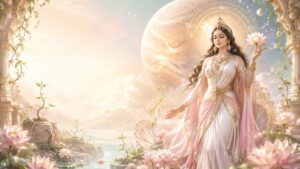 The Jyotish view: Shukra is considered the karaka of shukra dhatu — the reproductive and generative essence — and by extension, the ruler of Jala Tattva, the element of moisture that makes biological life possible. Philosophically, Shukra is the bridge between the gross and the subtle: it carries life-force (ojas) from the unmanifest into form. Where Guru (Jupiter) expands wisdom, Shukra makes life possible to begin with — it is creation at its most literal.
In everyday terms: Shukra governs the resources that sustain any living system — biological or organizational. In a company, this is institutional knowledge, creativity, and the intangible “lifeblood” that keeps culture alive: mentorship, shared expertise, and generosity of ideas.
Practical application: Just as Jala Tattva only sustains life when it flows rather than stagnates, knowledge and resources in a team only generate value when circulated. A leader strong in Shukra qualities shares information generously rather than hoarding it as leverage — because withheld water eventually stagnates, and withheld knowledge eventually calcifies an organization.
2. Retrograde by Nature — The Astronomy of Rebirth
The Jyotish view: Venus is astronomically unusual — it rotates in the opposite direction (retrograde rotation) to most planets in the solar system, meaning its sunrise occurs in the west rather than the east. In Vedic symbolism, this reversal is read as — the power of rebirth. Where Shani (Saturn) governs endings and restriction, Shukra governs the capacity to reverse course, recover, and begin again — astrologically tied to its role as guru of the Asuras in the Puranas, who famously restored the dead to life with Sanjeevani Vidya.
In everyday terms: This is the astrological argument for resilience — not as a personality trait, but as something structurally built into the nature of growth itself. Setbacks are not deviations from the natural order; recovery is.
Practical application: After a failed product launch, a missed target, or a public misstep, the instinct is often to treat the failure as a verdict. The Shukra principle suggests treating it as a phase — the “west sunrise” moment where recovery is not the exception but the expected next step. A useful practice: instead of only running a retrospective on what went wrong, run a rebirth review — what is now possible because of this failure that wasn’t possible before it?
3. The Tension Between Source and Consumption — Lagna and Bhoga
The Jyotish view: Shukra’s placement in a chart often speaks to the relationship between one’s lagna (the source — one’s inherent constitution and limits) and one’s desires (bhoga — consumption, pleasure, indulgence). A well-placed Shukra doesn’t mean unlimited indulgence; it means the desires are in right proportion to what the source (the body, the chart, the life) can actually sustain. Excess water drowns the very roots it’s meant to nourish.
In everyday terms: This is the ancient version of a conversation every organization is having today: ambition versus sustainable capacity.
Practical application: When planning a quarter or a sprint, separate “what we want to achieve” from “what our current bandwidth genuinely allows,” and build the plan on the second number, not the first. Teams that consistently plan from aspiration rather than capacity are, in
Shukra’s terms, consuming faster than their source can replenish — and eventually the well runs dry.
4. The Beauty Spot — Obstruction as Protection
The Jyotish view: Shukra is associated with a protective shadow — sometimes described as a “beauty spot” (til) — a mark that appears to be a blemish but is understood traditionally as auspicious and protective. The idea extends symbolically: what looks like an obstruction in a chart or in life may in fact be shielding something valuable from being consumed too quickly by external forces.
In everyday terms: Not every obstacle is an enemy of progress. Some frictions exist precisely to protect something worth protecting.
Practical application: The compliance review that slows down a launch, the stakeholder who says “not yet,” the budget constraint that forces a rethink — before treating these as pure obstacles to remove, it’s worth asking what risk they may be quietly absorbing. Removing every friction point in the name of speed can leave a system as exposed as removing every “beauty spot.”
5. Morning Star, Evening Star — The Discipline of Timing
The Jyotish view: Shukra’s visibility alternates between appearing before sunrise (Shukra as Morning Star) and after sunset (Evening Star), and classical texts treat these phases differently in terms of auspiciousness and energy. The underlying teaching is that the same planetary energy carries a different quality depending on timing — a reminder that muhurta (electional timing) matters as much as the inherent nature of a planet.
In everyday terms: Timing changes meaning. The same action — a pitch, a difficult conversation, a public announcement — can land completely differently depending on when it happens.
Practical application: Before a high-stakes decision or conversation, pause and ask whether this is a “morning star” moment that calls for visible, forward action, or an “evening star” moment that calls for restraint and quiet observation (mauna). Leaders who treat every moment as a moment for action often burn credibility; those who treat every moment as a moment for caution miss windows that don’t return.
6. The Body Is Mostly Water — Rhythm Over Intensity
The Jyotish view: With the human body composed largely of fluid, Shukra’s rulership over Jala Tattva extends to being a primary protector of physical vitality. Some traditions connect the 32-syllable Mahamrityunjaya Mantra to Shukra’s own 32 synodic revolutions across a 20-year cycle — a symbolic alignment of mantra, biology, and planetary rhythm intended to sustain ojas (vital essence) over a lifetime.
In everyday terms: Sustainability isn’t about intensity; it’s about rhythm.
Practical application: High performers who last in demanding careers aren’t usually the ones who sprint hardest — they’re the ones whose rhythm of effort and recovery repeats reliably enough to compound over years rather than burn out in months. A useful gut-check: if every week on your calendar looks identical in intensity, with no ebb, you don’t have a discipline problem — you have a rhythm problem, and Shukra would call that a warning sign, not a badge of honor.
In closing: For the Jyotisha student, Shukra remains one of the richest karakas in the chart — governing marriage, wealth, creativity, and vitality all through the single thread of Jala Tattva and its cyclical, regenerative nature. For everyone else, the same symbolism offers something rare: an ancient, tested vocabulary for problems we still haven’t fully solved — how to grow without depleting ourselves, how to recover without denial, and how to know, in any given moment, whether it’s time to act or time to be still.
Om Tat Sat
ॐ शान्तिः शान्तिः शान्तिः ॥