ॐ गुरवे नमः
All knowledge belongs to the Guru; any errors or omissions in interpretation are entirely mine.
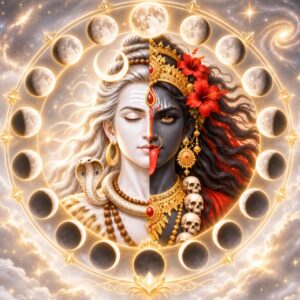
In Vedic Astrology, or Jyotish, time is not understood merely as a sequence of hours, days, and years. Time has qualities, rhythms, and patterns. The ancient sages organized these rhythms through the Panchanga, the five limbs of time: Tithi, Vara, Nakshatra, Yoga, and Karana.
Among these five, Tithi occupies a particularly intimate place because it describes the changing relationship between the Sun and the Moon. The Sun represents consciousness, vitality, and the soul, while the Moon represents the mind, emotions, nourishment, and our capacity to receive and respond.
Tithi therefore becomes much more than a lunar date. It is a measure of the relationship between consciousness and mind—and consequently, a powerful indicator of how a person experiences affection, emotional nourishment, family ties, social interaction, and marriage.
What Is Tithi?
A Tithi is determined by the angular distance between the Sun and the Moon. As the Moon moves approximately 13 degrees per day while the Sun moves roughly 1 degree, their relative motion produces a new Tithi for every 12 degrees of separation.
There are 30 Tithis in a lunar month:
- 15 Tithis in the Shukla Paksha, or waxing half
- 15 Tithis in the Krishna Paksha, or waning half
The cycle begins with Pratipada, develops through the waxing Moon, reaches Purnima (Full Moon), and then gradually returns toward Amavasya (New Moon).
This makes Tithi a study of relationship itself. The Sun and Moon are continuously relating to one another, and the changing angle between them describes a changing emotional and psychological field.
In this sense:
Tithi is the relationship between the Sun and Moon, and the quality of that relationship becomes a pattern within our own lives.
Because Tithi belongs to the domain of Jala Tattva, the water element, it is associated with feelings, emotional resources, affection, longing, attachment, and the capacity to flow with others.
Water is fundamental to life. The human body itself depends upon the circulation and maintenance of fluids, and Jyotish traditionally associates the Moon with the supply of Jala, while Venus has an important relationship with the circulation, enjoyment, and experience of that emotional and physical nourishment.
This is one reason Tithi becomes particularly relevant when studying relationships.
We may possess wealth, intelligence, status, or professional success, but if our emotional resources are depleted, relationships become difficult to sustain.
Every relationship has periods of:
- closeness and distance,
- happiness and disappointment,
- attraction and rejection,
- emotional abundance and emotional exhaustion,
- hope and frustration.
Tithi provides a symbolic framework for understanding these fluctuations.
Venus, the natural significator (Karaka) of relationships, affection, pleasure, sexuality, and marriage, becomes particularly important when studying Tithi. The connection between Tithi, Moon, and Venus can therefore reveal much about how a person gives and receives affection.
Traditional Jyotish symbolism also connects Venus with reproductive vitality and immunity. From this perspective, emotional well-being and physical well-being are not entirely separate. When a person experiences affection, belonging, and happiness, vitality can increase; prolonged emotional distress, conversely, can affect one’s overall resilience.
The deeper lesson is that emotional nourishment is itself a form of sustenance.
The lunar month is divided into two great movements:
Shukla Paksha
The Moon is waxing. Light is increasing, and the lunar principle is moving toward fullness.
Traditionally, Shukla Paksha is associated with Deva Karma—actions directed toward development, expansion, achievement, and receiving support.
Krishna Paksha
The Moon is waning. Light is decreasing, and the lunar principle is moving toward dissolution.
Krishna Paksha is traditionally associated with Pitri Karma—ancestral responsibilities, nourishment, family obligations, reflection, and the process of returning inward.
Neither half should simply be classified as “good” or “bad.”
They represent two necessary movements of existence:
growth and withdrawal, receiving and giving, expansion and release.
The same rhythm can be seen in day and night, the seasons, breathing, and the cycles of life.
One of the most evocative ways of understanding the lunar cycle is through the imagery of the horns of the Moon.
At the beginning of Shukla Paksha, the Moon is barely visible. Its crescent gradually grows. Around the first-quarter phase, the horns become increasingly distinct, and the Moon begins to display greater strength.
The symbolism becomes particularly important around Ashtami and Navami.
Ashtami represents a transitional stage—the child moving toward youth and independence. Navami represents a further stage of maturity and strength.
This symbolism explains why Navami is associated with Shri Rama. In the traditional interpretation presented here, Rama stands at the boundary where the Moon moves from immaturity into greater strength and clarity.
The lunar cycle can therefore be viewed almost as a biography:
birth → growth → maturity → fullness → decline → dissolution → rebirth.
Purnima, the Full Moon, represents maximum lunar illumination.
The Moon has reached its fullest visible expression, making Purnima particularly important in spiritual traditions.
Many teachers, saints, and spiritual traditions place special significance upon the Full Moon. The association between Purnima and the Guru is especially strong because the Guru represents the illumination of knowledge.
Purnima therefore symbolizes:
- completion,
- illumination,
- integration,
- wisdom,
- expanded awareness,
- spiritual realization.
At the same time, Purnima is a turning point. Once fullness is reached, the Moon begins to lose its light.
This is why the Full Moon can also be understood as a Gandanta-like transition—a moment between completion and dissolution.
A traditional contemplative approach is therefore to use Purnima for meditation, reflection, and spiritual practice.
At Amavasya, the Sun and Moon occupy essentially the same direction from the Earth’s perspective, and the illuminated side of the Moon faces away from us.
The visible Moon disappears.
Symbolically, Amavasya represents:
- darkness,
- hidden matters,
- ancestral karma,
- unconscious patterns,
- endings,
- dissolution,
- the unknown.
If Purnima represents complete illumination, Amavasya represents complete withdrawal of visible lunar light.
This is why Amavasya is traditionally associated with Pitris, ancestors, and the examination of unresolved patterns from the past.
Rather than viewing darkness only as something negative, Amavasya can be understood as a period in which what is hidden must eventually be confronted.
One of the most important components of Tithi analysis is the Tithi Lord, or Tithi Pati.
The Tithi Lord gives a particular planetary quality to the lunar day. The Tithi itself describes the emotional field, while its planetary lord helps describe how that field operates.
The traditional sequence of Tithi Lords is:
| Tithi | Tithi Lord |
|---|---|
| Pratipada | Sun |
| Dwitiya | Moon |
| Tritiya | Mars |
| Chaturthi | Mercury |
| Panchami | Jupiter |
| Shashthi | Venus |
| Saptami | Saturn |
| Ashtami | Rahu |
| Navami | Sun |
| Dashami | Moon |
| Ekadashi | Mars |
| Dwadashi | Mercury |
| Trayodashi | Jupiter |
| Chaturdashi | Venus |
| Purnima | Saturn |
| Amavasya | Rahu |
Ketu does not receive Tithi lordship in this system.
This itself has symbolic meaning. Ketu represents separation, detachment, renunciation, and the dissolution of worldly bonds. Marriage and ordinary human relationships require participation and connection. Ketu’s archetype is therefore fundamentally different.
The Tithi Lord becomes a key planet through which the emotional experience of relationship is expressed.
Marriage is not merely the presence of a spouse in the horoscope. In Jyotish, marriage represents a significant karmic relationship.
The 7th house is the principal house of spouse and partnership, while Venus is the natural significator of marriage and relationship.
Tithi adds another layer.
The Tithi Lord can be understood as describing the emotional resources a person brings into relationship.
Ask:
- What does the Tithi Lord represent?
- Where is it placed?
- What houses does it influence?
- Is it strong or weak?
- Is it afflicted?
- What is its relationship with Venus?
- What is its connection with the 7th house and 7th lord?
- What does it do from the 7th house?
These questions can reveal how easily or painfully a person experiences commitment.
A strong Tithi Lord does not necessarily mean a perfect marriage. Likewise, an afflicted Tithi Lord does not automatically mean divorce.
Instead, the Tithi can reveal the nature of the relationship lesson.
One of the most useful principles is to consider the Tithi Lord as an indicator of emotional supply.
A person may have everything externally—money, fame, education, property, status—but still feel emotionally deprived.
Another person may have comparatively little material wealth yet possess enormous emotional resilience.
The Tithi helps us investigate this difference.
When the Tithi Lord is strongly connected to the 7th house or Venus, relationships can become a major source of emotional nourishment.
When it is severely afflicted, combust, debilitated, or placed in difficult circumstances, the individual may have to work harder to maintain emotional equilibrium within relationships.
The important point is not to reduce astrology to a simple “good placement/bad placement” formula.
Relationships are never perfect.
Every relationship contains karma, compromise, growth, attraction, conflict, and learning.
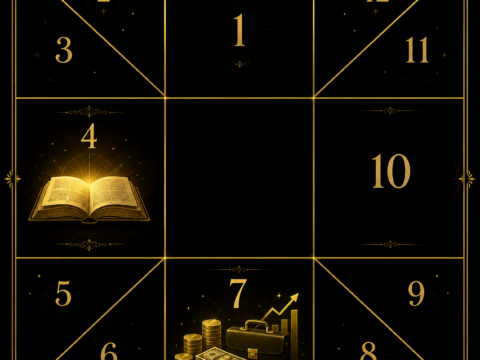
Tithi can also be studied through its relationship with the houses.
The question becomes:
What does this person emotionally value? What does the person naturally care about?
The house associated with the Tithi provides an important clue.
First House
The individual, body, identity, appearance, and personal existence become emotionally important.
Such a person may care deeply about their physical presence, identity, and reputation.
Second House
Family, food, speech, wealth, values, and nourishment become important.
There may be a strong desire to provide for others. Speech also becomes significant: words can nourish relationships or damage them.
Third House
Siblings, communication, travel, conversation, skills, and personal effort become emotionally engaging.
Such people may enjoy interaction, discussion, short journeys, and constant communication.
Fourth House
Home, mother, property, vehicles, emotional security, and inner happiness become central.
The person may require a strong sense of home in order to feel emotionally secure.
Fifth House
Children, creativity, music, intelligence, romance, and self-expression become important.
Sixth House
Service, conflict, health, competition, enemies, and obligations become prominent relationship lessons.
This can sometimes indicate that the individual must learn how to manage conflict rather than simply avoid it.
Seventh House
Spouse, partnership, agreements, social interaction, and direct relationships become central.
Venusian themes become particularly important.
Ninth House
Guru, higher knowledge, philosophy, religion, dharma, teachers, and worldview become emotionally important.
Such an individual may invest enormous emotional energy in knowledge, belief, teachers, or spiritual ideals.
Tenth House
Career, responsibility, authority, achievement, and public life become major emotional concerns.
Relationships with employers, employees, or professional associates can become particularly significant.
Eleventh House
Networks, friendships, gains, ambitions, large communities, and aspirations become important.
Twelfth House
Solitude, retreat, foreign places, spirituality, sleep, sacrifice, and liberation become prominent.
Tithi analysis becomes richer when we distinguish between Tithi Rashi and Tithi Bhava.
A useful interpretive principle is:
Tithi Rashi shows how the emotional nature expresses itself; Tithi Bhava shows where that emotional investment is experienced.
For example, a person may have a Tithi associated with an intense, fixed, or investigative sign. That describes the quality of their response.
The corresponding house tells us where that response manifests.
This distinction prevents simplistic interpretations.
The same Tithi can produce very different results in different horoscopes because the individual’s Lagna, planetary placements, house relationships, and planetary strength modify its expression.
Each Tithi has its own psychological and spiritual character.
1. Pratipada — Sun
Pratipada represents the beginning of the lunar cycle.
The Moon has just emerged from the darkness of Amavasya and is not yet strongly visible.
It therefore symbolizes:
- initiation,
- identity,
- emergence,
- vitality,
- the beginning of a new cycle.
The Sun is the Tithi Lord, emphasizing individuality, authority, father, reputation, and purpose.
A strong Pratipada Tithi can emphasize the desire to establish oneself and become recognized.
Its spiritual association is with Agni and Brahma, representing creative fire and the power to bring something into existence.
2. Dwitiya — Moon
Dwitiya represents the first visible emergence of the Moon.
It is associated with:
- family,
- care,
- nourishment,
- truth and perception,
- attention to detail,
- emotional sensitivity.
The Moon is its Tithi Lord, making lunar qualities especially important.
These individuals may be highly attentive to whether people are being sincere or deceptive. They may also care deeply about being cared for.
In relationships, the lesson is simple:
If you love a Dwitiya-born person, allow them to care for you.
The traditional deity associations emphasize creation, nourishment, and continuation of family.
3. Tritiya — Mars
Tritiya is ruled by Mars.
Mars gives courage, initiative, competitiveness, physical energy, and the capacity to act.
At its higher expression, Tritiya can produce extraordinary determination, skill, courage, and disciplined effort.
At its lower expression, the same energy can become impulsiveness, aggression, excessive sexuality, conflict, or association with problematic people.
This is why the quality of the Tithi Lord becomes critical.
The same Martian force that creates a warrior can create a destructive person if poorly directed.
The traditional association with Gauri also reminds us that Mars must ultimately be refined through respect, discipline, and conscious relationship.
4. Chaturthi — Mercury
Chaturthi is ruled by Mercury and associated with the removal of obstacles.
This is the Tithi of Ganesha.
Its qualities can include:
- intelligence,
- cleverness,
- adaptability,
- communication,
- strategy,
- curiosity,
- secrecy.
The lower expression can produce gossip, manipulation, fickleness, greed, or excessive cleverness.
The remedy is represented by Ganesha: remove obstacles before they become karmic burdens.
5. Panchami — Jupiter
Panchami is ruled by Jupiter.
It is associated with:
- morality,
- wisdom,
- intelligence,
- stability,
- truthfulness,
- prosperity,
- ethical conduct.
The individual may have a strong internal moral standard and may prefer relationships with people who possess integrity.
Panchami teaches that prosperity must be protected by wisdom.
Its traditional serpent symbolism reminds us that wealth and knowledge are often guarded by obstacles. The individual must learn how to approach prosperity without becoming controlled by attachment.
6. Shashthi — Venus
Shashthi is ruled by Venus and therefore strongly emphasizes Venusian themes:
- affection,
- beauty,
- relationships,
- prosperity,
- pleasure,
- art,
- attraction.
The individual may be highly affectionate and socially attractive.
However, Venus can also become excessive. Attachment, sensuality, pleasure-seeking, or dependence on relationships may become challenges.
Shashthi therefore asks:
Can pleasure be enjoyed without becoming bondage?
Its traditional deity association with Kartikeya reflects the warrior who must overcome hidden obstacles.
7. Saptami — Saturn
Saptami is ruled by Saturn.
Saturn brings responsibility, discipline, equality, perseverance, and accountability.
The mature expression of Saptami can produce people with:
- firm goals,
- strong responsibility,
- patience,
- endurance,
- concern for justice.
The traditional symbolism of Saptami also connects with the Sun and Indra, suggesting the disciplined mastery of one’s faculties.
The lesson is that responsibility does not necessarily diminish freedom. Properly understood, responsibility creates stability.
8. Ashtami — Rahu
Ashtami is one of the great transition points of the lunar cycle.
The quarter Moon becomes a powerful symbol of the child entering youth.
Rahu governs Ashtami, giving it unusual intensity.
Its higher expression includes:
- extraordinary knowledge,
- determination,
- unconventional thinking,
- deep loyalty,
- powerful concentration.
Its lower expression can produce:
- obsession,
- anger,
- fear,
- manipulation,
- extremism,
- emotional rigidity.
Ashtami is therefore not simply “bad because Rahu rules it.”
Rather, it is powerful.
The question is whether the person can master the mind.
Its traditional deity association with Maheshwara/Shiva reflects the capacity of consciousness to overcome conflict, attachment, and fear.
9. Navami — Sun
Navami is ruled by the Sun and represents strength, courage, authority, and maturity.
The symbolism of Shri Rama is especially important.
Navami represents the Moon crossing an important threshold toward maturity and strength.
People born under Navami may have:
- courage,
- passion,
- leadership,
- strong principles,
- competitiveness,
- determination.
They may be difficult to defeat when their Sun is strong.
The traditional deity associated with Navami is Durga, emphasizing the destruction of obstacles and the protection of dharma.
10. Dashami — Moon
Dashami returns to lunar lordship.
Its traditional deity is Yama/Dharmaraja, connecting the Tithi with karma, accountability, and dharma.
These individuals may seek certainty and evidence. They may prefer things that can be demonstrated, observed, or logically explained.
Their strength lies in conviction and discipline.
Their challenge can be emotional rigidity or difficulty accepting realities that cannot be easily proven.
11. Ekadashi — Mars
Ekadashi is again ruled by Mars but carries a particularly interesting spiritual association.
It is traditionally connected with fasting and purification.
At its lower expression, Mars can manifest as:
- jealousy,
- excessive desire,
- addiction,
- gambling,
- aggression,
- impulsive behavior.
At its higher expression, the same energy produces extraordinary skill, discipline, artistic refinement, and determination.
This is why Ekadashi is associated with fasting: desire is not necessarily destroyed; it is refined.
The individual learns to redirect Mars toward mastery.
12. Dwadashi — Mercury
Dwadashi is ruled by Mercury.
It can produce people who are:
- popular,
- socially adaptable,
- well-presented,
- communicative,
- interested in quality,
- intellectually flexible.
The lower expression is fickleness or excessive concern with appearances.
Its traditional association with Vishnu emphasizes preservation, order, and the proper use of one’s abilities.
13. Trayodashi — Jupiter
Trayodashi belongs to Jupiter and is associated with desire, attraction, and the higher understanding of Kama.
The lesson is not to eliminate desire but to understand and regulate it.
Trayodashi also represents an important threshold before the final dissolution of the lunar cycle.
Traditional symbolism connects this Tithi with the doorway toward the deeper emotional and spiritual dimensions of life.
14. Chaturdashi — Venus
Chaturdashi is ruled by Venus but occurs when the Moon is approaching complete darkness.
This creates an interesting contradiction:
Venus wants relationship, while the Moon is withdrawing.
Consequently, desire, attachment, passion, and emotional intensity can become particularly pronounced.
Its association with Shiva, especially Ishana Shiva, points toward the transformation of desire rather than its uncontrolled expression.
15. Purnima — Saturn
Purnima represents maximum integration and illumination.
Although the Full Moon is luminous, its Tithi Lord is Saturn in this system.
This gives Purnima an interesting combination: illumination + responsibility.
The Full Moon can reveal what has been hidden, but revelation also creates responsibility. Purnima therefore becomes an important time for meditation, spiritual study, and contemplation of one’s relationship with knowledge. The deity is Soma/Chandra—the Moon itself.
Amavasya — Rahu
Amavasya represents complete lunar darkness.
Its association with Rahu emphasizes hidden forces, ancestral patterns, unresolved karma, and the unknown.
Amavasya is therefore traditionally connected with Pitris, ancestors, and the wisdom of those who came before us.
Rather than fearing Amavasya, one can use its symbolism to examine the parts of life that remain unconscious.
What is hidden can eventually become conscious.
The importance of Tithi in relationship astrology becomes especially clear when we examine Venus.
Venus is the natural significator of:
- love,
- attraction,
- marriage,
- sexuality,
- pleasure,
- harmony,
- relationship.
Tithi describes the emotional field within which Venus operates.
Therefore, when studying relationships, examine:
- The Tithi.
- The Tithi Lord.
- Venus.
- The 7th house.
- The 7th lord.
- The connection between the Tithi Lord and Venus.
- The position of the Tithi Lord from the 7th house.
- The Navamsha and other relevant divisional charts.
This creates a much more nuanced picture than simply asking whether Venus is “good” or “bad.”
Another important principle is the relationship between the 7th house and the 9th house.
The 7th house represents partnership.
The 9th represents Dharma.
A relationship may exist without necessarily becoming a marriage in the deeper karmic sense.
From this perspective, marriage becomes a relationship in which two people participate in a shared dharmic path.
Therefore, connections between the Tithi Lord, 7th lord, and 9th lord can become significant when examining:
- marriage,
- commitment,
- shared purpose,
- timing,
- spiritual compatibility,
- the karmic meaning of the relationship.
The principles of Tithi become especially interesting when applied to historical and public figures.
Queen Victoria
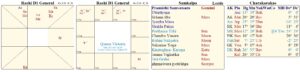
 Queen Victoria provides an illustrative example of a Shukla Pratipada birth, with the Sun as Tithi Lord.
The Sun emphasizes:
- authority,
- reputation,
- leadership,
- power,
- visibility.
Victoria’s life became deeply associated with monarchy, empire, public identity, and enormous political influence.
Her relationship with Prince Albert can also be studied through the Tithi Lord, Darakaraka, and timing techniques. The Tithi symbolism therefore resonates strongly with the extraordinary public role she eventually occupied.
Her chart also demonstrates an important principle: The Tithi does not operate in isolation. Its results become visible through the complete horoscope, including the Lagna, Moon, Venus, 7th house, Darakaraka, Dashas, and divisional charts.
Tithi should also be studied alongside the other limbs of Panchanga.
One traditional consideration is Panchanga Dosha, particularly when the Weekday Lord and Tithi Lord coincide in certain configurations.
Such combinations are traditionally considered capable of intensifying difficult experiences.
The results may manifest through:
- authority conflicts,
- health challenges,
- sudden changes,
- extreme circumstances,
- psychological pressure.
However, such combinations should never be interpreted in isolation.
A complete horoscope must always be considered.
The condition of the Tithi Lord is essential.
A planet may be:
- exalted,
- debilitated,
- in its own sign,
- combust,
- retrograde,
- afflicted,
- conjunct benefics,
- conjunct malefics,
- placed in a difficult house,
- strongly supported by aspects.
These conditions modify the Tithi’s expression.
For example, an afflicted Venus as Tithi Lord may create difficulty in receiving or sustaining affection.
- An afflicted Mars may turn courage into conflict.
- An afflicted Mercury may turn intelligence into manipulation.
- An afflicted Jupiter may turn wisdom into dogmatism.
- An afflicted Saturn may turn responsibility into fear or pessimism.
Therefore, the question is never simply: “Which Tithi was I born in?”
The better question is: “What is the condition of my Tithi Lord?”
Perhaps the deepest interpretation of Tithi is karmic.
Every human relationship is an interaction between two streams of karma.
We meet people for reasons.
- Some relationships nourish us.
- Some challenge us.
- Some teach us.
- Some transform us.
- Some remain for decades.
- Some disappear quickly.
Tithi provides a symbolic language for understanding why different people experience relationships so differently.
The Tithi Lord indicates a particular form of emotional investment.
The house shows where that investment is directed.
The sign shows how it behaves.
Venus shows how we relate.
- The 7th house shows partnership.
- The 9th shows dharma.
- The Moon shows the mind.
Together, these factors tell a much richer story.
Tithi Is Not About “Good” or “Bad”
A common mistake in astrology is to divide placements into good and bad.
Real relationships do not work this way.
A difficult Tithi can produce extraordinary strength.
A comfortable Tithi can produce complacency.
- Mars can become violence—or courage.
- Saturn can become depression—or responsibility.
- Rahu can become obsession—or unconventional genius.
- Venus can become attachment—or unconditional devotion.
- Jupiter can become dogmatism—or wisdom.
The same planetary force can operate at different levels of consciousness.
Therefore, the Tithi is better understood as a test and a potential.
It tells us something about the emotional terrain through which we must travel.
If Tithi represents Jala, then one of its most important questions is:
How much emotional water do I have available?
When emotional resources are abundant, we can forgive.
We can listen. We can compromise. We can love. We can tolerate differences.
But when emotional resources are depleted, even a small disagreement can become a major conflict.
This is why emotional strength is fundamental to marriage.
A person with a strong mind can experience hardship without allowing hardship to destroy the relationship.
A person whose emotional resources are constantly depleted may struggle to maintain even a relationship that appears externally compatible.
Thus: A strong relationship requires a strong Moon and adequate emotional resources.
Traditional Jyotish does not stop at diagnosis.
Every difficult planetary configuration has a pathway toward transformation.
The most universal remedy for Tithi-related emotional instability is awareness.
Meditation is particularly valuable because it strengthens the capacity to observe emotions without immediately acting upon them.
Depending on the Tithi and its Lord, traditional practices may include worship of the corresponding deity, mantra, fasting, charity, service, or disciplined spiritual practice.
Examples include:
- Sun: Agni and Surya practices
- Moon: Chandra and devotional practices
- Mars: Gauri/Kartikeya practices
- Mercury: Ganesha worship
- Jupiter: Guru/Vishnu/Krishna practices
- Venus: Lakshmi and devotional practices
- Saturn: disciplined service and dharmic responsibility
- Rahu: Shiva/Rudra-oriented practices
The purpose of a remedy is not to “erase” karma.
It is to change the way consciousness responds to karma.
An important distinction is made between the Tithi Pati and the Tithi Devata.
The Tithi Lord provides the planetary quality.
The Devata represents the divine intelligence that helps us navigate or overcome the obstacles associated with that Tithi.
In symbolic terms:
The Tithi Lord describes the field.
The Devata helps us master the field.
This is why traditional Tithi practice often involves both understanding the planetary principle and connecting with its corresponding deity.
The Deeper Meaning of Tithi
Tithi ultimately teaches us something profound about human relationships.
The Sun and Moon never remain at one angle.
Their relationship is constantly changing.
Likewise, our relationships change.
People grow.
Emotions rise and fall.
Affection intensifies and weakens.
Circumstances change.
The person we marry at one stage of life may be very different from the person we encounter years later.
The goal is therefore not to create a relationship that never changes.
The goal is to develop the emotional intelligence necessary to move through change without losing the relationship itself.
Tithi teaches us the rhythm of that movement.
Tithi is one of the most subtle and powerful components of Panchanga.
It begins with a simple astronomical relationship—the angular distance between the Sun and Moon—but unfolds into a rich symbolic system concerning mind, emotion, affection, family, marriage, karma, and spiritual development.
When studying Tithi in a birth chart, we should not stop at the name of the lunar day.
We should examine:
Tithi → Tithi Lord → Tithi Rashi → Tithi Bhava → Moon → Venus → 7th House → 7th Lord → 9th House → Darakaraka → Divisional Charts → Dasha.
Only then can we understand how the Tithi actually operates in a person’s life.
Most importantly, Tithi reminds us that relationships are not static.
They are living processes.
Like the Moon, they move through phases.
There is birth, growth, maturity, fullness, decline, darkness, and renewal.
And just as the Moon is never truly destroyed during Amavasya, emotional darkness does not necessarily mean the end of love.
Sometimes it is simply the beginning of another cycle.
Tithi is therefore not merely the lunar day. It is the rhythm through which consciousness, emotion, affection, and karma meet.
ॐ शांति शांति शांति