From a talk featuring Pandit Sanjay Rath, Andrew Foss, and Komilla Sutton
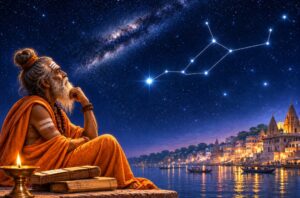 Guruji: When we talk of Ayanāṁśa, my first question would be: What Ayanāṁśa did the Ṛṣis use? Of course, at that time there was no B. V. Raman Ayanāṁśa, there was no Yukteśwar Ayanāṁśa. We’re talking about the Ṛṣis, and this is Vedic astrology, which comes from the Ṛṣis. So, of course, they used what is called a fixed star to get the starting point of the zodiac.
It’s called Citrāpakṣa because the Nakṣatra Citrā goes from 6 degrees 40 minutes Virgo—to 6 degrees 40 minutes plus of Libra. So the central point of Citrā is exactly 180 degrees opposite. That is the starting point of the zodiac. So we need a Yogatārā, or a fixed star, in Citrā Nakṣatra to define the starting point of the zodiac.
What happens is, the best way to do this is to observe that star every day, every night. That would be perfect. So every day we have the exact Ayanāṁśa, and then if we can put that into our calculations, we will have the exact Citrāpakṣa Ayanāṁśa.
So, since it is very technical and it is Citrāpakṣa—pakṣa means 180 degrees—therefore that would be the correct Citrāpakṣa, naturally observed Ayanāṁśa.
But instead of that, for convenience, people developed mathematical equations to be able to predict the Ayanāṁśa, and that’s where the calculation does work because, at the end of the day, it’s an interpolation. It does work for some time, for 40 years, 50 years, and then it goes haywire.
So the correct thing would be to observe it, and that is the real Citrāpakṣa Ayanāṁśa. And then you find that Lahiri Ayanāṁśa was good and was valid in 1947 or ’48 or ’50. Fifty years down the line, it starts going slightly awry. You see, Ayanāṁśas don’t last for more than 50 years. Most of these calculations don’t last for more than that because they’re approximations. That is the problem with any Ayanāṁśa.
Andrew Foss: But modern astronomy has developed so that we can very exactly calculate the position of any star. So if you use modern astronomical algorithms, you can know exactly where Citrā, which is called Spica, is positioned.
So, like in my software, you just select the Citrāpakṣa Ayanāṁśa. It works out where the star is, if you observed it today, and uses that for the Ayanāṁśa calculation.
And what I’ve observed in India is that basically there are the astrologers who use that position, and they have the various—there’s a bunch of Ayanāṁśas which are based on various approximate positions of Spica. So why not take the exact position?
Then there are other people who say, no, this is at the middle of—I mean, it’s the middle of Citrā Nakṣatra, between, as you said, Virgo and Libra, but the zodiac is starting on the opposite side, so we should really find a star on the opposite side.
But when you look on the opposite side of Spica, there is no star. So they take some star close to that, say at the end of Pisces, and so there’s a whole set of Ayanāṁśas based on that.
But you see, the point is that when you study the Vedic literature, the Vedic science, everything in Vedic science goes from zero to full. It’s like the new moon: there’s no moon; full moon, there’s just total moon.
The Ṛgveda has a fullness, and then there’s a progression to a point where the Paṇḍit doesn’t even repeat anything. There’s a moment of silence that represents a zero point of the circle. Maṇḍala, they say, circle.
So it has to be that wherever your Spica is, the brightest star that’s close to the zodiac, so it must be that the opposite side has nothing. It’s the unmanifest. It’s what we call Śiva, while Spica represents what we call Śakti.
And when you study the Nakṣatras and everything, you find that they’re all focused on these two points.
So the fact that there is no star at the beginning of Aries, it’s not a kind of mistake. It’s a genius of nature.
So we don’t need to try and find a star over there. We fix it on the Śakti. We don’t have to try and find a, you know, a symbol of Śiva. He’s the unmanifest over there. We fix it on the Śakti because, after all, the Śakti is said to be the source of everything. The manifest is coming from the Śakti.
So this is the philosophy behind the use of the Citrāpakṣa.