ॐ नमः शिवाय ॥
Om Gurave Namah
 Sāḍe Sātī is one of the most discussed and feared periods in Jyotiṣa. It is the transit of Śani through the 12th, 1st, and 2nd bhāvas from the Janma Rāśi, or the Rāśi in which Candra is placed. This period is often described as difficult, but such a description is incomplete
Sāḍe Sātī is not merely a time of loss, suffering, or obstruction. It is the time through which Śani tests the stability of the mind, removes what has become unsustainable, and forces the native to face reality without illusion. It may be a great blessing or the period of terrible suffering.
The rule traditionally attributed to the Parāśarī system is that Śani gives favourable results mainly while transiting the:
- 3rd from Candra,
- 6th from Candra,
- 11th from Candra.
His gocara through most of the other positions from the natal Moon is considered more difficult. This provides the general classical background for understanding why the 12th, Janma Rāśi, and 2nd from Candra are treated as a prolonged testing and suffering period.
Why is it so terrifying for many people? Candra is the Graha connected with our mind, emotions, and relationships with other people. The 12th from Candra often shows the birth family, the people whom we support, those to whom we give, and those who depend on us. Therefore, during this gochara, difficulties in married life may arise, as well as conflicts between parents and children. A change of residence, including a move to a foreign place, may also occur.
Gochara over the natal Moon is different. Candra represents me in society; it is my manas, which connects me to the four Kendras of life. Both Śani and Candra are Grahas connected with āyuṣ, or the longevity of a person.
We can understand the influence of the Grahas upon one another by considering the three principal doṣas. Candra is a Vāta–Kapha Graha, while Śani is a purely Vāta Graha. Therefore, when Śani influences Candra, it may create an imbalance of Vāta.
The Caraka Saṃhitā discusses aggravated Vāta in detail, especially in Cikitsāsthāna, Chapter 28, Vātavyādhi Cikitsā. It explains that an imbalance of Vāta doṣa may lead to restlessness, anxiety, disturbed sleep, dryness, pain, tremors, stiffness, weakness, and irregular functioning of both the body and the mind.
So we can add to that this transit will lead to problems with reputation (1st bhava is our name), danger from accidents, healt hproblems, depressions, falure in undertakings.
The 2nd bhāva is always connected with sustenance and expenditure. Therefore, the 2nd from Candra represents those who give to us—the Hari principle. It is connected with our finances and stability, and it may test us through financial losses, danger arising from government actions, and loss of livelihood.
Śani is Kāla—time manifested. He is a very strict Graha and represents tapas.He is known as Mandha Graha, the one who moves slowly. He is the tax collector of our past debts. He can take away wealth and health. He may lead a person into complete poverty, or he may make one rise through pain and difficulties. Śani always represents the pressure of karma.
As for mind level Navamsha is important we shall say that Sade Sati in Navamsha itself can put a more intense impact on the manas and person’s life.
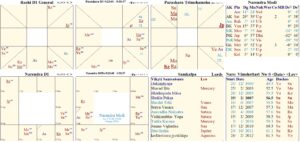
This is the chart of Narendra Modi. He first came to power nationally on 26 May 2014.
His Candra is in Vṛścika Rāśi, and Śani entered Viśākhā Nakṣatra on 2 November 2014.
Let us examine his natal chart.
Before that, Śani was in Tulā and influenced his Lagna and the 12th from Candra. In 2012–2014, Narendra Modi’s personal life became the subject of public attention because he had concealed his marriage since 1968. However, before the general election in April 2014, he officially stated the name of his wife, Jashodaben, in his election declaration.
This Moon is in Scorpio with Mars forming Rudra Yoga both at graha yoga level and bhāva level as well. Rajayoga comes from exaltation of Moon and that happens in Taurus. 10th Lord Moon is debilitated in 2H forming Simhasana-Throne Yoga. His sensere faith and worship in Somanath temple brought this Candra out of debility and by some miraculous obstacles he could become a Prime Minister of the country. Exactly with transit of Śani on his natal Moon he obtained power and became a Prime Minister.
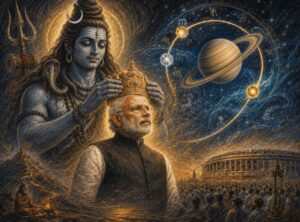
So what do we learn from that? Tradition teaches that Śiva worship is one of the means to improve the effects of Sāḍe Sātī on the Moon. Śiva is the one who decides who will be the king on this planet.
He is Tulā Lagna and Śani is a Yoga Karaka for him, forming a powerful rajayoga with Śukra LL.
At the time of Śani’s entry into Vṛścika Rāśi on 2 November 2014, Candra was placed in Kumbha rāśi. According to Mūrti Nirṇaya, the form assumed by the transiting Graha is determined from the position of Candra at the moment of the transit, counted from the native’s Janma Rāśi.
| Moon sign (Janma Rāśi) | Position of Candra on 2 November 2014, counted from the Janma Rāśi | Mūrti Nirṇaya | General effect |
|---|---|---|---|
| Aquarius, Virgo, Aries (Kumbha, Kanyā, Meṣa) | 1st, 6th, 11th | Svarṇa Mūrti | Adverse |
| Libra, Capricorn, Gemini (Tulā, Makara, Mithuna) | 5th, 2nd, 9th | Rajata Mūrti | Good to very good |
| Sagittarius, Leo, Taurus (Dhanuṣ, Siṃha, Vṛṣabha) | 3rd, 7th, 10th | Tāmra Mūrti | Average to good |
| Scorpio, Cancer, Pisces (Vṛścika, Karkaṭa, Mīna) | 4th, 8th, 12th | Loha Mūrti | Average to adverse |
In this case, Śani attained the position of Loha Mūrti, which is traditionally considered Average to adverse. So how adverse it was? We can say that his perosnal state of mind was just about to leave sansara at that time.
Narendra Modi reportedly wished to become a monk in the Ramakrishna Mission, but his request was declined on three occasions. During his final attempt, he met Swami Atmasthanandaji Maharaj, who was then associated with the Ramakrishna Mission centre in Rajkot.
Under the Swami’s guidance, Modi deepened his understanding of Swami Vivekananda’s teachings and of the scriptures. Swami Atmasthanandaji eventually advised him that his true calling lay elsewhere and that monastic life was not meant for him.
Years later, when Modi met the Swami again at Belur Math, he expressed gratitude for that guidance, acknowledging that the advice had helped redirect the course of his life.
He was born in Anurādhā Nakṣatra, and therefore Viśākhā is his Parama-mitra Nakṣatra, which can give excellent results. It proves the influence of Śiva on his life and destiny.
So, you can see how Sāḍe Sātī can be favourable in an individual chart and how its effects, supported by appropriate remedial measures, may also turn out positively.
Vedic Remedies in Astrollogy, the book written by Pandit Sanjay Rath which is taken by many people as a very important and reliable peace of knowledge advises different remedies for different Gocara of Sani during Sade Sati.
When Shani travels 12th from Candra the worship of Sri Kali Ma and Graha mantra of Saturn is advised:
ॐ प्रां प्रीं प्रौं सः शनैश्चराय नमः ॥
oṃ prāṃ prīṃ prauṃ saḥ śanaiścarāya namaḥ
When Sani transits Janma rashi one should worship Sri Hanuman in addition to the bija mantra of Saturn:
शं शनैश्चराय नमः ॥
śaṃ śanaiścarāya namaḥ
When Sani travels 2d from Candra worship of Sri Krishna as well as Saturn is advised.
शं नो देवीरभिष्टय आपो भवन्तु पीतये ।
शं योरभि स्रवन्तु नः ॥
śaṃ no devīr abhiṣṭaya āpo bhavantu pītaye |
śaṃ yor abhi sravantu naḥ ||
Written by Dana Khanina, inspired by the teachings of Guruji Pandit Sanjay Rath and the Gurus of Parampara.
OM TAT SAT
Om Shanti, Shanti, Shanti